Journal Entry
Pitti Uomo Gave You an Idea. Here's How to Turn It Into Your Own Suit Brand
Walked Pitti Uomo 110 and left wanting to build your own tailoring label? Here is the realistic path from a stand you loved to a launched made-to-measure suit line. Fabric, minimums, sampling and cost.
Every June and January, Pitti Uomo turns the Fortezza da Basso in Florence into the densest square kilometre of menswear on earth. The current edition, Pitti Uomo 110, 16-19 June 2026, under the season's theme "The Pitti Pool", is no different: hundreds of stands across sections like Fantastic Classic and Futuro Maschile, guest designers, and a few thousand buyers walking the floor with a notebook and the same half-formed thought: I could do my own version of this.
If that thought is yours, here is what happens next, from a stand you admired to a tailoring label that ships.
Inspiration versus brand
What you fell for at Pitti is almost never the whole brand. It's usually one specific thing. A soft Neapolitan shoulder, an unlined summer jacket, a particular green, a way of finishing a lapel. Write down the one thing rather than "I want a brand like theirs." A made-to-measure line is built one decision at a time, and a sharp starting point beats a vague mood board every time.
A useful filter: would your future customer recognise that one thing and pay a premium for it? Soft-shouldered travel suits in crease-resistant high-twist wool passes that filter; nice suits does not.
The path, end to end
| Stage | What happens | Typical timing |
|---|---|---|
| 1. Define the product | Pick the garment (suit, jacket, tuxedo), the construction (full-canvas, half-canvas), the silhouette and the cloth story. | A weekend of decisions |
| 2. Choose cloth | Select from European mills, the same Biella and Huddersfield names the brands at Pitti use. | 1 to 2 weeks of swatches |
| 3. Sample | The factory makes a first piece to your spec. You fit it, correct it, approve it. | 14 to 20 working days per round |
| 4. Brand it | Your woven labels, your internal branding, your packaging. | Runs alongside sampling |
| 5. Launch & reorder | Sell made-to-measure or to-order so you carry little or no inventory, and reorder by the piece. | Ongoing |
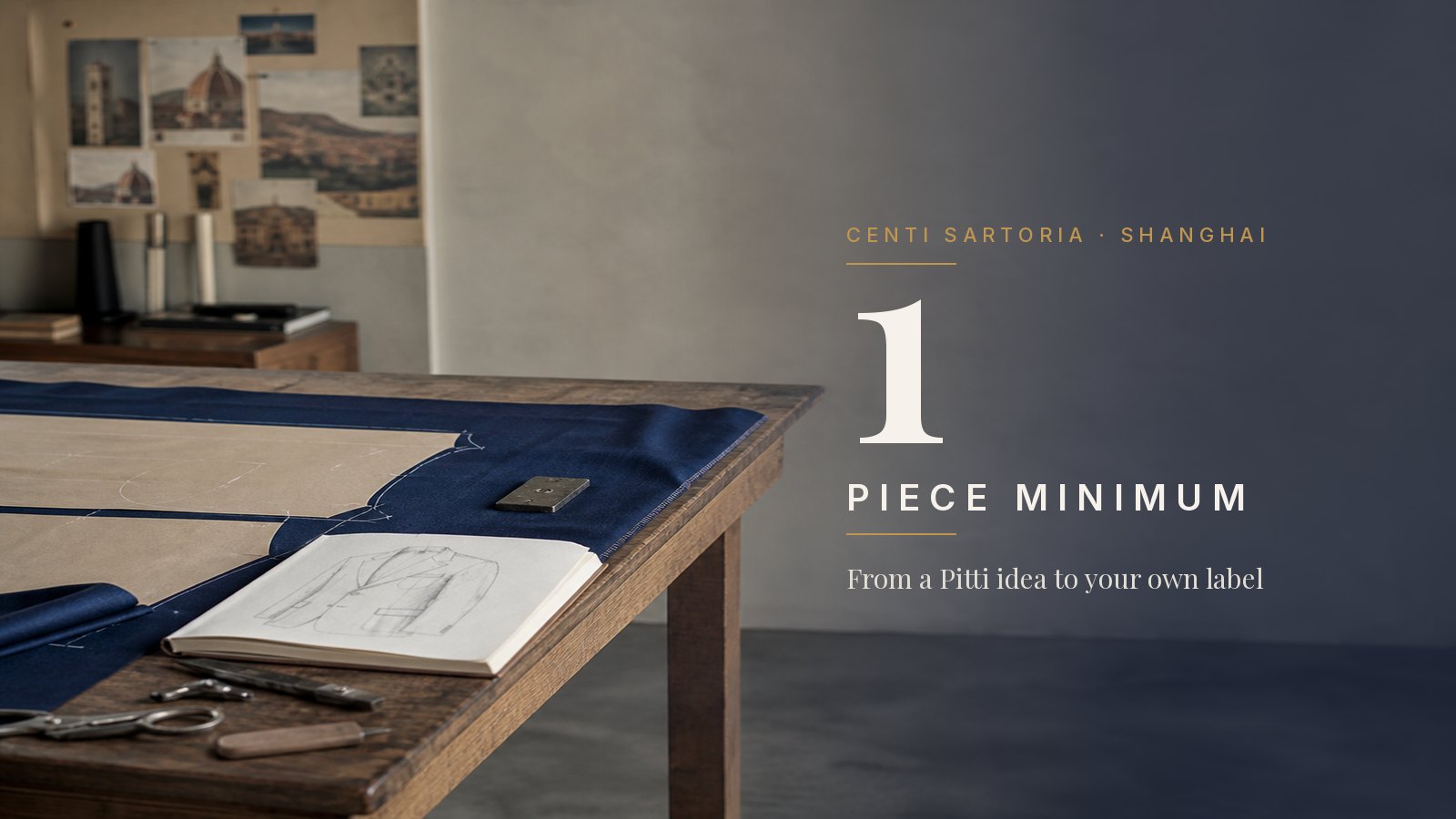
The part that surprises most first-time founders: you do not need to commit to a container of stock to start. With factory-direct made-to-measure, the minimum can be a single piece, which means your first "production run" can literally be your first paying customer's order.
What you need, and what you don't
You need: a clear product point of view, a name and a logo, somewhere to take orders (even a simple site plus WhatsApp), and a manufacturing partner who will work at a low minimum.
You don't need: your own factory, a fabric warehouse, a 50-unit-per-style minimum, or six-figure startup capital. Those are the barriers that used to keep tailoring brands rare, and factory-direct private-label manufacturing is what removed them.
If you want the full step-by-step, we wrote a longer guide on how to start your own clothing brand and a focused one on how to start your own suit brand.
Where the suits get made
The open secret of a lot of "Made in Italy"-feeling tailoring is that the cloth is European and the construction is done in a high-volume, high-skill atelier. That's our lane: Centi Sartoria is a made-to-measure suit manufacturer in China. A Shanghai atelier of 200 house tailors working premium European cloth from 33 mills and merchants, factory-direct, from a one-piece minimum, with roughly a 14 to 20 working-day production cycle.
For a founder, that combination is the whole game: designer-grade construction and the same fabrics as the Pitti stands, without the cost or risk of owning any of it. You bring the point of view; the factory brings the canvas, the mills and the hands. Less romantic than a stand in Florence, admittedly, but it is how the stands in Florence get stocked.
A first move after the show
- Pick the one thing from the floor that you can't stop thinking about.
- Decide the single garment you'd launch with.
- Order one sample in a European cloth, with your label in it.
- Put it on a real customer, listen to what they say about it, and reorder.
That sequence is small, cheap and reversible, and it's how most modern tailoring brands begin, Pitti inspiration or not.
When you're ready to make that first sample, our private-label suit manufacturing page explains exactly how it works, or you can tell us what you saw and what you want to build and we'll quote a first piece.
Centi Sartoria is a factory-direct made-to-measure suit manufacturer in Shanghai. We help founders launch designer-grade tailoring lines from a one-piece minimum.