Journal Entry
What to Check on Your First Sample Before You Reorder
A first sample proves whether what a factory told you matches what they made. A working checklist for what to verify before you place a larger order, and an honest list of what one sample can never prove.
The courier buzzed while we were still on the call. She had the box open before I finished my sentence, the jacket on over her blouse before the tape had fully come off the flap, and she was in front of the mirror behind her till within a minute. A phone came up, a photo went into the shop's group chat, three thumbs up came back before I could ask whether anyone had checked the inside pocket. By the time we hung up, the message on my side said fifty pieces, navy and mid grey, ship as soon as you can. Nobody on that call turned a seam inside out. Nobody asked where the canvas stopped. The whole decision ran on one piece of evidence, which was that it looked good in a mirror.
That is the part of a first sample least likely to be wrong. Cut a jacket to the measurements you sent and it will pass a mirror test, because that is what a spec sheet is for. A sample that fits tells you the pattern maker read your numbers correctly. It tells you nothing about the fifty jackets you are about to commit to, because almost none of the risk in a first order lives in the silhouette. It lives in places a mirror cannot reach, and the only window you get to check them against what you were told closes the moment you place the real order.
What the mirror cannot tell you
I do not think that buyer did anything unusual. Most people react to a garment on a body first, because it is the most immediate thing in the box to respond to, and everything else on this list means putting the jacket down and going looking for something less obvious. But a good fit is confirmation, not information. Had the jacket not fit, that would have told you something went wrong between your spec sheet and the cutting table. The fact that it did fit tells you the step least likely to fail, worked. It says nothing about the three or four steps that do fail, and none of those show up in a photo taken from across a shop floor.
Open the jacket first
If your quote said full canvas or half canvas, the only way to confirm it is to open the front and look, not press a thumb against the chest and guess. Ask your contact to send the sample unlined, or undo the hem lining yourself, and follow the canvas panel down from the shoulder. On a half canvas jacket it stops in a curve above the waist, and the front below that line is fused straight to the wool. A full canvas jacket carries the same panel all the way to the hem, stitched rather than glued. We photograph our own front panels for exactly this reason, both constructions side by side with the terms defined, on our full canvas vs half canvas vs fused guide.
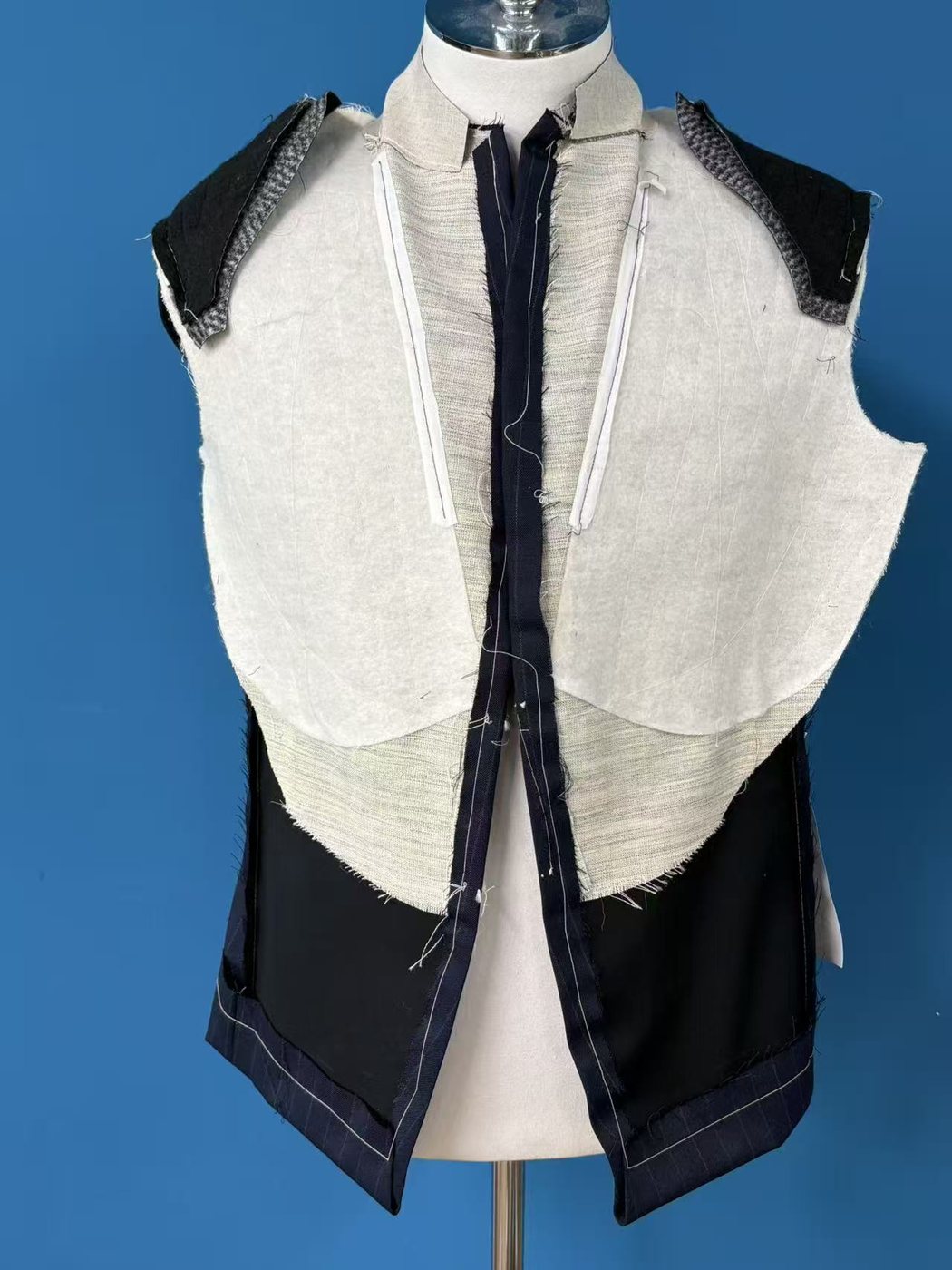
Half canvas, with the panel stopping above the waist. If your invoice says full canvas, this curve is the wrong answer.
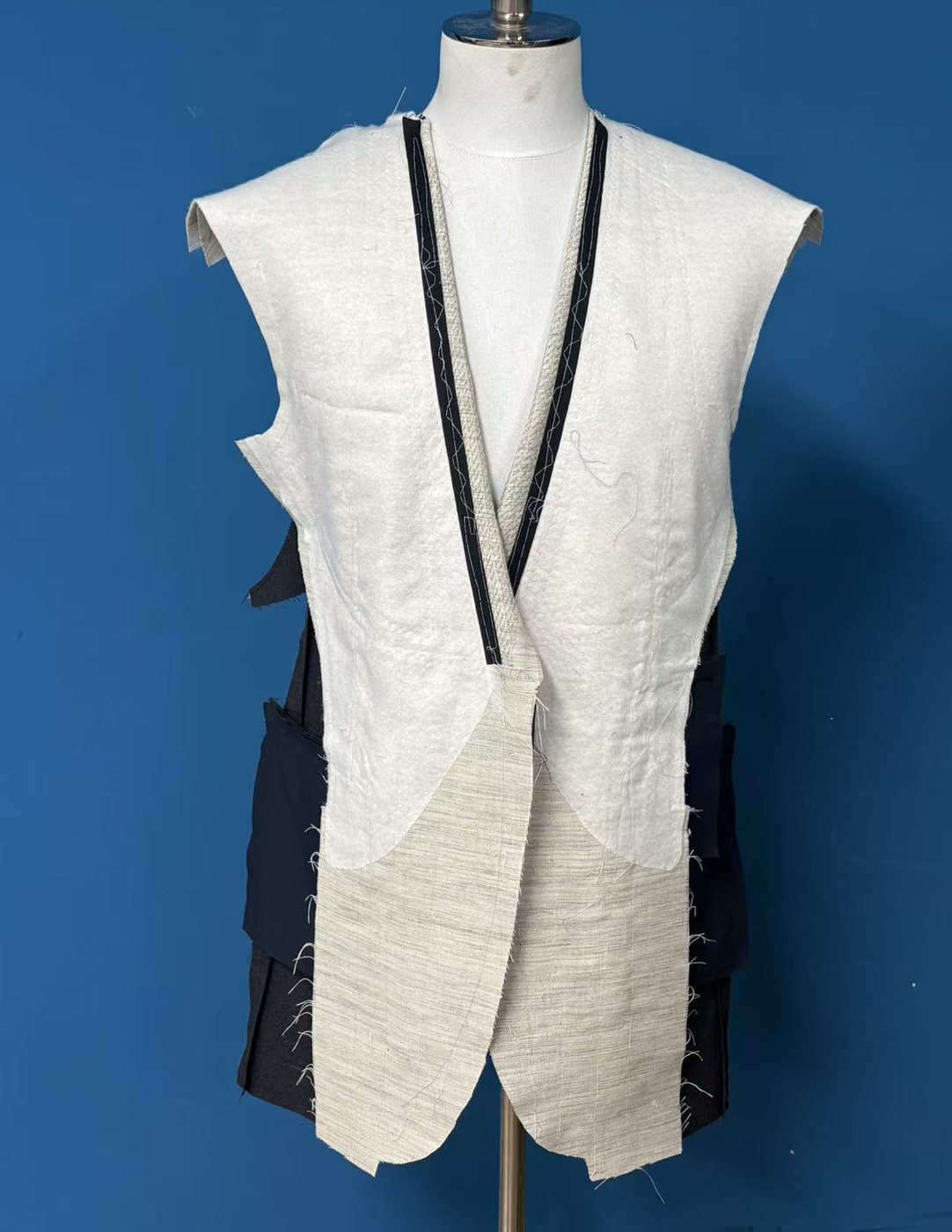
Full canvas, the same panel carried to the hem. This is the line a full canvas quote is promising you.
Canvas depth is one question. Whether a machine or a hand did the padding inside that canvas is a separate one entirely, answered by looking at the stitching along the lapel rather than the canvas itself, and it deserves its own read rather than a paragraph borrowed here; we cover it in full in which suit construction to sell. What belongs on this checklist is narrower: does the canvas in your hand go where the quote said it would go. Yes or no, answered in under a minute with the lining out of the way, and it is the first thing to check, not the fifth.
Match the cloth to a bunch number
Ask for the bunch number before the sample even ships, not after you are holding the garment and trying to remember what the fabric looked like on a screen weeks earlier. When it arrives, hold the swatch card or the original reference next to the garment and confirm they are the same cloth, not a close approximation somebody thought would do. We push buyers to make this a habit on the fabric side generally, and the same logic applies to a sample: ask for the bunch, not the country, because a country of origin cannot be checked against anything in your hand, and a bunch number can.
Weight is the other half of that check. It is also the easiest item on this entire list to verify, which is probably why so few buyers bother with it.
Across the 822 fabrics we carry with a weight recorded, 597 sit in a 240 to 300 gram band, out of a wider range that runs from 98 grams up to 440. If a quote promised cloth in that band and what arrived feels lighter, a fabric scale settles it in under a minute, and a jacket cut from cloth lighter than promised will show it in the first crease that does not fall out by lunchtime. Every fabric we carry with a recorded composition is a single fibre, never a blend, which matters here because a bunch number and a fibre content then have only one correct answer between them, traceable back to a mill in Europe or Australia. A supplier who cannot give you both for the sample in your hand is not describing the cloth you are holding.
Measure the garment flat
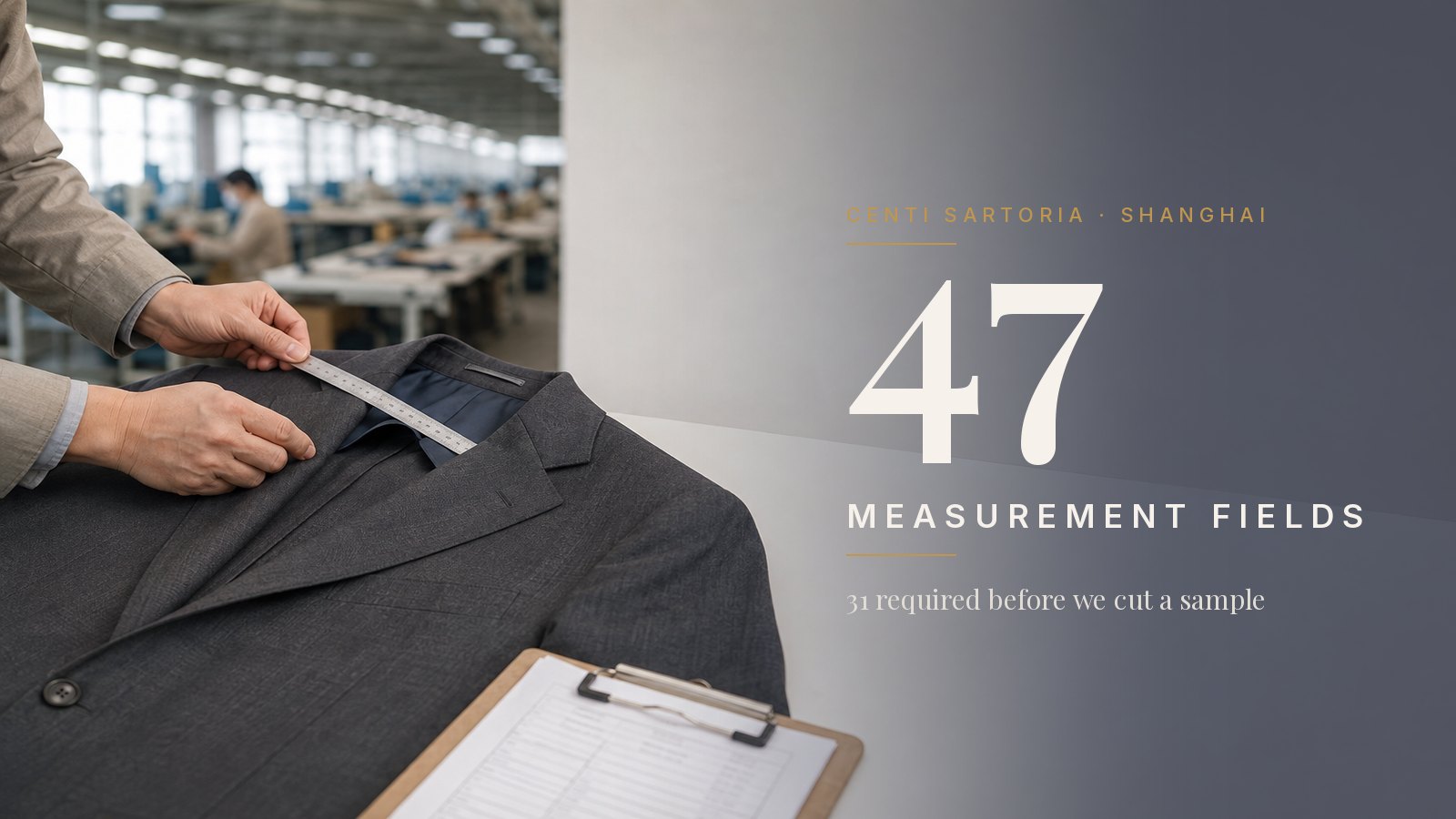
Put the sample flat and measure it against the same spec sheet you sent, field by field, rather than relying on how it felt going on. Our size system runs to 47 measurement fields in total, and on a jacket alone that is thirteen separate points: chest, waist, stomach, seat, shoulder, bicep, sleeve length, front length, back length, neck, front chest, back chest and sleeve cuff. Checking a sample means going through that list with a tape measure, not trying the jacket on once and deciding it feels about right, and it means agreeing beforehand how many millimetres of drift on any one field counts as normal and how many counts as a fault. Decide that tolerance before you are staring at a number on a tape and guessing whether it matters, because that is a far harder conversation to have after the fact, when one side already has money on the table. Our own fit system is built around that same set of fields, so a sample that does not match it is not a matter of opinion either way.
Turn out the pockets
The inside of a jacket is where a factory's real standard shows up, because it is the one part nobody expects a customer to look at. Turn out the inside pockets and check the stitching is even and finished, not just tacked enough to survive a fitting room. Run a finger along the facing edge where it meets the lining and feel for it lying flat rather than puckering. Check the lining seams themselves, particularly at the armhole, where a rushed job shows first. None of this changes how the jacket looks on a hanger, and all of it tells you what the same factory does when nobody is going to see it, on the fifty jackets nobody outside your shop will ever turn inside out either. A rushed lining seam never shows up in a photo taken for a group chat.
What one sample cannot tell you
This is the part of the list most buyers skip past, and it is the most useful part, because it tells you where your own judgement has to stop no matter how carefully you check.
You cannot tell canvas quality by touch. You can see where the canvas runs and you can see who padded it, but you cannot see or feel how much horsehair is in it, and a supplier's word on fibre content is not something a sample proves either way.
You cannot tell whether one jacket represents fifty. A first sample may well have been cut and sewn by the most careful hand in the workshop, precisely because it is the piece meant to win your order. The only way to answer that question is to ask for a second sample before you commit further, or to place your first real order as a small batch rather than a full run. Our minimum order is a single piece per style, which exists for exactly this reason: a second sample costs you the price of one more garment, not a production commitment, so there is no good reason to skip it.
You cannot tell how the jacket will age. Whether a fused interlining will delaminate, or a canvas will lose its shape after a hundred wears and a few dry cleans, are questions that take years to answer, and no amount of handling a garment on day one will shortcut that clock. File that one away rather than pretending a new sample can settle it.
A single garment cannot even test something as basic as dye lot consistency, because that question only exists once you have more than one piece to compare side by side.
Before the real order goes in
Looking good in a mirror belongs last on this list, and never on its own. It is the one thing every sample gets checked for and almost nothing else does, which is why it is worth saying so directly. Do not commit to a full order on the strength of one sample. Open the jacket, check the cloth against a bunch number, measure it against your spec sheet, turn out the pockets, and only then decide whether the mirror told you enough. A fifty piece order should not run on a photo in a group chat.
Our production runs 14 to 20 working days from a confirmed order to shipment, and that window does not include the days you spend checking what arrives. Build that time into your own schedule before the courier turns up, not during the week you had already planned to place the reorder.
If you are building this checklist for the first time rather than refining one you already run, it sits well alongside the broader list of questions worth asking before you start a clothing brand, and the same guide is worth a second look for its section on landed cost, since a sample that fails this checklist after duty and freight are already paid is a considerably more expensive lesson than one caught on the first piece. Tailor shops adding made-to-measure production behind an existing fitting room should run the same list on their own first sample, not just the finished garments they hand to clients.
We cut and sew every order ourselves, in our own workshop in Shanghai, on cloth sourced out of Europe and Australia rather than any single region, which is part of why we can answer a canvas or a bunch number question directly instead of relaying it from somewhere further up a supply chain. A Classic two piece starts at €108 ex-works, and a full canvas two piece starts at €254. That second number buys canvas the full length of the front. It does not buy a padding method, and it makes no claim about who stitched it, which is exactly the kind of gap this checklist exists to catch before an invoice does. If you want a longer list of what to ask before choosing who makes your samples at all, our guide to choosing a made-to-measure partner is the place to start. Or skip the reading and send us your current spec sheet, and we will tell you what a first sample against it should look like before you place a single order.
Frequently asked questions
What should I check first when a sample garment arrives from a manufacturer?
Open the jacket before you try it on. Fit is the thing least likely to be wrong on a first sample, because it was cut to measurements you already sent, so it tells you the least. Check where the canvas runs, match the cloth against a bunch number, and measure the finished garment against your own spec sheet before you decide the mirror told you enough.
How can I tell if a suit sample is full canvas or half canvas?
Undo the lining at the hem, or ask for the sample unlined, and follow the canvas panel down the front. On a half canvas jacket it stops in a curve above the waist and the front below that line is fused to the wool. A full canvas jacket carries the same panel, stitched rather than glued, all the way to the hem. We photograph both constructions side by side on our full canvas vs half canvas vs fused guide.
What is the easiest thing to verify on a sample, and the thing most buyers skip?
Fabric weight is the easiest. Most business suiting sits in a 240 to 300 gram range, and any fabric scale settles the question in under a minute. It is the fastest check on this whole list, which makes it the one with the least excuse for skipping.
Should I place a full order based on one sample garment?
No, not on its own. A first sample may have been cut by the most careful hand in the workshop, precisely because it is the piece meant to win your order, and one jacket cannot prove what fifty will look like. Ask for a second sample before you commit further, or place your first real order as a small batch. A one piece minimum order exists for exactly this reason, so the cost of checking is small.
What can't you tell from a single sample garment, no matter how carefully you check it?
Three things stay outside a single sample's reach: the actual fibre content of the canvas, which you cannot verify by sight or touch, whether that garment represents ordinary batch quality rather than a best case, and how the jacket will hold up after years of wear and cleaning. A sample answers construction and measurement questions directly. It cannot answer questions that only show up over time or across multiple units.