Journal Entry
How to Verify a Suit Manufacturer Really Uses Italian Mill Cloth
Ask for three things in writing before you order: the bunch reference, the weight in grams per metre, and the mill reference on your paperwork. A check any buyer can run in one email, including on us.
You verify it by asking for three things in writing, before any money moves: the bunch name and reference number, the composition and weight in grams per metre, and confirmation that the mill's reference will appear on your order documentation. A manufacturer working from real mill books answers all three in one email, usually in three lines. A manufacturer reselling unbranded cloth answers with a paragraph about Italian heritage. That difference is the whole test, and it works on any supplier, us included.
The three-step check
- Ask which bunch, and what the reference is. Not "do you use Italian fabric" but "which bunch, which reference". A mill sells numbered swatch books, not a country. An answer with a number in it can be checked against the mill; an answer with an adjective in it cannot.
- Ask for composition and weight in grams per metre. Weight is the number that decides how the finished suit behaves, and it is the one a supplier reading from a real bunch has in front of them. No weight means no mill book.
- Ask for the mill reference on your paperwork. Before you order, get written confirmation that the bunch and reference will be printed on the order confirmation and the invoice. This commits the supplier, in advance, to a specific claim on a specific piece of paper.
To run the check on us: our supplier directory lists all 33 mills and merchants we buy from, and each page states whether we hold that cloth in Shanghai or order it in. Two houses are on the shelf, Zegna and Vitale Barberis Canonico. The rest, Loro Piana and Holland & Sherry among them, are ordered in against a confirmed order, and we say which is which before you quote your client.
The rest of this article is why those three questions work, and what to do with the answers.
What "Italian fabric" tells you
It is the second week of the season and I have been holding cloth for six hours. Somewhere around the fourth appointment a buyer from Antwerp asks me the question I get every season, always in a slightly lowered voice, as though it were rude: how do I know this is the cloth you say it is?
It is the only question in the room that matters, and almost nobody asks it out loud.
Every supplier you meet will tell you they use Italian cloth. Most of them are telling the truth in the narrowest possible sense, and all of them know that you cannot check.
That is the whole problem. A claim that cannot be checked carries no information. It costs nothing to make, so everyone makes it, so it tells you nothing about who is worth ordering from.
Compare it with a different sentence: this bunch, from this mill, this reference number, this weight, and the reference printed on your order paperwork. That one can be verified, and fewer people say it for exactly that reason.
So the test has less to do with fabric than with whether a supplier is willing to be specific in writing. Everything below is a way of finding that out.
Step one: ask for the bunch, not the country
A mill does not sell "Italian wool." It sells bunches: numbered swatch books, issued by season, each carrying a defined set of cloths with stated compositions and weights.
A Super 110s worsted in a 280 gram twill, from a named bunch, is a thing that exists in the world and can be pointed at. "Italian wool" is a category with a flag attached.
So instead of do you use Italian fabric, ask:
Which bunch, and what is the reference?
When a supplier answers a fabric question with an adjective, you have learned something. When they answer with a number, you have learned something considerably better.
Notice what this question does even when the answer is disappointing. A supplier who says we buy unbranded cloth woven to our specification, here is the composition and weight has told you the truth and may be an excellent partner. The one to walk away from is the one who keeps saying Italian.
Step two: composition and weight, in grams
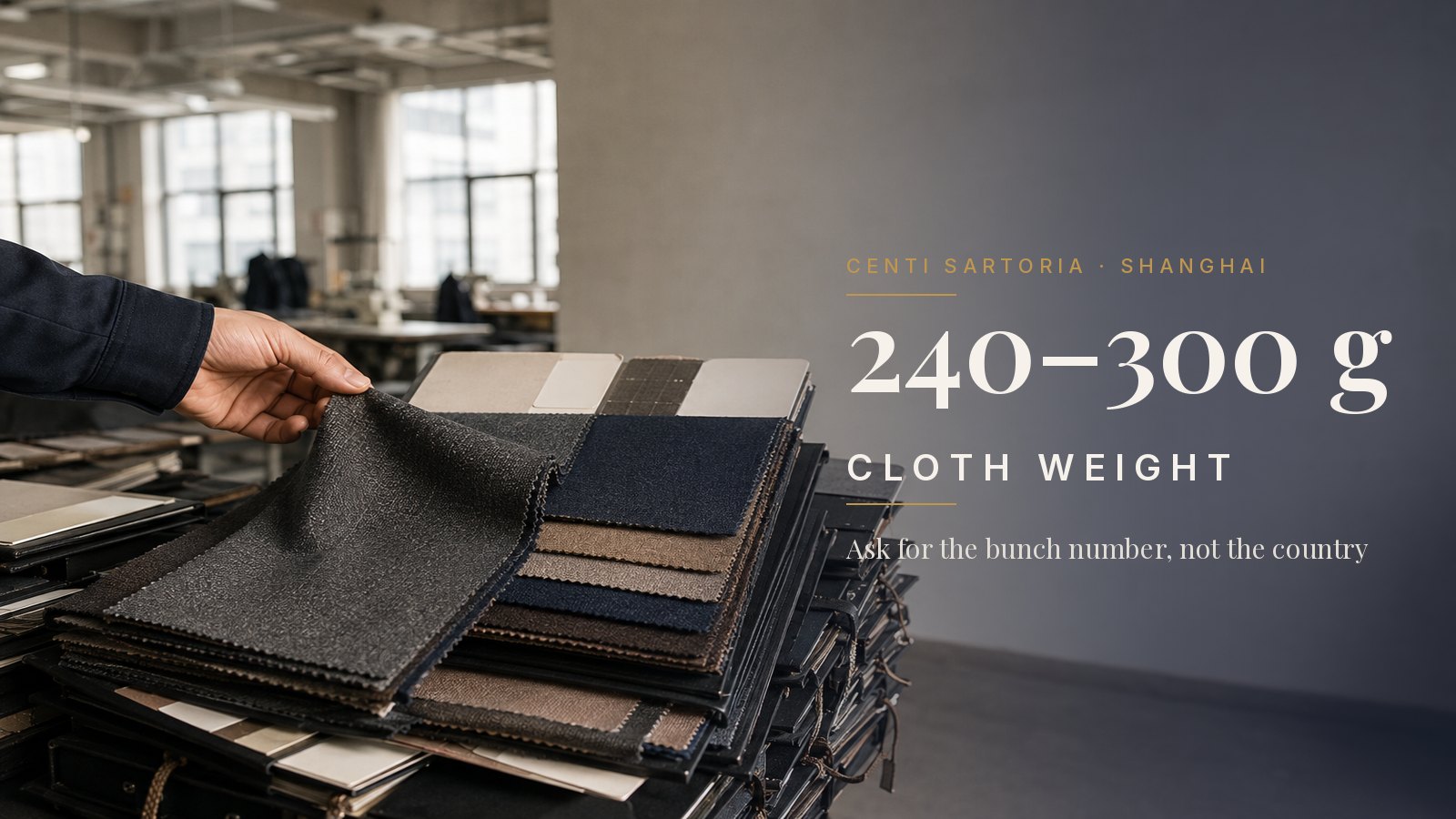
Weight is the number amateurs never ask for and the one that decides most of how the finished suit behaves. Under 240 g is summer weight and will crease. 240 to 300 g is where most business suiting belongs. Above 340 g is autumn and winter. A supplier who cannot give you a weight is not reading from a mill book.
Composition matters for the same reason. A bunch states it exactly, down to the percentage of silk or mohair in a blend. A reseller states it approximately, because they are reading a label rather than a mill sheet.
Step three: the reference on your paperwork
Ask for this in a single email rather than on a call, because you want the answer in a form that still exists in six months.
The third thing is confirmation that the mill reference will appear on your order documentation. This one separates the field, because it commits the supplier, in advance, to a specific claim on a specific piece of paper.
None of the three is hard for a supplier who is doing what they say, and all three are awkward for one who is not. That asymmetry is the entire value of asking.
The selvedge test
Many mills weave their name into the selvedge, the finished edge of the roll. Ask for it in the parcel with your sample.
I want to be straight about how much this proves on its own, which is less than people think. Selvedge can be trimmed. A photograph of a selvedge proves that a selvedge exists somewhere, and anyone determined to mislead you can get around this particular check without much effort.
It still earns its place, for the same reason as everything else here: it is specific, easy for an honest supplier and annoying for a dishonest one. You are watching how somebody behaves when asked to be precise, which is a different exercise from building a courtroom case.
One fixed quote
This is the test I would run, and it costs a few emails.
Pick one garment and hold it completely fixed. A half-canvassed two-piece, a named bunch, a stated weight, the same lining, the same buttons, the same everything. Send that identical specification to every supplier on your shortlist, then read the replies for shape rather than for price.
The useful supplier comes back with a line-by-line answer: cloth, making, trims, your label, packing, and freight and duty stated separately. The word ex-works or FOB appears somewhere and they explain which one they mean. The one to be careful with comes back with a single number and warm language.
You will find, doing this, that the quotes were never comparable in the first place. Two suppliers quoting the same garment on different Incoterms can differ by a third before anyone has been dishonest about anything. This is the most common way a cheap supplier turns out not to be cheap, and you can only see it by fixing the garment and reading the structure of the answer.
What we put on paper
I would rather apply all of this to us than have you take my word for it.
We hold accounts with 33 mills and merchants, and every one of them has a page in our supplier directory that says whether the cloth is held in Shanghai or ordered in. Held means we can start cutting: 162 Zegna styles across Trofeo and Traveller, and 40 Vitale Barberis Canonico styles from Four Seasons, on the shelf now. Ordered in means the mill's own lead time is added to ours, and we tell you that before you quote a client. For anything we quote from a mill, you get the bunch and the reference before you order.
Our own house range is a different case: it sits in our building rather than at a mill, so there is no outside bunch number to hand over, and the composition and weight on the swatch card are ours to publish rather than copy from somebody else's book. Where a line in that range carries a composition on the card, it is a single fibre, no undeclared blends. Weight across everything we carry, house range and mill cloth together, runs from 98 to 440 grams, which on its own is wide enough to explain why two suits that are both technically wool can behave nothing alike on a warm afternoon. Ask for swatches and you will get selvedge where the mill weaves one.
Then there is the thing half the industry blurs, and we will not.
The cloth is European or Australian, depending on the line. The garments are cut and sewn in Shanghai, in our own atelier, by our own tailors. Origin is really three questions, and we answer them separately rather than collapsing them into one flattering word: where the fibre grew, where the cloth was finished, where the garment was made.
I am aware that saying this costs us something with a certain kind of buyer. It is worth it, and not out of virtue. A supplier who is vague about origin to win your order has shown you exactly how they will handle the next awkward question, once they have your deposit.
The short version
If you take one thing from this, take the substitution: stop asking where the fabric is from, and start asking which bunch it is, what it weighs, and whether the reference goes on your paperwork.
The suppliers worth your money will answer in one email. The rest will send you a paragraph about Italian heritage, and you will have your answer anyway.
If you want to run that test on us, tell us the garment and we will quote it properly, with the bunch and the weight on the page. The supplier directory lists every mill we buy from and whether we hold it. Our suit fabric guide covers what the specifications mean, the house cloth range lists every composition and weight we hold, and if you are earlier than that, the guide to starting a clothing brand has the other nine questions worth asking a factory before you send money.
Frequently asked questions
How do I verify a suit manufacturer really uses Italian mill cloth?
Ask for three things in writing before you order: the bunch name and reference number, the composition and weight in grams per metre, and confirmation that the mill's reference will appear on your order documentation. A supplier working from genuine mill books answers all three in one email. A supplier who is reselling unbranded cloth answers with adjectives about quality and country.
What is a bunch, and why does it matter more than the country?
A bunch is the numbered swatch book a mill issues each season, carrying a specific set of cloths with stated compositions and weights. It is a thing that exists and can be pointed at, whereas 'Italian fabric' costs nothing to say and cannot be checked. When you ask for a bunch reference you are asking for the only part of the claim that is falsifiable.
Does the selvedge really prove anything?
On its own, no. Many mills weave their name into the selvedge, but selvedge can be cut away and a photograph proves little. It is useful as one of three checks, alongside the bunch reference on your paperwork and a like-for-like quote. What matters more than any single test is whether a supplier is willing to be specific in writing at all.
Which mills does Centi Sartoria actually buy from?
33 mills and merchants, each with its own page in our supplier directory stating whether we hold the cloth in Shanghai or order it in. Two houses are held in stock: Zegna, 162 styles across Trofeo and Traveller, and Vitale Barberis Canonico, 40 styles from Four Seasons. Everything else, Loro Piana and Holland & Sherry included, is ordered in against a confirmed order.
Where are Centi Sartoria's suits made?
The cloth is European or Australian depending on the line. The garments are cut and sewn in our own atelier in Shanghai, by our own tailors, and we say so on every page rather than letting the cloth's origin imply the garment's. A supplier who blurs origin to win an order will blur other things once they have it.