Journal Entry
Questions to Ask a Made-to-Measure Factory Before the First Order
Ten questions a tailor shop should ask any made-to-measure factory before placing the first order, with what a good answer looks like for each one.
Last month a shop owner forwarded me his notes from three factory calls he had done in a single week. He had asked each one the same opening question: what is your lead time? He got three answers: five days, ten days, fourteen days. On paper, the five-day factory looked fastest. When I read the detail, the five-day number started counting after the cloth arrived at the factory, which the factory ordered after receiving payment, which took another three weeks. The fourteen-day factory counted from the confirmed order and included everything except shipping. The fastest-sounding answer was the slowest real timeline by more than a week.
That is the problem with factory calls that stay at the surface. A number without a definition is not information. It is a trapdoor. The ten questions below are the ones that, in our experience, separate a useful first conversation from one that produces a folder of brochures and nothing you can price from.
The checklist: ten questions to ask a clothing manufacturer before the first order
Print this list or keep it open on your phone during the call. Each question is followed by what a useful answer sounds like and what a vague one hides.
Write the questions down before the call. A checklist on paper does more for a first order than a second meeting ever will.
1. From which day is the lead time counted?
Why it matters: "fourteen days" can mean fourteen days from payment, from pattern approval, from cloth arrival or from confirmed order. If you cannot tell your client when the suit will ship, you cannot sell the suit.
A good answer names a single starting point. Ours is 14 days in production from a confirmed order, shipping extra. A vague answer says "about two weeks" and leaves the starting point out.
2. Does the lead time include shipping?
Why it matters: a factory quoting five days production plus three weeks for cloth sourcing plus another week of transit is not faster than one quoting fourteen days production with shipping on top. Ask whether the number on the page is door to door or ex works, and if ex works, ask what shipping typically adds for your country.
3. Calendar days or working days?
Why it matters: fourteen working days is nearly three calendar weeks. Fourteen calendar days is two weeks. The difference is five days, which in a wedding season is the difference between delivery and apology. Ask which one, and hold the factory to whatever it says.
4. Will they send a price list before or after the call?
Why it matters: if a factory will not tell you what a two-piece suit costs until you have sat through a presentation, you cannot calculate your margin beforehand, and the meeting becomes a sales pitch rather than a business conversation. A factory that publishes prices or sends them on request is telling you it has nothing to hide in the numbers.
Our ex works prices are public: CMT from USD 100, full make from USD 167, half canvas from USD 197 per two-piece suit, Shanghai ex works. You can run your margin calculation before we ever speak. For a wider comparison of who publishes what, see our guide to MTM suppliers for tailor shops.
5. Can you send your own cloth?
Why it matters: if your shop already holds fabric from a house the factory does not buy from, cut, make and trim lets you use it. If the factory does not accept outside cloth, your existing stock is dead weight the moment you switch. Ask whether they do CMT, what the per-suit price is, and how much cloth to send per garment.

A finished two-piece starts from USD 167 ex works Shanghai. Ask what that number includes before you compare it to another factory's quote.
6. What is the minimum order?
Why it matters: a factory that requires fifty pieces minimum is not offering you a trial. It is asking you to commit before you have seen a single garment. A one-piece minimum lets you test the factory with a real order at real cost, judge the result, and decide whether to continue. We take orders from one piece, which is why a trial order and a regular order look the same on our end.
7. Which fabrics are in stock and which are ordered in?
Why it matters: a factory that says "we have 10,000 fabrics" may hold none of them. Ask how many are physically in the factory and how many are ordered from the mill after you confirm. Stock cloth ships inside the production window. Ordered-in cloth adds the mill's own lead time on top, which can be weeks.
We hold Zegna Trofeo and Traveller (162 styles) and Vitale Barberis Canonico Four Seasons (40 styles) in Shanghai. The remaining mills and cloth merchants, 33 in total with 26 of them in Europe, are ordered in on a confirmed order. We give a digital fabric book and send swatches on request rather than shipping full physical bunch books.
8. Who owns the pattern, and can you match a reference garment?
Why it matters: if you are switching from another factory, your clients already expect a certain fit. Ask whether the new factory can take a garment you already sell, use it as a reference, and produce a trial piece that matches it. If the answer is no, every client you have fitted before becomes a re-fitting project. If the answer is yes, ask what they need from you: the garment itself, the measurement sheet, or both.
We ask shops to send a garment they currently sell as a reference. We make one trial piece to match it, so the transition does not reset your fit.
9. How do you place orders: system, email, or phone?
Why it matters: email ordering works until you are placing ten suits a week and losing track of which spec sheet went with which fabric. Ask whether the factory has an ordering system, what it does, and whether it catches errors before production starts. A system that suggests a size from height and weight, lets you confirm measurements field by field, and sends the order straight to the cutting floor removes one layer of human error from every order.
Our ordering system covers 47 measurement fields, 31 of them required, suggests a starting size from height and weight, and routes confirmed orders directly to the factory. A shop gets access to it after the initial three-minute check at b2b.centisartoria.com/start.
10. What happens if something is wrong with the finished garment?
Why it matters: every factory will tell you quality is excellent. The real question is what they do when it is not. Ask for the actual policy before the first order, not after you are holding a jacket with the wrong canvas. A good answer is simple and clear. Ours is: we stand behind every piece; if something is not right, we make it right. For more on what a remake clause should cover, see our guide to remake clauses between a shop and its factory.
What the answers tell you beyond the facts
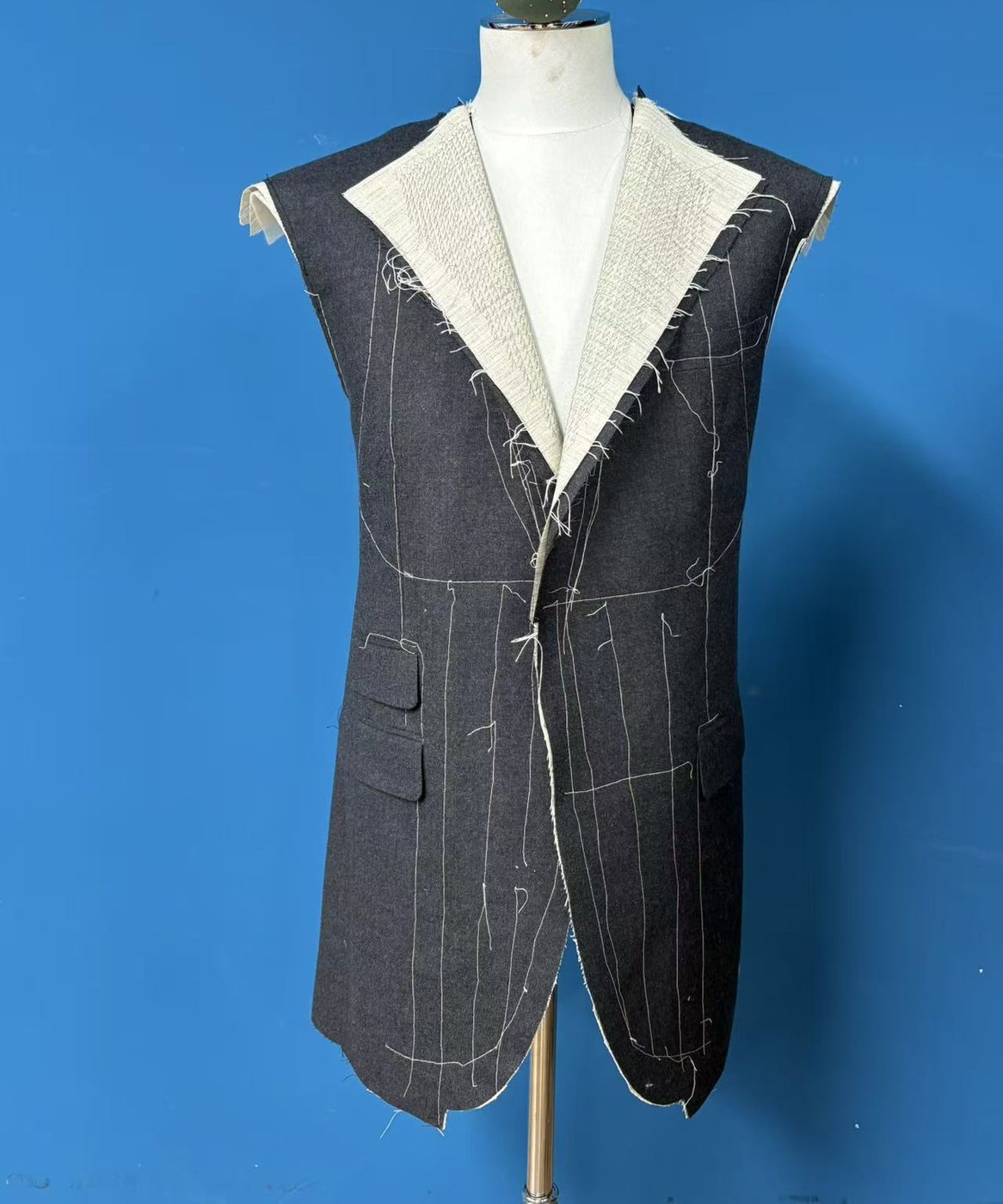
Machine-padded full canvas in our Shanghai factory. Ask your factory which canvas and which padding method, not just "full canvas".
The ten questions above are not a test the factory can fail. They are a filter for how the factory communicates. A factory that answers all ten clearly, with numbers and named starting points, is a factory that will communicate clearly when something goes wrong at unit forty-seven. A factory that hedges on lead times and hides prices behind a meeting will hedge and hide when you need a straight answer about a late shipment.
Pay attention to which questions get a direct number and which get a paragraph. Lead time, price, minimum, stock and CMT all have one-line answers. If the factory needs three minutes to explain any of them, the answer is probably not the one you want.
If you are comparing several factories side by side, our how to choose a suit manufacturer guide gives you the structure for that comparison. The questions on this page are earlier in the process: they are what you bring to the first conversation so the comparison has real numbers in it.
After the call: one order, not fifty
A meeting that produces clear answers to these ten questions earns one trial order, not a commitment. Place a single piece, check it against what to check on a first sample, and let the garment answer the questions the call could not: how accurate the measurements are, whether the canvas is where the quote said it would be, and whether the finished suit matches what your shop already sells.
A one-piece minimum exists so that this step costs you one suit, not a season.
Frequently asked questions
What is the single most important question to ask a made-to-measure factory before ordering?
Ask from which day the lead time is counted. A factory that says 14 days from a confirmed order and a factory that says 14 days from when you first enquire are promising two very different things. The answer tells you whether you can plan delivery dates for your clients or whether every order is a guess.
Should I ask for a price list before the first call with a factory?
Yes. A factory that publishes prices or sends them before a call lets you calculate your margin before you invest time in a meeting. If they will not share a price list until after the call, ask why, and decide whether the meeting is worth your afternoon without knowing the numbers.
How do I know if a factory really uses fabric from the mills it names?
Ask for the bunch number before the garment ships, not after. A bunch number traces a cloth back to a specific mill and collection. A factory that can give you a bunch number for every order is sourcing from the mill it claims. One that gives you only a country of origin or a fibre content is not answering the question.
Can I send my own cloth to a made-to-measure factory?
Many factories accept cut, make and trim orders where you supply the cloth. Ask whether they do, what the per-suit price is for CMT, and how much fabric to send per garment. If your shop already holds cloth from a house the factory does not buy from, CMT lets you use it without changing your fabric range.
What should a factory's answer to 'what if something is wrong' actually say?
A good answer names the principle without turning it into a legal document. We say: we stand behind every piece, if something is not right, we make it right. What matters is that the factory accepts responsibility clearly rather than hiding behind a returns policy full of exclusions. Ask to see the clause before you order, not after you need it.