Journal Entry
Bespoke Suit Manufacturer: What a Factory Can Honestly Call Bespoke
Every second factory listing says bespoke. Most of them mean made to measure. A buyer's checklist for what a bespoke manufacturer actually does, what made to measure does instead, and three questions that separate the two before you place an order.
A shop owner in Munich wrote to us last spring asking whether we could make bespoke suits. The honest answer was no, and I told her so, which surprised her. She had been talking to five other factories that week, and every one of them had said yes. When I asked her what she meant by bespoke, the answer was what I expected: a suit made for one customer, to that customer's measurements, in a construction she could choose. That is what we do. It is also what every made-to-measure factory on her list does. What none of them do, and what none of them were honest about, is actual bespoke work. The word just tested well, so they used it.
This is not a small distinction. If you are sourcing suits for your shop, your brand, or your online platform, the word on a supplier's website tells you what they think you want to hear. It does not tell you what happens on their cutting table. The gap between those two things is where the wrong order gets placed and the wrong promise gets made to your customer.
What a bespoke manufacturer actually does
A bespoke suit starts with blank paper. A cutter takes measurements, studies the client's posture and proportions, and drafts a pattern from scratch for that one person. The pattern is not adjusted from a template. It does not exist until the cutter draws it, and it will never be used for anyone else.
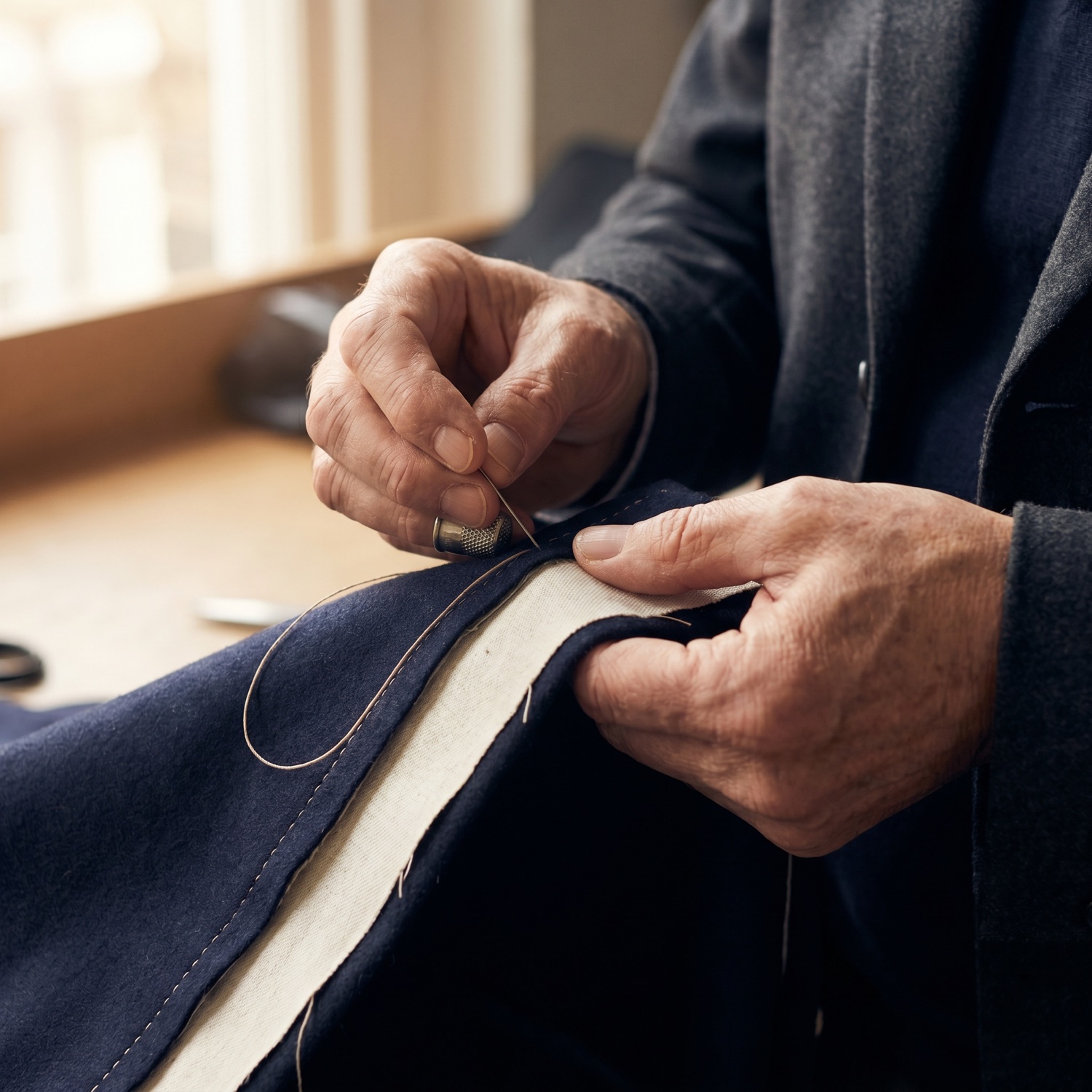
From that pattern, a basted garment is assembled loosely, tried on the client, marked, taken apart, adjusted, and reassembled. This happens at least twice, sometimes three or four times. The construction is predominantly by hand: the canvas is hand-padded, the buttonholes are hand-sewn, the seams are pressed and shaped on the body rather than on a form. On Savile Row, a single bespoke jacket takes 50 to 80 hours of hand labour. The minimum timeline is typically 8 to 12 weeks, and the cost starts well above USD 2,000.
That is what the word means. A factory processing hundreds of orders a month cannot do this, because bespoke requires the client in the room and the cutter at the board, one person at a time.
What a made-to-measure factory does instead
A made-to-measure factory starts with a proven base pattern, a block, and adjusts it to the customer's measurements. The block has been refined over thousands of cuts. It is reliable, it is repeatable, and it is the reason a factory can deliver a personal fit in 14 days rather than 12 weeks.
The customer sends measurements (our system runs to 47 fields, 31 of them required), chooses construction (fused, half canvas, or full canvas), selects cloth from 33 mills and cloth merchants (26 of them in Europe), and the garment is cut, sewn, pressed and shipped from a single factory. No fitting on a half-finished garment. No pattern drafted from zero. The fit comes from the measurements and the block, not from a cutter watching the client walk across a room.
This is what we do. It is what the five factories in that Munich buyer's inbox were doing too. The difference is that we say so.
Three questions that separate the two
If a factory calls itself a bespoke manufacturer, ask these three things before you send a spec sheet:
1. Does the factory draft a new pattern from scratch for each customer, or adjust an existing block?
A bespoke house drafts from scratch. A made-to-measure factory adjusts a block. There is no version that is both. If the factory says "we create a unique pattern for every client" but processes 3,000 suits a month, the maths does not work. Ask how many cutters they employ and how many orders they ship. The ratio tells you which method is in use.
2. Does the client attend fittings on an unfinished garment?
A baste fitting, where the garment is loosely tacked together, tried on, marked, taken apart and reassembled, is the step that defines bespoke and the step no factory in the world can do remotely. If the client never tries on a half-finished jacket, the process is made to measure. That is not a flaw. It is the reason the suit ships in two weeks instead of three months.
3. Is the construction predominantly by hand?
Bespoke construction is largely hand work: hand-padded canvas, hand-stitched buttonholes, hand-finished edges. Made to measure can include hand work (we offer hand-padded full canvas as an option), but the bulk of the construction is by machine. A factory that says "bespoke" but sews on industrial machines is describing made to measure with a borrowed word.
| Bespoke | Made to measure | |
|---|---|---|
| Pattern | Drafted from scratch for one person | Adjusted from a proven block |
| Fittings | 2 to 4, on a basted garment | 0 to 1, on a finished garment |
| Construction | Predominantly hand | Predominantly machine, hand options available |
| Timeline | 8 to 12+ weeks | 14 days in production (Centi Sartoria) |
| Minimum order | 1 (one client at a time) | 1 (but scalable to thousands) |
| Who it suits | A client who wants the process | A shop, brand or platform that needs repeatable fit at volume |
Why the word matters for your shop
If you sell bespoke and your factory does made to measure, the claim breaks down the moment a knowledgeable customer asks who drafted the pattern or how many fittings the garment went through. That is a credibility problem for your brand, not for the factory.
If you sell made to measure and call it what it is, you can talk honestly about what your customer gets: a suit cut to their measurements, in cloth they chose, in a construction they specified, shipped in a timeline they can plan around. That is a strong proposition. It does not need a borrowed word to sell.
The more practical risk is subtler. A factory that calls made to measure "bespoke" to win your order is a factory that will call other things by the wrong name too. If the word on the website does not match what happens on the cutting table, ask what else does not match. The same test applies to cloth origin, to canvas depth, and to every other claim that is cheaper to make than to deliver. We covered the cloth side of that test in detail in how to verify mill cloth is real.
What we do, stated plainly
We are a made-to-measure factory in Shanghai with 200 house tailors. We make suits, trousers and waistcoats, one piece at a time, from a confirmed order to shipment in 14 days, shipping extra. Per two-piece suit, ex works Shanghai: CMT from USD 100, full make from USD 155, half canvas from USD 185. We offer fused, half canvas and full canvas construction. We source cloth from 33 mills and cloth merchants, 26 of them in Europe.
We do not draft patterns from scratch. We do not conduct baste fittings. We do not describe our work as bespoke. A shop that wants bespoke work done should keep it in-house, or find a bench tailor who does it by hand. What we do is make the suit the shop has already fitted and specified, accurately, at a price that leaves the shop a margin, and deliver it in a timeline the shop can promise its client.
Drafting a pattern from scratch over several fittings stays in your shop. We make the suit to your measurements and fit notes. That is the division of labour, and we think it is a good one, because it means the shop keeps the relationship and the factory keeps the consistency.
If you want to see what that division looks like on a real order, see prices and your margin, 3 min. Or send us your current spec sheet and a sample you are happy with, and we will tell you what a first piece against it costs and how long it takes. Get in touch.
Frequently asked questions
What does a bespoke manufacturer actually do that a made-to-measure factory does not?
A bespoke manufacturer drafts a new pattern from scratch for each customer, builds the garment largely by hand, and refines it through two or more fittings while it is still in pieces. A made-to-measure factory adjusts an existing base pattern to the customer's measurements and produces the garment with industrialised precision. The pattern is the dividing line: drafted from zero versus adjusted from a block.
Can a factory be a bespoke manufacturer at volume?
Not at scale, no. Bespoke means drafting an individual pattern and fitting a partially assembled garment on the client's body, which requires the client in the room and hours of hand work per piece. A factory producing hundreds or thousands of suits a month is doing made to measure, which adjusts a proven block to measurements, not bespoke, which starts from blank paper.
How do I tell if a supplier calling itself a bespoke manufacturer is really doing made to measure?
Ask three questions. Does the factory draft a new pattern from scratch for each order, or adjust an existing block? Does the client attend multiple fittings in an unfinished garment? Is the construction predominantly by hand? If the answer to any of these is no, the factory is doing made to measure, regardless of the word it puts on its website.
Is made to measure worse than bespoke?
It is different, not worse. Made to measure delivers a personal fit from a proven pattern at a fraction of bespoke's time and cost, and it can still be built full canvas. A shop selling to fifty clients a month needs repeatable accuracy, not a pattern drafted from scratch each time. The question is whether the word on the website matches what the factory actually does.
Does Centi Sartoria make bespoke suits?
No. We make made-to-measure suits in our own Shanghai factory with 200 house tailors, from a one-piece minimum, in 14 days in production from a confirmed order, shipping extra. We offer fused, half canvas and full canvas construction. Drafting a pattern from scratch over several fittings stays in your shop. We make the suit to your measurements and fit notes.