Journal Entry
What a Tech Pack Looks Like When the Garment Is Tailored, Not Cut-and-Sew
A tech pack built for a bomber jacket or a hoodie does not carry over to a blazer. The four things that change when the garment is tailored rather than cut-and-sew, and what we ask for before we cut against a pack that is missing them.
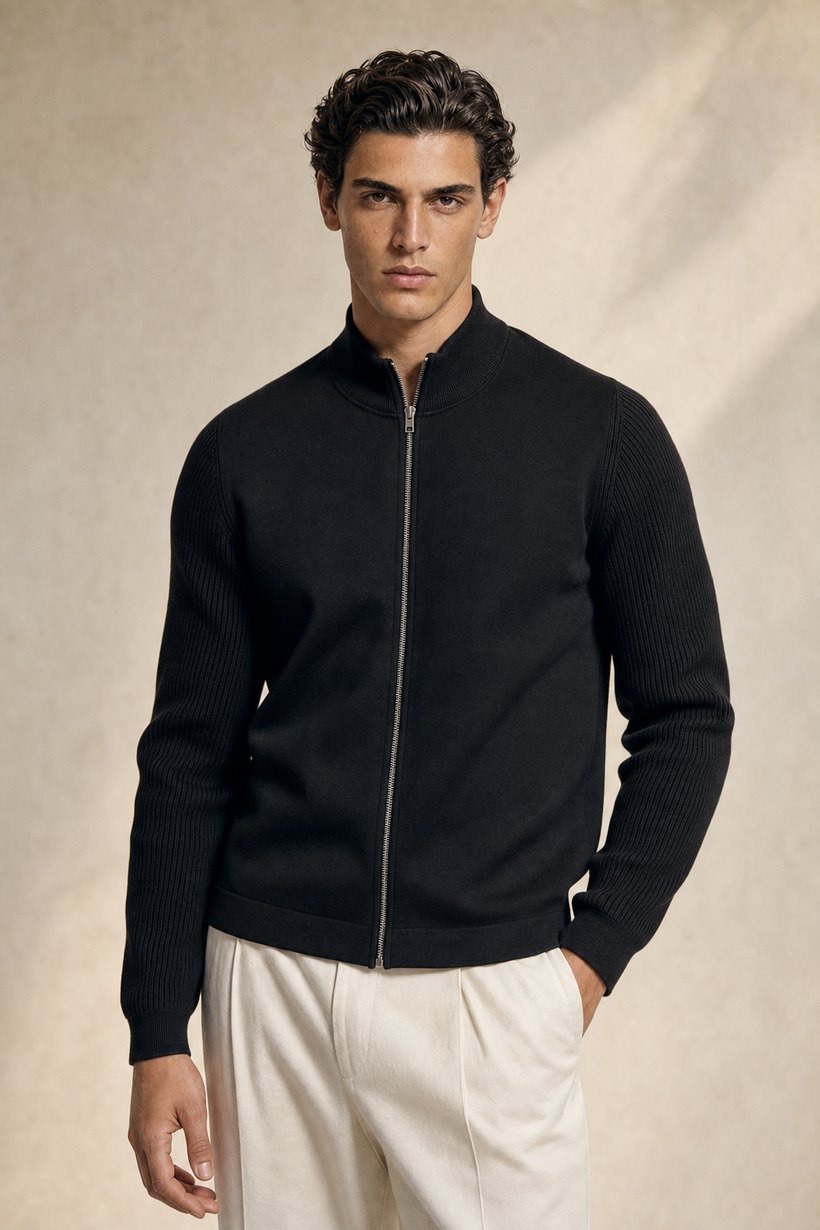
A founder wrote to us in the spring with two documents attached to the same email. The first was a tech pack for a bomber jacket his brand already sold: a flat sketch front and back, a bill of materials with the shell and lining fabric composition down to the percentage, callouts for the zip pull and the rib cuff, a grading table across five sizes. It was a good document. It had clearly been used before, corrected after a few production runs, and it told us almost everything we needed before we asked a single question.
The second document was the same template, filled in for a blazer he wanted to add to the same line. The sketch was there. The bill of materials named "navy wool blend" with no bunch number. The measurement table carried a chest, a waist, and a sleeve length, each one taken flat off a jacket he liked from another brand. Nothing about canvas. Nothing about shoulder width as its own field, because on the bomber the shoulder had never needed to be. We asked four questions before we could quote it, and by the third one he said what most people say at that point: I did not know a jacket needed all this.
The pack that worked for the bomber does not fail because it was careless
That is the part worth saying plainly, because it is easy to read a thin tailoring spec as a sign the founder did not do his homework. He did the homework. The pack that got a bomber jacket into production for two seasons running was a competent piece of work, and most of its structure is exactly what we would ask for on a tailored garment too: a clear bill of materials, callouts on the details that are easy to misread across a language gap, a labelling section that states country of origin without guessing. None of that changes.
What changes is what those sections have to contain, because a bomber jacket and a blazer are solving different problems. A bomber is built from panels cut to a finished size, forgiving of a few millimetres because the shell fabric and the rib trim both give a little. Once the pattern is graded and approved, the fabric is close to interchangeable: swap one mid-weight nylon for another from the same weight class and the garment barely moves. A tailored jacket does not work that way. The pattern is drafted around a specific cloth's weight and hand, the shoulder is built rather than simply cut, and there is a layer inside the front, the canvas, that a cut-and-sew pack has no section for at all because cut-and-sew garments do not have one.
Geometry has nowhere to hide
On a woven, structured garment, the cloth does not stretch to absorb a mistake the way jersey does. Move a shoulder measurement half a centimetre and the sleeve head has nothing to hang from. That is the reason our own fit system treats shoulder width as the one field with no useful tolerance, and it is also why a spec sheet built for a garment that does forgive small errors will not carry over a habit of leaving that field loose.
The cloth itself decides more of the pattern than most first-time tailoring packs account for. Weight and weave change how a chest is cut and how much the pattern has to compensate for drape. We hold 33 European mills and merchants in our supplier directory, with fabrics ranging from 98 grams up to 440, and 597 of the 822 we have a recorded weight for sit in a 240 to 300 gram band that covers most business suiting. Two of those houses, Ermenegildo Zegna and Vitale Barberis Canonico, are held cut and ready in our own building in Shanghai, 162 styles and 40 styles respectively; everything else in the directory is ordered in against a confirmed order. A pack that names "wool blend" instead of a bunch number is asking us to guess which of those a jacket should be cut for, and the guess shows up first at the chest, not at the seams.
Construction is the other section a cut-and-sew pack has no place for. Full canvas, half canvas, or fused changes how the front of a jacket is built from the inside out, and it is a decision that has to be named rather than implied by a photo of a reference garment. We set the three constructions out side by side, opened up, on our full canvas vs half canvas vs fused page, because seeing the difference settles more arguments than describing it does.
What we ask for before we cut
When a pack arrives shaped like the bomber one, built for a tailored garment, this is the list we send back, in the order it matters:
- The cloth, with a bunch number. Not "navy wool," not a weight range. A specific length from a specific mill, so composition and weight both resolve to one answer.
- Construction named. Full canvas, half canvas, or fused, stated as a term rather than shown as a photo of a garment you like the look of.
- A full set of body measurements, not a flat table. Our own system runs 47 fields across jacket, trousers, waistcoat and shirt, 31 of them required. A jacket alone needs thirteen: chest, waist, stomach, seat, shoulder, bicep, sleeve length, front length, back length, neck, front chest, back chest and sleeve cuff.
- A base size, if you are grading a range. Naming which size the block is drafted at prevents a confusion that otherwise only surfaces once the range is already cut.
- Tolerances at the fields that matter most. Shoulder and chest first. Without a stated tolerance, a small drift is either fine or a defect depending entirely on who is arguing about it later.
- A reference garment, if one exists. An actual jacket, measured flat, settles in an afternoon what a document without these fields would take four emails to sort out. We cover this in more detail, alongside the vocabulary a factory uses to read a pack, on our garment tech pack page.
None of this is a longer document for its own sake. Every line on that list is there because we have seen a first sample come back wrong without it.
What the gap actually costs
The founder from the spring sent a reference blazer after that exchange, along with a bunch number for a cloth he had already priced separately. We measured the reference flat, matched the cloth to the weight band it needed, and quoted a full canvas construction because the reference jacket held its shape the way only a full canvas front does. The first sample came back close enough to sell on the first attempt.
Had we cut against the original pack, "navy wool blend" with no canvas named and a shoulder measurement borrowed from someone else's jacket, the more likely outcome is a sample with a shoulder seam sitting slightly off the bone, discovered only once the piece was in hand. Our production runs 14 to 20 working days from a confirmed order, and that clock does not distinguish between a first attempt and a second one. A gap in the pack does not usually cost more money. It costs a repeat of that whole window, plus the days spent working out what was missing the first time, which is a more expensive lesson than the four extra questions would have been.
This is also why we treat a single piece as a real order rather than a formality. Our minimum is one garment per style, so the cost of sending a properly specified sample before committing to a run is small next to the cost of finding a gap in the pack after fifty pieces are already cut. If you are building the checklist for the first time rather than refining one you already run, our guide to what to check when that first sample arrives covers the other half of this exchange: what the finished garment should tell you once it is back in your hands.
Before the first pack goes out
A tech pack built for cut-and-sew work is not the wrong instinct. It is the right habit applied to a garment that does not answer the same questions in the same order. Name the cloth first, with a bunch number. State the construction. Send the full set of body measurements rather than a flat table borrowed from a reference photo. Give us a tolerance on the fields that cannot be corrected after the fact. Send a reference garment if one exists.
If you would rather skip the back-and-forth on a first attempt, send us your pack and a reference garment and we will tell you, before anything is cut, whether what you have is a made-to-measure order or a pattern development project. Those are genuinely different pieces of work, and it costs nothing to find out which one you are asking for.
Frequently asked questions
Can I use my existing cut-and-sew tech pack template for a tailored jacket?
The document shape can carry over: a bill of materials, callouts, a labelling section. What cannot carry over is the content of the measurement section. A cut-and-sew pack usually lists finished flat measurements with a fixed seam allowance. A tailored jacket is built from body measurements and a fit block, and the finished garment depends on the cloth as much as the pattern, so a flat measurement table on its own tells us almost nothing about how to cut it.
What is the first thing that changes when a garment is tailored rather than cut-and-sew?
The order of decisions. On a cut-and-sew pack, the fabric is one line among many and can often be finalised last. On a tailored pack, the cloth has to be named first, with a bunch number, because its weight and weave decide how much canvas and interlining the jacket carries and how the pattern is cut. Send us a jacket spec with the cloth left as 'wool blend, TBD' and everything after that line is provisional.
Do I need my own pattern to get a made-to-measure quote from you?
No. Made-to-measure runs from a fit block and an option set rather than a pattern you own, so what we need is the cloth, the construction, the style options, and the measurements per order. A full tech pack with a graded pattern becomes necessary only when you want a garment outside that option set, or your own block entirely. Say which of the two you are asking for in the first email and we will tell you if the pack you have is enough.
My tech pack has a fabric weight range instead of a bunch number. Is that a problem?
It is workable but it is a gap, not a spec. A weight range tells a cutter roughly how the cloth will behave; a bunch number tells us the exact composition and lets us hold you to it. Our own fabrics run from 98 to 440 grams across 33 European mills and merchants, and 597 of the 822 we have a stated weight for sit between 240 and 300 grams, which is a wide enough band that 'medium weight wool' can mean three different jackets.
How many measurement fields does a tailored jacket actually need, compared to a cut-and-sew garment?
Our own system runs to 47 fields across jacket, trousers, waistcoat and shirt, of which 31 are required, and a jacket alone accounts for thirteen of them: chest, waist, stomach, seat, shoulder, bicep, sleeve length, front length, back length, neck, front chest, back chest and sleeve cuff. A cut-and-sew spec sheet for the same body might carry six or seven. The difference is not thoroughness for its own sake. Woven cloth does not stretch to cover a missed field the way jersey does.