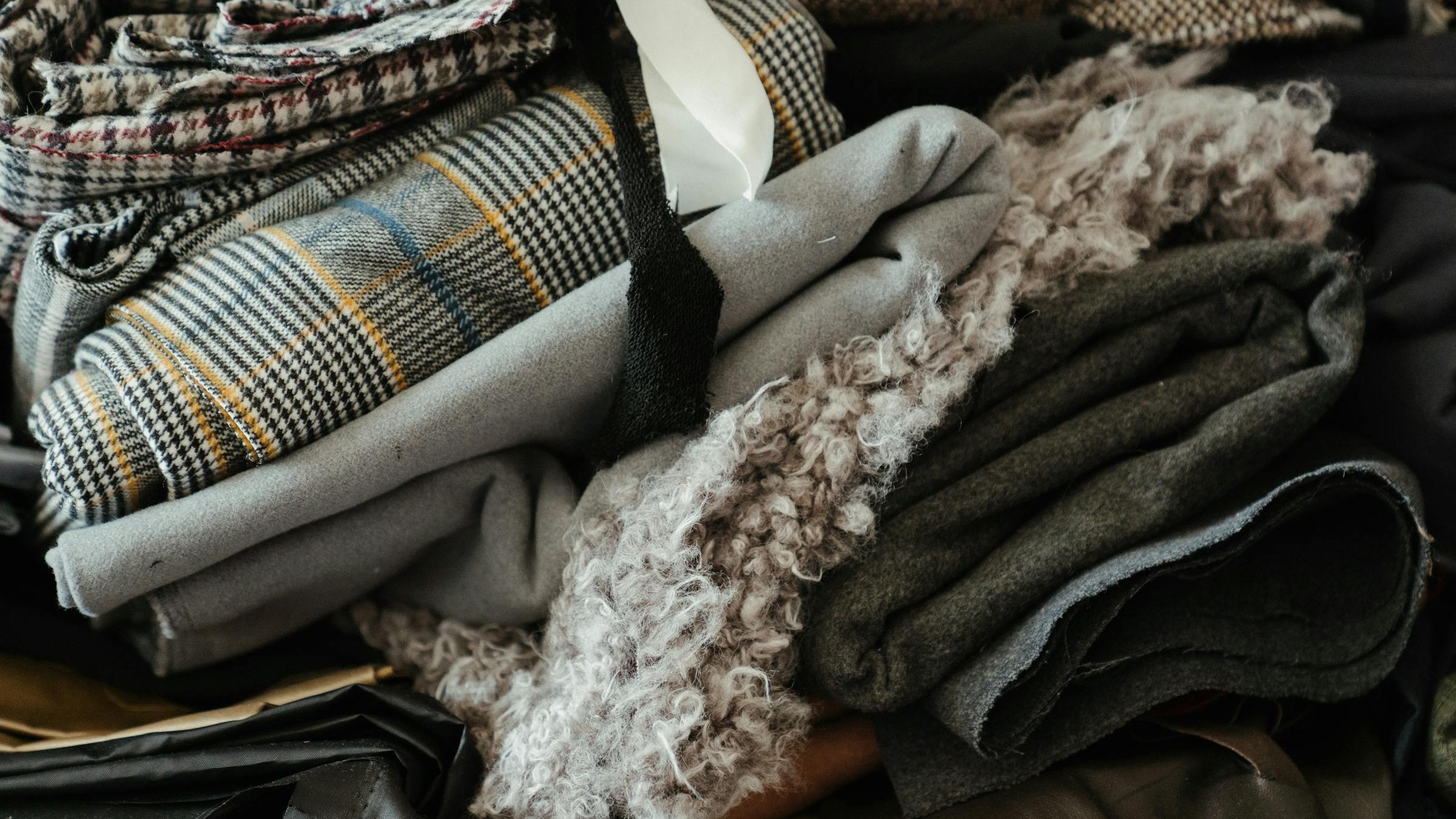
Eighteen years between the roots and the name
Fratelli Tallia di Delfino's own history page marks its roots in 1903, and the company didn't take the name printed on its bunch cards today until 1921, when the founder's sons split off to trade fabric under their own banner. A separate worsted-yarn company followed in 1929, and the two branches merged in 1933 into what the mill calls its market-leading wool fabric business. Eighteen years is a long gap to leave sitting in a company history page, and it tells me there was a working mill on the Strona river before there was a name worth putting on a swatch card. The mill still states that 100% of its production stays in Strona, in the Biella valley where it began. That is a claim worth checking by asking where a specific bunch was actually woven, not by taking the word "Biella" on a label at face value.
From Mongolia and Australia before it reaches Strona
The mill lists seven raw materials on its own site: merino wool, cashmere, vicuña, mohair, silk, linen and hemp. Its own description of that sourcing says the journey starts in Mongolia and crosses Australia before the fibre reaches Italy, and its heritage page names Mongolian cashmere, Australian wool and South African mohair specifically. Vicuña in particular is not a fibre I would promise on a short timeline. It comes from a wild Andean animal that can only be shorn every few years under strict quota, it moves through the market in small lots, and the price moves with the lot size. I do not quote same-week delivery on anything from that end of the range, and neither should you if a client asks for it.
How far the count goes
Tallia di Delfino's wool goes as fine as Super 200s, most recently in a bunch called Suprema Lana that pairs Super 170s with Super 200s, shown at Milano Unica for the Spring/Summer 2025 collection and built, by the mill's own account, on a technique developed from its 120-year archive. A Super 200s jacket holds a press beautifully in an air-conditioned showroom, and it creases within the hour on a client who wears it through a nine-hour flight and sits in it the whole way. I point travelling clients to the Super 130s to 150s range in the same bunch, and save the 200s for a suit that lives in a closet between events rather than a garment bag.
The mill's appetite for unusual material goes past raw fibre and yarn count. In 2011 it worked with Piana Clerico, a company that processes gold for textile use, to spin wool together with 24-carat gold thread for a capsule it called 24K. A more recent capsule, Honey Way, finishes wool-silk blends with beeswax at weights between 250 and 340 grams, a treatment usually reserved for cosmetics rather than cloth. I would not put either in a boutique's opening order. They read as proof-of-concept pieces meant to pull a buyer deeper into the range, not a starting point for a stockist ordering from this mill for the first time.
A name Marzotto bought, the mill Strona still weaves
Tallia di Delfino joined Marzotto Group, which the mill's own site calls the largest European textiles group, in 2008. That matters more for paperwork than for cloth: the legal entity behind the brand today is Biella Manifatture Tessili Srl, under the coordination of Marzotto Wool Manufacturing, a fact printed at the bottom of the mill's own site rather than on the collection pages a buyer usually reads. Never assume an invoice or a compliance certificate will arrive addressed to "Fratelli Tallia di Delfino." Get the actual company name in writing before you pass paperwork to a client's accountant. On the credential side, the mill won the Fabric No. 1 Award from Saks Fifth Avenue and The Woolmark Company in 2013, a prize judged on composition, construction and handle, not on a name over a door.
Ordering Tallia di Delfino through Centi Sartoria
We buy this cloth as a customer of the mill, not as an authorised dealer, a licensee or a representative of Tallia di Delfino or Marzotto Group, and we do not describe ourselves as one. What we cut from it is made to measure to a client's own figure in our Shanghai atelier. If a client conflates that with a fully hand-worked process, read how the two actually differ before you correct them. For construction advice once the cloth is on the table, from a Suprema Lana jacket to a Honey Way sport coat, see which construction we recommend for which fabric. Tallia di Delfino sits on our supplier list as special order only: nothing is held in Shanghai, and vicuña or cashmere lots need checking against availability before you quote a client. Contact us with the bunch and quantity, and we will confirm the real date, mill time included.