Journal Entry
The Three-Piece Is Back. The Waistcoat Is Where the Fit Fails
Three-piece orders are arriving with a fully specified jacket, a fully specified trouser, and a waistcoat carrying almost no information at all. The third piece is cut from measurements collected for the other two, and it is the one garment that cannot hide the gap.
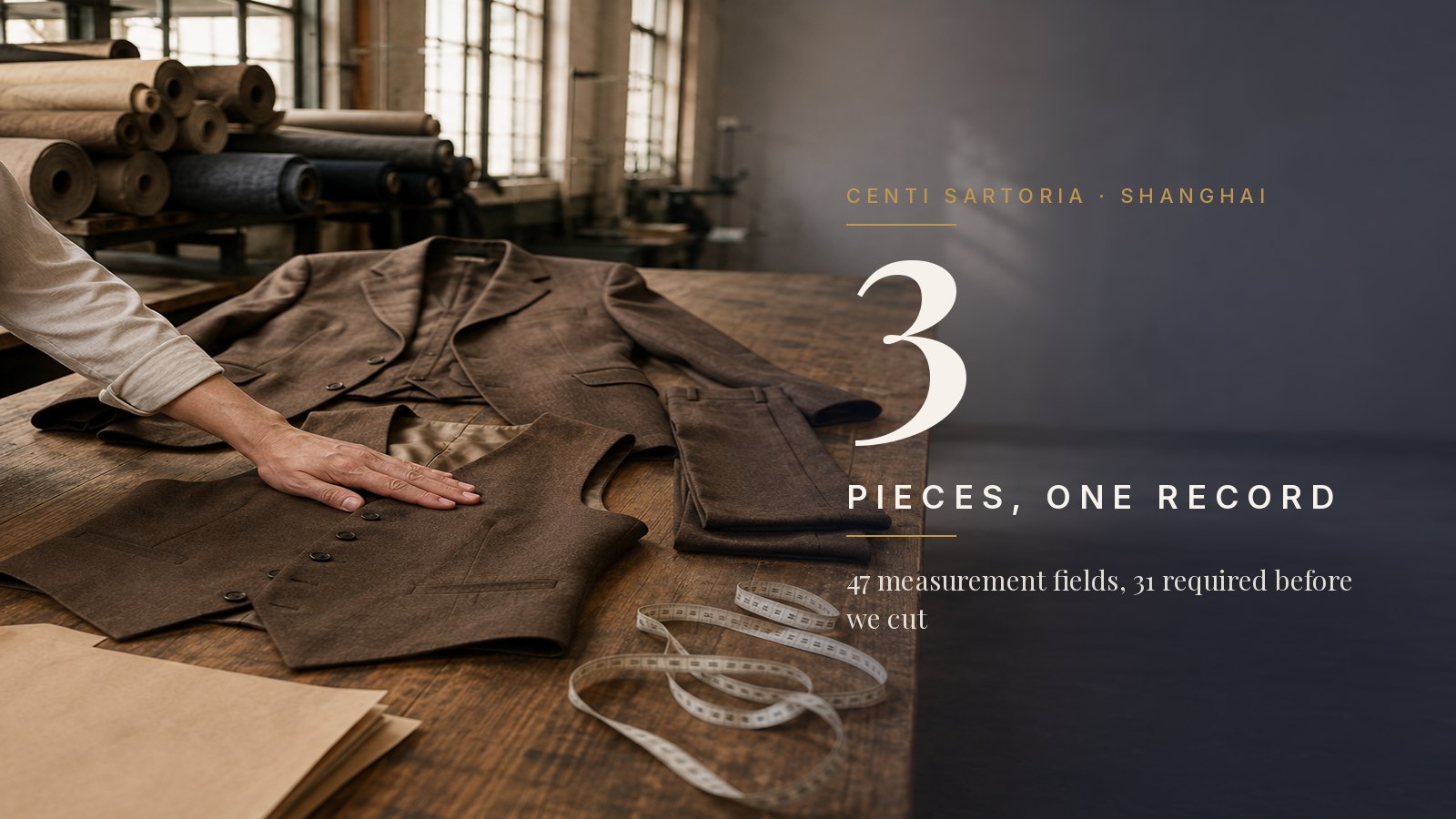
The order came in on a Tuesday with a photograph attached, and the photograph was the most detailed part of it. A groom in a mid-brown three-piece, jacket open, waistcoat buttoned to the second-last button, the whole thing tonal and quiet in exactly the way the season has been asking for. The jacket section of the form was filled in. Lapel width, button stance, pocket style, the lining, a note about the shoulder. So was the trouser section. The waistcoat section had a tick in the box that said include, a cloth reference copied from the jacket, and nothing else.
That order is not unusual. We have been seeing more of them since the third piece stopped being optional. Coverage of the season keeps landing on the same read, that the waistcoat has gone from an optional add-on to a statement of intent, worn buttoned under an open jacket or on its own without one. What has not moved at the same speed is the paperwork. Shops are selling three garments and measuring for two.
One body record, three different garments
Our order form collects 47 measurement fields, of which 31 are required before anything gets cut. That record does not split by garment. A three-piece order does not open a separate waistcoat form with its own fields; the waistcoat is patterned from the same body record the jacket and trouser came from. On paper this looks efficient, and for the most part it is.
The problem is which fields each garment leans on. A jacket carries most of its shape in the chest and shoulder, and it is forgiving through the middle because it is usually worn open. A trouser lives at the waist and seat and has nothing to say about the torso above it. That leaves a band of the body, roughly from the base of the chest to the natural waist, where the jacket is generous and the trouser is absent. The waistcoat is cut through exactly that band, and it is buttoned.
So the fields that matter most for the third piece are the ones a shop has the least reason to take carefully. Stomach is the clearest case. Our size chart asks for it, and it is one of several a stock chart never bothers with, along with front chest and back chest. On a jacket order, a stomach figure that is a centimetre or two off gets absorbed by the drape and nobody notices. On a waistcoat it is the difference between a garment that closes cleanly and one that pulls a small horizontal fold above the buttons every time the client sits down.
None of that shows up as a measuring error when the shop takes the measurements. It shows up later, on the one garment with no room to hide it.
Ease, and where the waistcoat has none
Ease is the word for the space a pattern adds beyond the body itself. A jacket is built with a good deal of it, because it has to sit over a shirt, sometimes over a waistcoat, and move with the arms without dragging the whole front sideways. The canvas inside the chest is doing structural work too, holding a shape that the body underneath does not strictly dictate.
A waistcoat has almost none of that. No sleeves, so no arm movement to accommodate. No canvas through the body in most builds. It sits directly over a shirt, closed, and the shirt is thin. Every allowance the jacket makes on the client's behalf without being asked is an allowance the waistcoat does not have available.
The waistcoat is also a useful diagnostic for that reason. When a three-piece comes back and the note says the jacket is fine but the waistcoat is tight across the front, the jacket is usually not fine either. It is loose enough that the client has not registered the same discrepancy in it yet. We would rather see that note than not see it, because it tells us something about the body record we could not have learned from a two-piece order.
The one question no tape answers
One question on a three-piece order causes more back and forth than any of the fields above, and no tape measure answers it: where the waistcoat should finish at the front.
Traditionally it covers the trouser waistband completely, so that no shirt shows between the bottom of the waistcoat and the top of the trouser when the client stands or sits. That depends on where the client wears his trousers, which is a habit rather than a body dimension, and it depends on rise. The wider, higher-rise trouser that has come back alongside the three-piece changes the answer. A waistcoat cut to the length that worked over a low-rise trouser will now sit well above the waistband and expose a band of shirt the client did not ask to see.
We cannot infer that from the measurements, because it is a styling decision made in the room between the shop and the client. It needs to be written on the order. A shop that adds a single line saying that the client wears his trousers at the natural waist, or that he wants the waistcoat cut long, saves an alteration that would otherwise happen after delivery.
Tonal three-pieces and dye lots
The current preference runs tonal, with the waistcoat cut from the suit cloth itself rather than set against it. That works when all three pieces are cut together from one reservation of cloth, and it breaks down when the waistcoat is added later.
We work premium cloth from 33 mills and merchants, 26 of them in Europe. A portion of that is held and ready to cut. Most of it is ordered in against a confirmed order rather than kept on the rack, and we say so rather than implying that every bolt is on a shelf in Shanghai. For a tonal three-piece, that distinction matters more than usual. Two pieces cut in March and a third piece cut in June may come from different dye lots of the same cloth, and on a tonal outfit, built so the pieces read as one, a small difference in lot is visible in a way it never would be on a contrasting waistcoat.
The fix is a scheduling habit rather than a technical one. If there is any chance the client will want the third piece, reserve the cloth for all three at the time of the first order, even if the waistcoat is cut later. A single piece is a normal order for us, so nothing about our minimum forces a shop to commit early. The cloth is what forces it.
What to put on a three-piece order
A short checklist, in the order we read them:
- Three torso fields. Stomach, front chest and back chest, taken over a shirt with the tape level and the client breathing normally. These three carry the waistcoat.
- Where the waistcoat finishes, stated as a preference. Covering the waistband at the natural waist, or a specific length, but stated either way.
- Single or double breasted, and whether the client wants it collarless, which is showing up more often this season than it used to.
- Lapel width. If the waistcoat has them, we cut waistcoat lapels at 5, 6.5 and 8.5 cm, and the right one follows the jacket's lapel rather than being chosen on its own. There is more on how those numbers relate in our note on lapel width and proportion.
- Back cloth, meaning whether the back panel is cut in the suit cloth or in lining. This affects how the waistcoat wears without a jacket, which is now a common use case rather than an edge case.
- Button count. Including the bottom button, which is a house convention question and should not be left to ours by default.
- One cloth reservation. Covering all three pieces, even if the waistcoat is cut later.
Our style options run to 347 across jacket, trouser, waistcoat and shirt combined, so the waistcoat is not short of choices. The gap has never been in what a shop can specify, only in what gets left blank because the form allowed it.
For a shop selling more three-pieces
The three-piece is a good thing to be selling. It raises the value of an order without adding a client, and the client who buys one tends to be the client who comes back. The failure mode is narrow and predictable, which makes it easy to close. Take three measurements carefully instead of approximately, write down one styling decision that no measurement captures, and reserve the cloth for all three pieces at once.
If it helps to see how the whole record fits together before you send an order, our guide to measuring someone for a suit walks through the fields themselves, and our note on what to check on a first sample covers what to verify when a three-piece arrives. For grooms specifically, most of what we cut in three pieces goes through our wedding suit programme.
We cut three-piece orders from a single piece, with no bulk minimum, in 14 days in production, plus shipping. If you have a three-piece order sitting on your desk and you are not sure the waistcoat section is complete, send it to us before you confirm it. We would rather ask you two questions now than send you a waistcoat that needs an alteration you did not budget for.
Frequently asked questions
Why does the waistcoat fit worse than the jacket when both were cut from the same measurements?
Because they are not asking the same things of those measurements. A jacket is usually worn open, carries a canvas and a layer of ease, and drapes over whatever sits underneath it. A waistcoat is buttoned, close to the body, and has almost no ease built in anywhere. Any softness in the stomach or front chest figures gets absorbed by the jacket and shows up on the waistcoat, which is why the third piece is so often the one a shop sends back.
What should a shop measure differently when adding a waistcoat to an order?
Nothing extra needs inventing, but three fields a jacket tolerates being approximate need to be taken with care: stomach, front chest and back chest. Take them over a shirt rather than over a jumper, with the tape level and the client breathing normally rather than holding still. Add the client's own preference on where the waistcoat should end, because that is a decision, not a measurement, and the form cannot guess it.
Can I order the waistcoat later if the client decides after the fitting?
You can, and a single piece is a normal order for us, so there is no minimum standing in the way. The risk is cloth rather than pattern. If the jacket and trouser were cut from a bolt we no longer hold, or from a mill line ordered in for that order, a waistcoat cut months later may come from a different dye lot and read slightly off next to the pieces it is meant to match. Ordering all three against one cloth reservation avoids that.
Should the waistcoat be cut from the same cloth as the suit?
That is the current preference in most of what we see, and it is the safer default. The 2026 direction runs tonal rather than contrasting, with the third piece in the suit cloth itself or in a close relative of it. A contrast waistcoat is still a legitimate choice, particularly for weddings, but it should be a decision written on the order rather than the result of a bolt running short.
Does adding a waistcoat change the 14 day production time?
No. Our production window runs 14 days from a confirmed order to shipment whether the order is a two-piece or a three-piece, and the waistcoat is cut alongside the other pieces rather than after them. What does move the clock is a cloth we do not hold, which is a sourcing question that sits before cutting rather than inside it.