Journal Entry
When Fused Is the Right Answer, Not the Cheap One
Fused construction earned its bad name honestly, but the defect behind it was a mismatch of glue, press and cloth, not a flaw in the category itself. Where fused is the correct choice, where it still is not, and what the difference actually costs.
A boutique owner in Lisbon called us this June because her summer range would not move. Every jacket on that rail was full canvas, the same construction she used for her winter flannels, because a supplier once told her canvas was simply the better choice and she took that as settled. One customer had tried on the same jacket twice, in April and again in June, and walked away both times. It sat heavier under the arm than the weight of that cloth should have felt, and was priced well above the fused jacket hanging two rails over in a nearly identical grey. She had priced her whole summer collection as though canvas always earns its premium. It does not, not on cloth this light, and her own rail told her that before we did.
That call is the article in miniature. Fused construction has a bad reputation among people who know tailoring, and the reputation was not made up. It comes from a real defect that used to happen often enough to be memorable. But the defect was never about fused as a category. It was about which cloth fused was being asked to carry, and on the cloth that boutique owner was trying to avoid, fused was always going to be the better answer, not the cheaper one she had talked herself out of.
Where the bad reputation comes from
Retailers bring us some version of the same story every year. Someone arrives with a jacket, usually inherited or bought secondhand, with the chest gone wavy in a pattern that will not press flat. They hold it up as proof that fused construction cannot be trusted, and I understand why. A visible flaw across the front of a jacket is a serious thing, and it does not go away because someone explains the chemistry to you afterward.
Turn that jacket over, though, and look at the cloth. In every case I can remember, it is heavy: a dense flannel, a tightly woven worsted, something well into the range where a press has to drive adhesive through a lot of fabric to get an even bond. Early fusing adhesives and the presses that applied them were not consistent, and on cloth that dense the bond failed in patches rather than holding evenly across the panel. Once it lets go, it does not go back. The underlying manufacturing problem is largely solved today. What has not caught up with the fix is the story that got attached to it, and stories outlive the defects that caused them.
Bubbling is a matching failure
Split the sentence "fused suits bubble" into what it claims and it comes apart into two different statements. The first is that bubbling is caused by fused construction. The second, more accurate one, is that bubbling is what happens when an adhesive, a press setting and a cloth are mismatched, and that mismatch shows up far more often on heavy, dense cloth than on anything light.
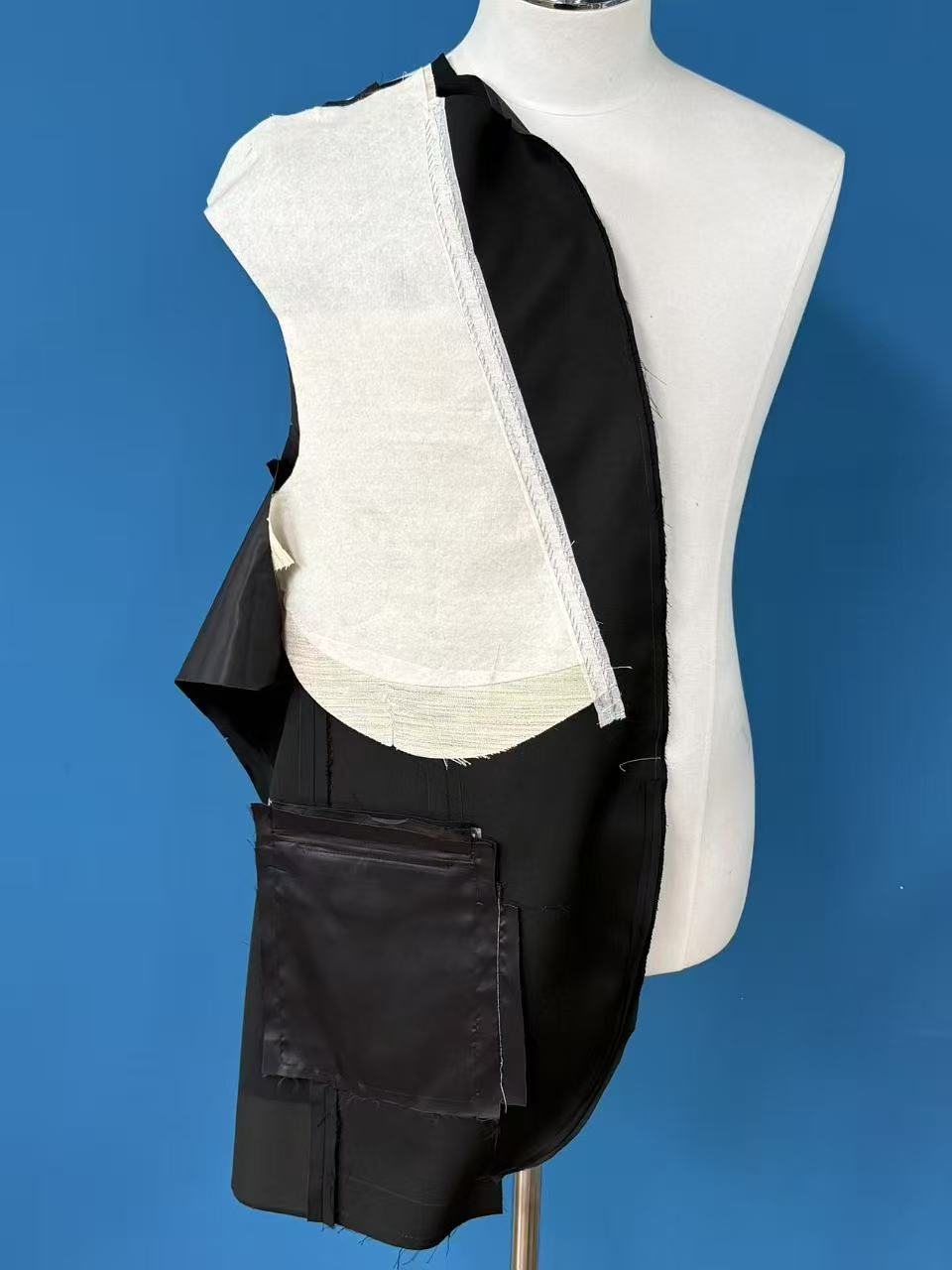
Nothing floats under this front. On a cloth this light, there is nothing for a canvas to hold onto anyway.
Above roughly 340 grams, do not buy fused. I mean that as a boundary rather than a hedge: a press cannot drive adhesive evenly through cloth that dense, the bond is more likely to fail in patches, and a front can go dead or start lifting at the edges within a season or two of hard wear. Up there the old reputation is still earned, and no adhesive on the market fully removes the risk once the weave is that heavy.
Below that line, the story reverses. On an open, lightweight weave, the same category of adhesive under the same press sits flat and stays flat, because there is less fabric mass for the bond to fight against. The failure was fused construction asked to do a job it was never suited for, not fused construction in general.
Where canvas has nothing to work with
This runs against our own instinct as a workshop that has spent years arguing for canvas. Below 240 grams, do not buy our full canvas. A canvas panel earns its price by giving a heavy cloth something to press against and mould around over years of wear. A cloth this light has no body for the canvas to work with, so what you are buying is extra weight, extra heat and a higher price for a jacket that will not hold a press line any better than the fused version hanging next to it.
The cloth range in between the two extremes is the one that decides anything. Of the 822 fabrics we carry with a recorded weight, 597 sit in the 240 to 300 gram band, and that band is exactly where construction choice changes what a customer feels wearing the jacket, the same territory we cover from canvas's side in full canvas at scale. Outside that band in either direction, the decision mostly makes itself: light enough and canvas cannot help you, heavy enough and fused should not be on the table.
A full-make two-piece in fused, in our cloth, starts from USD 155 ex works Shanghai. Full canvas is quoted by specification and costs more. That gap buys real material and real labour, worth paying for on cloth heavy enough to use it. On a cloth under 240 grams it buys a customer a heavier, hotter jacket for more money, which is the complaint that sent the Lisbon boutique looking for a second opinion. If you are pricing an entry tier for someone buying their first made-to-measure suit, fused at the lower price point is the correct construction for what they are buying, priced accordingly, and there is no compromise in it for them to accept. Anyone building a margin model around a construction ladder should read the one number worth building your model on before assuming the more expensive line is always the more profitable one to push.
Where fused is still wrong
None of this makes fused the universal answer. If you are selling a suit to someone building a working wardrobe, something they expect to wear two hundred times a year for the next five, do not put them in fused. There is nothing inside a fused front that can move. Canvas earns its keep slowly, taking on the shape of the shoulders and chest underneath it wear after wear, and a jacket a customer plans to live in needs that room to change. A fused front looks the same on day one and on day eight hundred; it does not get better, only older.
The same goes for cloth heavy enough that the adhesive is fighting a losing battle from the first pressing, the 340 gram line from earlier. I have never once talked a customer out of a bubble they could already see in a shop mirror, and I stopped trying years ago. By the time it shows, the jacket is already a return, a re-order, or a customer you do not see again. On that cloth, canvas is the only option that will not embarrass you eighteen months in.
What to ask instead
Whether a manufacturer fuses is the wrong question. Almost everyone does, for some part of a range, and treating fused as an admission of cutting corners pushes the conversation underground instead of ending it. The useful question is what construction a supplier recommends for a specific cloth, and why, the same instinct behind telling buyers to ask a mill for the bunch number, not the country instead of accepting "Italian wool" as an answer on its own. A supplier who only pushes canvas is giving you the same non-answer as one who only pushes fused. Neither has looked at the cloth in front of them.
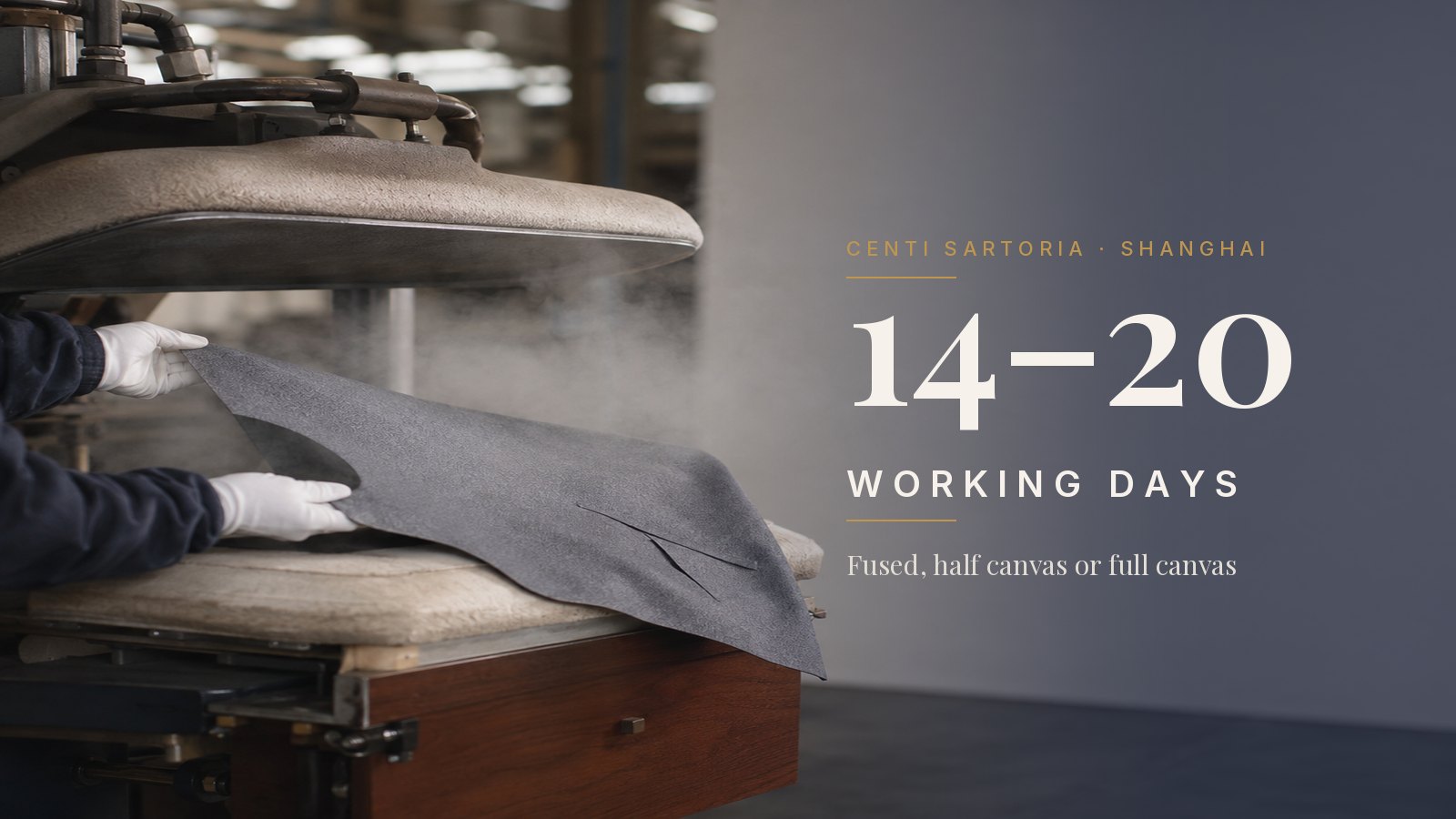
One assumption worth correcting while you are asking: fused does not buy you a faster jacket. Our production runs 14 days whichever construction a style uses, because most of that window is cutting, sewing and finishing, not the padding steps fused removes. If a supplier offers you fused specifically to beat a deadline, ask what they are cutting from the schedule, because it usually is not padding time.
If you are still working out what belongs on a price list at all, the questions we lay out for a founder building a first line, including how to press a manufacturer on construction choices, cover this from the buying side rather than the selling side. Ask the same question whichever seat you are sitting in: which construction the supplier recommends for this cloth, and what happens if you ask for the other one anyway.
We are not neutral on this ourselves. Our own instinct, and the instinct of most workshops that build both, is to sell up. Canvas costs more, so it gets recommended more often, including on cloth where it does nothing the fused version could not have done at a lower price. That instinct is worth naming, because a buyer who does not know it exists has no reason to push back on it.
Where we draw our own line
For readers who want the underlying definitions rather than the buying logic, what is inside a fused, half canvas or full canvas front, those are laid out with photographs on our full canvas vs half canvas vs fused guide. This piece is about which one to choose once you already know what they are.
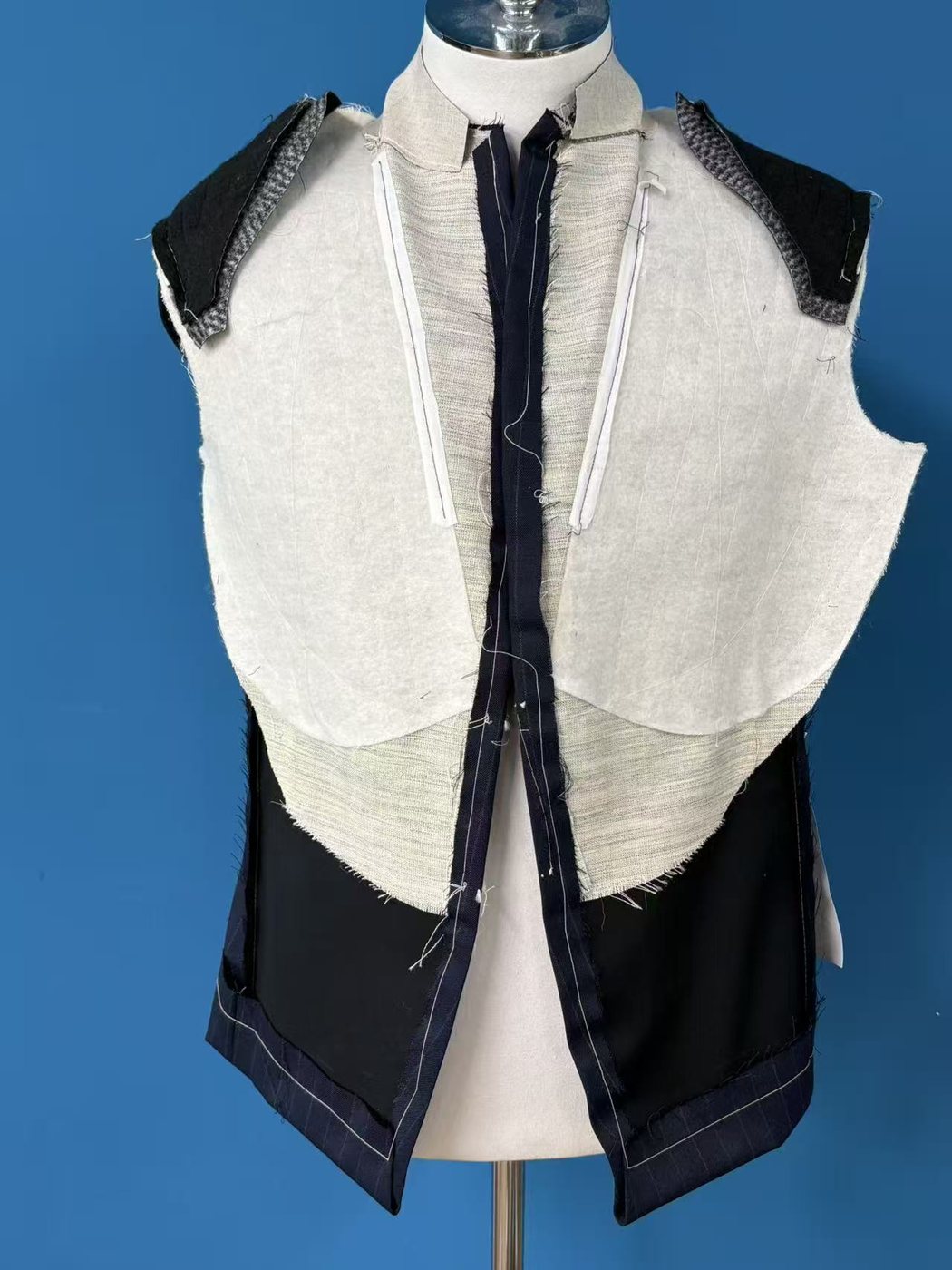
This is what a fused front cannot offer on a heavier cloth: a panel with something floating underneath it, free to move with the body.
How that canvas gets padded onto the wool is a separate decision, and a separate line on a price list, covered in full in which construction to sell and how to price it. Fused versus canvas is a cloth and purpose decision; padding method is a labour and price decision. Do not fold them into one line on a spec sheet, because a buyer asking about one will assume you have answered the other.
Our own cloth runs from heavier European weights down to lighter, open weaves, including an Australian merino line built for exactly the gap fused is best at closing, and our minimum order is a single piece, so a shop unsure which construction sells does not need to commit to a production run to find out. Put one fused and one full canvas from the same weight of cloth on the rail and let a customer's hands make the argument neither of us has to. If you already know which cloth you are trying to place, tell us the weight and what it is for and we will tell you which construction we would build it in, fused included, whether or not that is the more expensive answer.
Frequently asked questions
Is a fused suit bad?
Not inherently. The reputation comes from a real defect, adhesive and press settings that failed on the wrong cloth and produced bubbling across the chest that could not be pressed back out. That failure is a mismatch between glue, heat and fabric density, not a fixed property of fused construction. On a lightweight, open weave under about 240 grams, a well matched fused front sits flat and stays flat. Above roughly 340 grams, on a dense cloth, it is far more likely to fail, which is where the bad reputation comes from.
When should a retailer choose fused construction over canvas?
On cloth under about 240 grams, where a canvas panel has nothing dense enough to press against and cannot earn its extra cost. It also suits occasion wear worn only a handful of times a year, where canvas's advantage of moulding to a body over years of wear never gets the chance to build up, and it works as a sensible entry price point for a first-time buyer who has not yet decided whether they will order a second jacket.
Why does fused construction sometimes bubble or delaminate?
Bubbling happens when the adhesive, the press temperature and dwell time, and the cloth do not match. It shows up far more often above roughly 340 grams, where the press cannot drive adhesive evenly through a thick, dense weave and the bond fails in patches instead of holding evenly across the panel. Once it happens it does not press back out, which is why one bad jacket outlives the fix in a customer's memory.
Can the same cloth be built either fused or full canvas?
Physically yes, but the two will not perform the same. On a lightweight summer cloth, a full canvas version costs more to build and gives the wearer no shaping advantage the cloth can support, while the fused version sits lighter and costs less. With a heavy cloth meant to be worn for years, the reverse is true. Ask which construction a supplier recommends for a specific cloth and why, rather than choosing a construction first and asking the mill to fit it.
Does choosing fused construction shorten production time?
No. Our production runs 14 days regardless of which construction a style uses. Fused removes padding steps, but those steps do not sit on their own separate, faster schedule, so switching construction is not a lever for a rush order.