Journal Entry
Best Suit Fabric Brands: 20 Names a Shop's Clients Ask For
A working table of the 20 suit fabric brands your clients are most likely to name, sorted by what each one actually is: a mill or a merchant, held or ordered in, and which customers it fits.
A shop owner in Rotterdam asked us last month to quote a jacket in Dormeuil Amadeus. When we asked what weight and bunch number she wanted, there was a pause. She had sold Dormeuil for two years without knowing it was a merchant house in Paris, not a weaving mill, and that the cloth was woven in Yorkshire. It did not change her order. It did change how she talked about it to the next customer who asked.
That conversation repeats itself with different names every week. A client walks in asking for Zegna or Loro Piana because they read the name somewhere. The shop owner needs to know, quickly, what each name actually is, whether the cloth is sitting in a warehouse ready to cut or needs to be ordered from Europe, and how to set expectations around lead time and price without overpromising or underselling. This is that table: the 20 best suit fabric brands your clients are most likely to ask about, sorted by what matters when you are the one placing the order.
Italian mills: the names behind most of the world's worsted
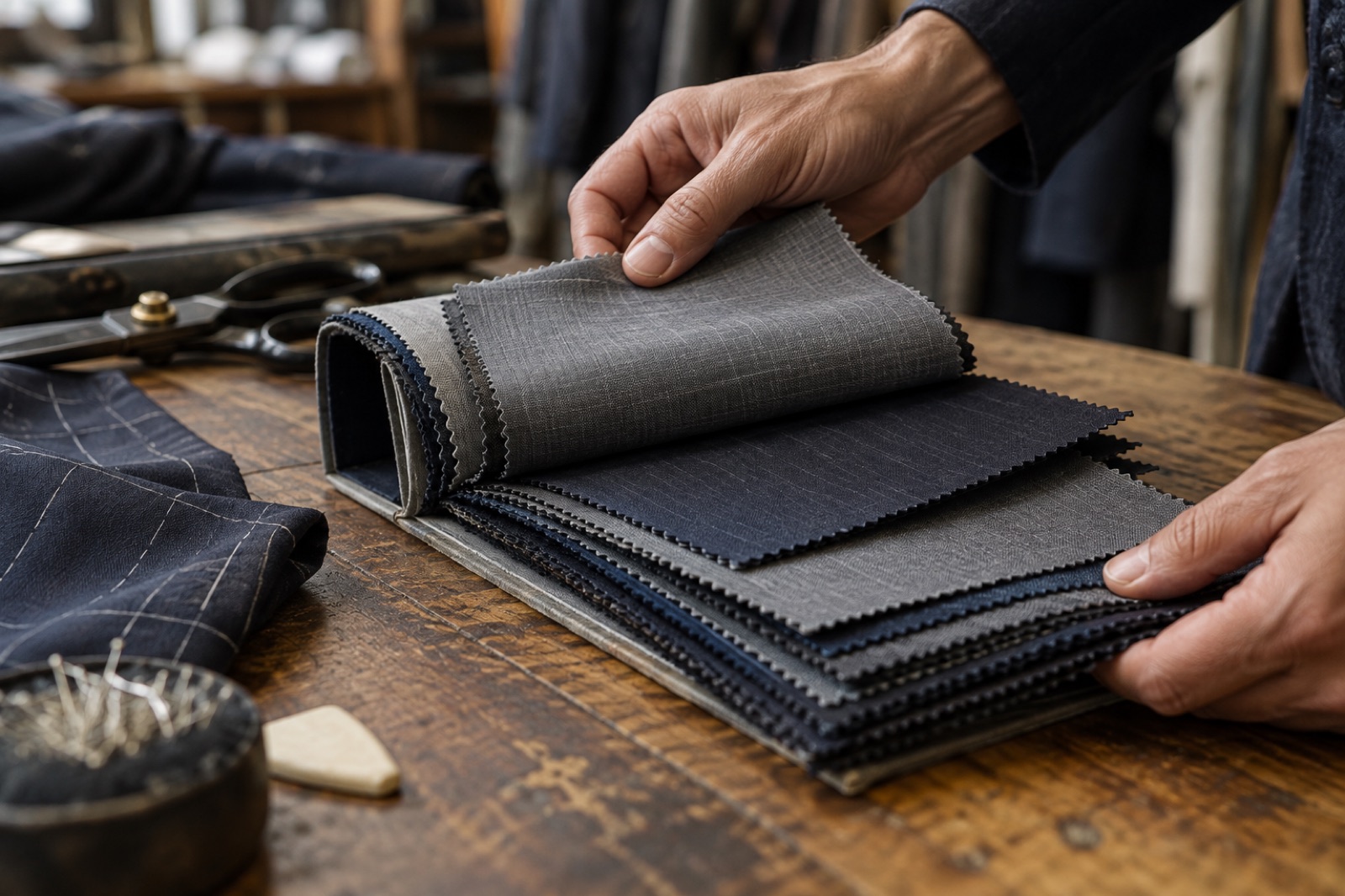
A swatch bunch open on the cutting table, the kind of book a shop shows its clients before placing an order.
The largest share of the world's fine worsted suiting comes out of the Biella district in Piedmont. Seven of the twenty names on this list weave there, and understanding what separates them saves a shop from treating them as interchangeable.
Zegna (Italy, mill, held in Shanghai). Founded 1910 in Trivero, vertically integrated from fibre to finished cloth. We hold 162 Zegna styles in Shanghai: 99 Trofeo and 63 Traveller. Trofeo is the occasion cloth. Traveller is a high-twist Australian merino engineered against creasing, built for the client who flies every week. Cut to order in 14 days in production from a confirmed order, plus shipping.
Vitale Barberis Canonico (Italy, mill, held in Shanghai). The world's oldest continuously operating wool mill, founded 1663 at Pratrivero, still family-run. Owns merino sheep farms near Mudgee, New South Wales, since the early 1980s. We hold 40 Four Seasons styles (Super 100s to 130s) in Shanghai. This is the book that covers daily business wear: built for weekly use, not the display case.
Reda 1865 (Italy, mill, ordered in). Founded 1865 in Valle Mosso, owned by the Botto Poala family since 1919. Reda owns three merino stations in New Zealand (not Australia), around 30,000 hectares. First Italian textile company to hold B Corp certification, awarded 2020. The 130's Suit bunch runs 260 to 275 grams per metre.
Drago (Italy, mill, ordered in). Founded 1973 in Lessona, vertically integrated: spins, weaves and finishes on one site. Weaves Super 130s to Super 210s wool, plus Mongolian cashmere. Around 1.7 million metres a year.
Fratelli Tallia di Delfino (Italy, mill, ordered in). Roots traced to 1903 in Strona. Sources merino, cashmere, mohair, silk, linen and hemp. Weaves as fine as Super 200s in its Suprema Lana bunch. Part of Marzotto Group since 2008; the mill states 100% of production still stays in Strona.
Guabello (Italy, mill, ordered in). Founded 1815 in Mongrando. A quieter Biella name, best known for its Super 130s Onethirty collection. Full production still run at the single Mongrando site. Also part of Marzotto Group.
Cerruti 1881 (Italy, mill, ordered in). Two companies share this name: a Biella wool mill founded in 1881 on the Cervo river, and a Paris fashion house that borrowed the year in 1967. We buy from the mill, Lanificio F.lli Cerruti. Owned by Gruppo Piacenza since November 2022.
Italian and Neapolitan merchants
Not every Italian fabric brand is a mill. Some of the most recognised names in a tailor's bunch book are merchant houses that commission cloth from mills they do not own.
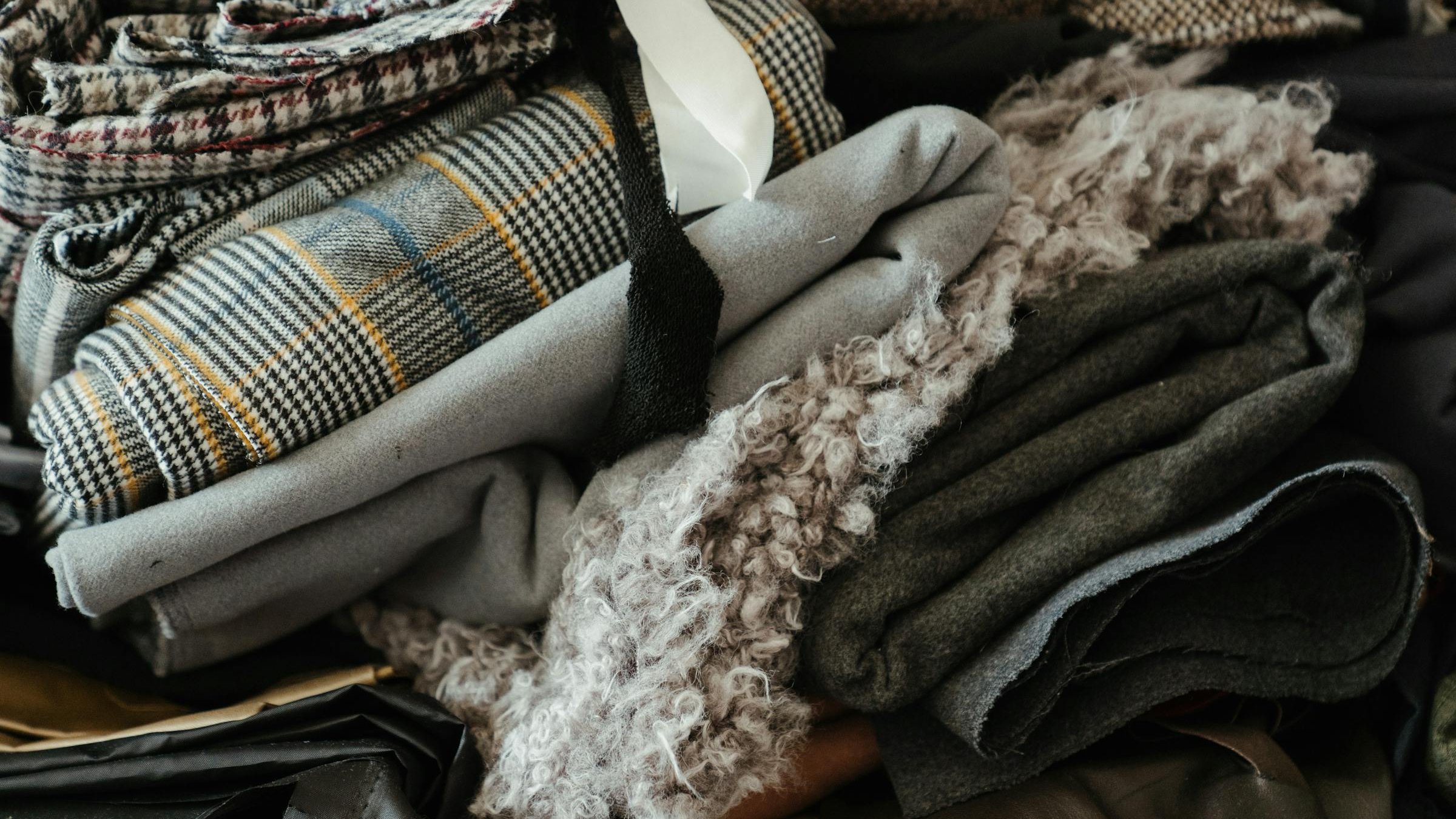
A stack of suiting cloths from across our library: checks, houndstooth, flannel and textured weaves.
Loro Piana (Italy, mill, ordered in). Founded 1924 in Quarona, now 94% owned by LVMH. Known for rare fibre: cashmere, fine merino bought at the top of the market. No public bunch book; the group's own textile trade site sits behind a login. Not held in our Shanghai stock.
Caccioppoli (Italy, merchant, ordered in). Trading from Naples since around 1920, same address at Piazza Nicola Amore. A cloth merchant, not a mill. Finished cloth sourced mainly from Biella. Known for soft-handle cashmere blends, Donegal and herringbone jacketings. New collections twice a year.
Ariston (Italy, merchant, ordered in). Family-run since 1920, based at Nola near Naples. Best known for its linen-silk summer range and expressive printed cloth that Biella's worsted mills do not touch. We file Ariston as a merchant house, not a weaving mill.
Carlo Barbera and E. Thomas are two names that appear inside some of the bunches on your shelf without running their own showrooms. Our supplier Gladson's page states that Gladson sources from both.
British and Belgian cloth houses

A glen plaid in grey worsted from our range, the kind of pattern English and Scottish mills have woven for over a century.
Dormeuil (France, merchant, ordered in). Founded 1842 in Paris by Jules Dormeuil. Family owned for more than 180 years. A merchant house, not a mill. By trade reporting, as much as 85% of Dormeuil's cloth is woven at Pennine Weavers in Keighley, Yorkshire, the same commission mill that weaves for Dugdale Bros and Holland and Sherry.
Scabal (Belgium, merchant and mill, ordered in). Founded 1938 in Brussels. Owns and runs its own weaving mill in Huddersfield, bought in 1973. Pioneered Super 150s, then 180s, then 200s cloth from 1990 onward. Flagship at No. 12 Savile Row since 1972.
Holland and Sherry (United Kingdom, merchant, ordered in). Founded 1836 in London by Stephen Holland and Frederick Sherry. A merchant house: commissions cloth from Yorkshire and Scottish mills. Cape Horn, one of its best-known bunches, is an 18.5 micron wool with 1% cashmere added. Headquartered on Savile Row since 1982.
Dugdale Bros (United Kingdom, merchant, ordered in). Founded 1896, widely described as the last independently owned cloth merchant in Huddersfield. Flagship Fearnought bunch: 100% wool, 18 ounces, close to 500 grams. Heavier than anything in the Biella range.
Huddersfield Fine Worsteds / Hardy Minnis (United Kingdom, merchant, ordered in). Formed 1976 by merging historic Yorkshire houses. Hardy Minnis has held a Royal Warrant to the Royal Household since the 1930s. Around 188 bunches in the current catalogue. Alsport, its thornproof country cloth, runs 16 to 22 ounces.
Names we do not carry, and what a shop can do about it
Three names on this list are not among our 33 mills and cloth merchants: Fox Brothers, Harrisons of Edinburgh, and Drapers. If your shop already holds cloth from any of them, or from any other house we do not buy from, the route is CMT (cut, make and trim): you supply the cloth, we cut and sew. CMT starts from USD 100 per two-piece suit, ex works Shanghai, one-piece minimum, 14 days in production from a confirmed order, plus shipping.

A dark check from our range, four sleeve buttons, the sort of cloth a shop might hold from any mill or merchant on this list.
What the table tells a shop, and what it does not
The table above sorts each name by three things that matter at the ordering stage: whether it is a mill or a merchant, whether we hold it in Shanghai or order it in, and what country it comes from. It does not rank them. Zegna Trofeo and Dugdale Fearnought are not competing for the same customer, and treating them as a ladder from cheap to expensive misses the point. The question is which client in your shop is asking for what, and whether the cloth behind the name matches the occasion, the season and the budget.
Of the 822 fabrics we carry with a recorded weight, 597 sit in the 240 to 300 gram band, out of a wider range from 98 to 440 grams. Most of the Italian names above fall inside that band. The British names sit heavier. Knowing where a name sits on the weight scale matters more than knowing where it sits on a prestige scale, because weight determines whether the cloth works for the climate your client lives in, and prestige does not.
We work with 33 mills and cloth merchants, 26 of them in Europe. Two of those 33, Zegna and Vitale Barberis Canonico, are held in our Shanghai stock and ship in 14 days from a confirmed order. The other 31 are ordered in against a confirmed bunch reference, and their lead time adds the mill's own production and shipping to ours.
For a full overview of every house we source from, including the names not on this list, see our suppliers page. For the cloth itself rather than the name behind it, our suit fabric guide covers weights, weaves and fibre types across the full library.
Frequently asked questions
Which suit fabric brands should a new tailor shop carry first?
Start with the two we hold in Shanghai and can ship in 14 days from a confirmed order: Zegna (Trofeo and Traveller, 162 styles) and Vitale Barberis Canonico Four Seasons (40 styles). Between them you cover luxury occasions and daily business wear, without tying up capital in cloth you have not sold yet.
What is the difference between a cloth merchant and a weaving mill?
A mill owns the looms and weaves the cloth itself. A merchant commissions cloth from mills it does not own, bundles it under its own name and sells it through its own bunch books. Dormeuil, Holland and Sherry, Caccioppoli and Ariston are merchants. Zegna, VBC, Drago and Reda are mills. The distinction matters because a merchant's bunch might share a loom with another merchant's, and the lead time includes the merchant's own handling step.
Can a shop send its own cloth to a made-to-measure factory?
Yes. CMT, cut make and trim, means the shop supplies the cloth and the factory cuts and sews. We run CMT from USD 100 per two-piece suit, ex works Shanghai, with a one-piece minimum and 14 days in production from a confirmed order. Shops that already hold Fox Brothers, Harrisons of Edinburgh or any other cloth not in our library use this route.
How many fabric brands does Centi Sartoria source from?
We work with 33 mills and cloth merchants, 26 of them in Europe. Of the 822 fabrics we carry with a recorded weight, 597 sit in the 240 to 300 gram band. Two of those 33, Zegna and Vitale Barberis Canonico, are held in our Shanghai stock. The other 31 are ordered in against a confirmed bunch reference.
Does carrying a suit fabric brand name mean a shop is an authorised dealer?
Not necessarily. A tailor shop that buys cloth through a factory like ours is buying as a customer, the same way the factory buys from the mill. The name on the selvedge tells the end client where the cloth was woven, not who is authorised to sell it. We buy from these mills and merchants as a customer. We are not an authorised supplier, dealer or representative of any of them.