Journal Entry
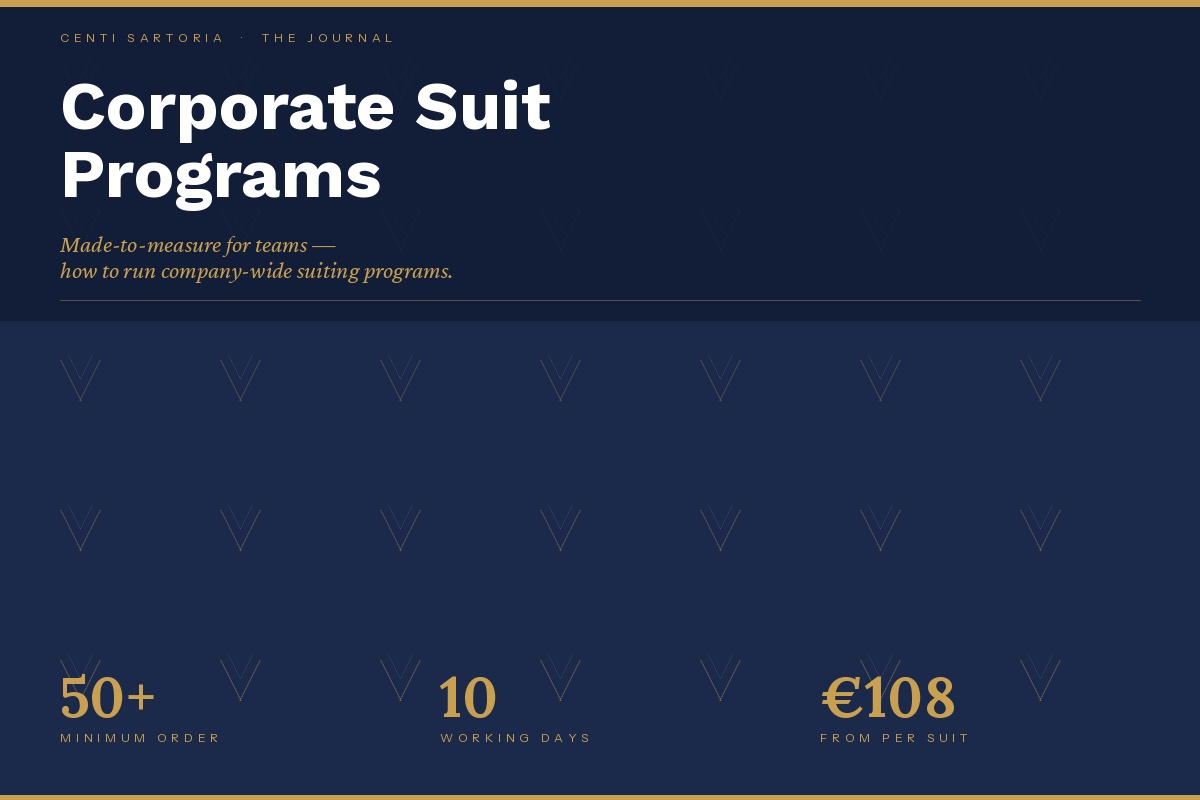
Corporate Suit Programmes: What Actually Breaks a Group Order
Dressing twenty people for one day is a deadline problem before it is a tailoring one. What actually breaks a corporate made-to-measure programme, and how to plan around it.
Nine days before a leadership summit two years ago, an events coordinator sent me a message I still think about. Twenty-six people needed jackets. Twenty-three measurement sheets were already in. The other three were scattered across three time zones mid-conference, one of them replying to emails from an airport lounge with two bars of signal. She was not asking me to hurry so much as asking a harder question: could the twenty-three go into production without the three, and if so, what would the three latecomers end up with.
That question is the real subject of this piece, more than lapels or linings: whether a group of people who did not all respond on the same day can still end up looking like they did.
A deadline problem first
Nobody's team photo gets ruined by a slightly narrow lapel. It gets ruined by three empty seats where jackets should have been, or by one navy that reads two shades off next to the other nineteen. Both of those are date problems and headcount problems wearing a fabric label.
Off-the-shelf sizing does not solve this either, even though it looks safer on paper. A size 40 bundles several measurements into one block: pick it for your shoulder width and your sleeve length is whatever that block happens to include, correct or not. One person fixes the mismatch with a local tailor and moves on. Twenty people fixing twenty different mismatches with twenty different tailors gives you twenty separate alteration outcomes standing next to each other on the day, which is some way short of a matching group.
If you are the person organising this, whether you sit in HR, run an events company, manage a hotel's front of house, or are the groomsman sorting out eight suits for a wedding, nobody will judge you on whether you understood half canvas versus fused. You will be judged on whether the group is dressed, together, on the day you promised. I have sat across from that person enough times to know that the suits are rarely what goes wrong. The schedule is what goes wrong.
One batch versus the stragglers
This is the structural problem, and most suppliers skip past it in their sales material.
A group reads as a set when it is cut and made together, one fabric run, ordered and confirmed on the same day, which is what makes twenty jackets look like one decision instead of twenty separate ones. But any group past a handful of people will have stragglers. Someone is travelling. Someone's manager has not signed off the expense yet, or someone has simply not filled in the form and is not answering the reminder either.
So you have two options and neither is good without a decision made in advance. Wait for the last person, and the whole group's timeline slides to match your slowest respondent; do not wait, and the latecomers become a second, later order that may not match the first as closely as everyone assumes it will, and nobody finds that out until the second parcel is opened next to the first.
I am not going to tell you we guarantee an exact match across two production batches, because on cloth dyed in lots nobody can promise that and mean it. What I will tell you is what to ask, of us or anyone else: is this order going into production as a single batch, at what headcount does a second batch become unavoidable, and what happens to shade consistency when it does. Ask those questions before you commit any money, not after the first batch ships. The same logic applies to the fabric itself: ask for the bunch reference, not just a colour name, because two rolls sold under the same description are not always the same roll.
There is a second version of this problem, and it has nothing to do with fabric batching. Our style catalogue runs to 347 options across jackets, trousers, waistcoats and shirts, which is a real advantage for one person ordering one suit. For a group it is a hazard: leave everyone free to choose their own lapel, vent or pocket style, and you get twenty individual orders that happen to arrive in the same shipment rather than a matching set.
Decide the specification once, for the whole group, before anyone is measured, and do not reopen it person by person. No guarantee solves the stragglers problem, only a decision written down before the first measurement sheet comes in: a real cutoff date, and a plain statement of what happens to anyone who misses it. Most groups never write that sentence down, then argue about it nine days before the event instead.
Working backwards from production
Production runs 14 days once measurements are confirmed. That is the number to plan from. The direction matters too: work backwards from it rather than forward from your event date, because the two methods land you in very different places even when they start from the same calendar.
Forward planning starts with "the gala is in six weeks" and works out how much slack that leaves, which is exactly how a coordinator reaches production day still missing sign-off from three people with nothing in reserve. Backward planning starts at the production window, adds shipping and customs clearance, adds a buffer for the garment that will need adjustment, and only then tells you the last date measurements can arrive. Do that sum before you announce a date.
Rework is the part people forget to budget for, and if a garment needs a real fix rather than a small adjustment, the production clock runs a second time for that person, on top of the shipping clock, on top of whatever buffer you thought you had. Build in slack for at least one remake from the start, because past a dozen people the odds of needing it are not small. We have written up how the production process actually runs end to end.
One suit before twenty
The minimum order is one suit. For a group programme that is the cheapest insurance in this entire process, and I would use it every time.
Before you commit twenty people to a fabric and a price point, order one suit. Put it on whoever approves the budget, or whoever is most particular about fit, and let them wear it for a week before the group order goes in. A single pilot suit costs you one suit's worth of mistake instead of twenty. It surfaces the wrong assumption early. Cloth heavier or lighter than the photographs suggested, a fit preference the whole group will share, a lining colour that looked fine on screen: all of it shows up while it still costs one suit to fix.
This is also where the price conversation belongs. Our full-make two-piece starts from USD 155 ex works Shanghai; full canvas is quoted by specification. Do not treat those as the same product at two prices. Construction changes what a suit actually does over years of wear, and a pilot suit tells you which one your group needs before you are twenty suits deep.
Forty-seven fields and one reviewer
Our form runs to forty-seven measurement fields. A number of them exist to check each other, so a wrong entry, a sleeve length that does not match the person's height, for instance, is usually catchable before the cloth is cut.
Catchable, but only if somebody is looking. Do not let twenty-six people submit measurements into twenty-six separate accounts with nobody reviewing the sheet before it ships to production. Appoint one internal owner, whether that is you, an office manager or an events coordinator, whose job is to open every sheet and flag anything that looks off against the person's height and build. Our fit and sizing system explains what each field is actually checking for, and it is worth reading before you distribute the form, not after somebody's sleeves come back wrong.
Self-measurement across a group spread over several offices or cities is harder than measuring one person in a room, and no set of instructions removes that gap entirely. A second pair of eyes on the finished sheet is the only real mitigation, and it costs nothing but ten minutes per person.
Cloth weight
We carry 831 fabrics on file, 822 with a declared weight, and 597 of those sit between 240 and 300 grams. That band is where I would keep a corporate or uniform order. I do not recommend anything under 240 grams for a suit that sits through a full shift or stands for hours at an event. Cloth that light creases before lunch. Creased is not the look anyone approved in the sample.
Inside that band you have real, named options rather than a generic "wool blend": Ermenegildo Zegna's Trofeo at 240 grams or their Traveller at 250, Vitale Barberis Canonico's Four Season at 280, alongside our own house range. Linen runs lighter by nature and we hold it too, but I would treat it as a warm-weather choice rather than a year-round uniform fabric, for the same creasing reason.
What you can customise
Some group-branding requests are real options rather than things we improvise per order. Logo or lettering embroidery is a standard jacket option. Lining is customisable too: jacket lining, sleeve lining and waistcoat lining can each be specified separately, which is a legitimate way to carry a company colour on the inside of the garment rather than announcing it on the outside.
Some requests we do not supply. Branded garment bags printed with a company name are the common one. If that matters to your programme, ask your supplier, us included, whether they can arrange it through a third party, and do not assume it is included in the order, because for most manufacturers it is not.
If you run an events or styling company bundling this into a service you sell on, the sums that apply to a boutique adding made-to-measure apply to you too, particularly the one number worth building that model on. And before you sell it as your own service rather than a referral, read what changes once you are the one taking the client's money, written up here for stylists facing the identical decision.
Landed cost
Ex-works is not landed cost, and quoting one as the other is the most common way a corporate budget comes in short. Ex-works is the price at our door. What lands in your country also includes freight, duty under whatever HS classification applies, payment processing, and the rework contingency covered above.
I am not going to hand you a per-suit shipping estimate here, because it moves with destination, courier and duty rates. A wrong number is worse than no number. We laid out how to work out a real landed cost properly, and the method holds whether you order one suit or a hundred. Run your own numbers before you quote a per-head budget internally, because that figure decides whether the programme gets signed off.
When to skip made-to-measure
There are three situations where I would tell a group to do something else, and mean it, even though it costs us the order.
If you have eight days and six people, do not start a made-to-measure programme. Alter ready-to-wear instead, and spend the time you saved trying it on each person in the room. The advantage of made-to-measure only pays off with enough runway to use it, and eight days is not that.
Avoid running a group's first order when everyone is scattered across cities, has never been measured before, and there is no time for a pilot suit first. That combination stacks every risk in this article on top of the others, with no way to catch a problem before it reaches twenty people at once. Fix one of them first.
And if the budget only clears a cloth under 240 grams for something people will wear all day, the thing to revisit is the budget, before anyone gets measured, because no amount of good tailoring corrects for cloth that was too light for the job from the start.
If you are a tailor shop taking this kind of order for a client company, the step-by-step version for shops (locking one specification, measuring every person, ordering in batches and adding late joiners) is on group suit orders for tailor shops.
Tell us the headcount and the date you need to hit, and we will quote it properly, with the production window and the landed cost stated separately rather than folded into one flattering number. If a single pilot suit is where you want to start, say so when you get in touch.
Frequently asked questions
How far in advance should we start planning a corporate suit programme?
Work backwards from production, not forward from your event date. Production runs 14 days once every measurement is confirmed, and you still need to add shipping, customs clearance and a buffer for at least one remake on top of that. Most groups assume two or three weeks of runway is enough and it usually is not, once you count backwards properly. Set a hard cutoff date for measurements in writing before you distribute the form, because the alternative is negotiating it nine days before the event instead.
What happens if a few people in the group miss the measurement deadline?
Decide this before the deadline arrives, not after. A group order looks like a matching set because it is cut and made together in one batch. Waiting for stragglers pushes the whole group's date back, and not waiting means the latecomers ship in a second batch that may not match as closely as everyone assumes. We do not promise an exact match across two separate production runs, and I would be careful of any supplier who does. Write the policy down before you collect a single measurement sheet: a real cutoff, and a plain answer for what happens to anyone who misses it.
Can you guarantee every suit in a group order will look identical?
No, and I would be careful of anyone who tells you yes without qualification. What drives consistency is a group cut and made together as one batch from one confirmed fabric order, plus a style specification locked once for the whole group rather than each person choosing their own lapel or vent. Ask for both explicitly on your order, from us or from anyone else, and get the answer in writing. What nobody should be promising is a guaranteed dye match across two batches ordered weeks apart, because that is not fully within any manufacturer's control.
What does a corporate made-to-measure programme actually cost once shipping and duties are included?
More than the ex-works price alone, and the gap depends on your destination, so treat any flat per-suit shipping figure with suspicion. Our full-make two-piece starts from USD 155 ex works Shanghai, or from USD 100 CMT with your own cloth; landed cost adds freight, duty at whatever HS classification applies, and payment processing on top of that. Work out your own landed cost before setting a per-head budget for approval, and build in a rework contingency for at least one remake, because that figure is what decides whether the programme gets signed off.