Journal Entry
Custom Overcoats for a Suit Shop: The Order That Starts in October
A suit shop already knows how to measure a man. But overcoat measurements are not suit measurements. What changes on the spec sheet when you add outerwear, which cloth weights work, and why October is the ordering deadline.
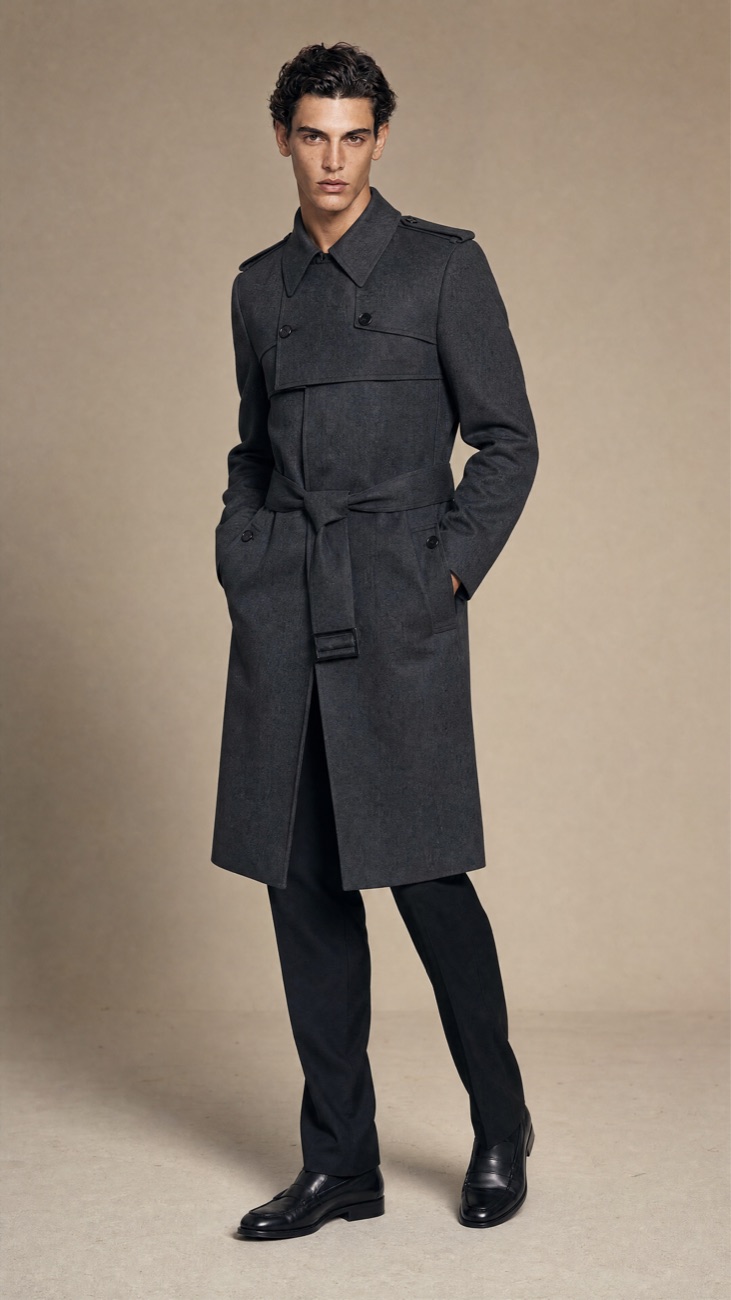
Every October the same thing happens. A shop that has been sending us suit orders all year calls with something new: a customer asked for a coat. Not a jacket, not a sport coat, a proper overcoat, the kind of garment most suit shops talk about adding and few actually do. The custom overcoats men order through their tailor start from different measurements than a suit, and that is where most first attempts go wrong. The question is always the same: can we just use our existing form? The short answer is no. An overcoat wraps around a jacket rather than replacing it, and that single difference changes the numbers at nearly every point on the spec sheet.
What changes on the measurement sheet
The core issue is layers. A suit is measured over a shirt. An overcoat is measured over a suit jacket, and sometimes over a waistcoat beneath that, so the starting point is already bigger at every circumference. If a shop sends us the same chest number it uses for a suit, the coat will pull across the front the moment the wearer buttons the jacket underneath.
Here is the short list of what moves.
Chest: Measure over the jacket the wearer will typically wear under the coat. Do not add manual ease on top of that. The factory pattern already builds in overcoat ease, but it needs the chest circumference with layers on, not without.
Sleeve length: This is the measurement that catches every first overcoat order. A coat sleeve must sit past the jacket cuff. The standard expectation is that the coat sleeve covers the jacket sleeve entirely when the arm hangs at rest. Measure from the shoulder point to the wrist bone with the jacket on, not from the shoulder to where the jacket cuff ends. The wrist bone is fixed; the jacket is what moved underneath.
Back length: A suit jacket ends at the hip or just below. An overcoat runs to the knee, mid-thigh, or mid-calf depending on the silhouette, and that is a decision the shop needs to make before the tape comes out. The spec sheet asks for a number in centimetres, not a description like "knee-length," because what sits at the knee on a man who stands 175 centimetres is a different number from what sits at the knee on a man who stands 190.
Shoulder: Measure at the bone, over the jacket. The seam should still sit at the natural shoulder point, but with the bulk of a jacket underneath, the raw number will be wider than the one on file for a suit.
Our own measurement guide covers the 47 fields we use across garments, 31 of them required, and the overcoat shares most of those fields with a suit. What changes is not the list of fields but the condition under which they are taken: jacket on, not shirt on.
A checklist for the first overcoat spec
A suit shop adding custom overcoats to its offering for the first time should confirm each of the following before sending the order.
- Silhouette decided: single-breasted or double-breasted; knee-length, mid-thigh or mid-calf. Agree on this with the client before measuring, because back length depends on it.
- Chest measured over the jacket: not over a shirt, not from a suit record on file.
- Shoulder at the bone, over the jacket: the same landmark as a suit, but taken with layers.
- Sleeve length to the wrist bone, over the jacket: the coat sleeve must clear the jacket cuff.
- Back length as a number: measured from the nape to the agreed hemline, in centimetres.
- Cloth confirmed: overcoating weight, with the bunch number and mill name, not a screen grab from a lookbook.
- Construction specified: canvas type, lining (full or half), whether the coat carries an interlining for wind.
- Label decided: your brand label, a co-brand, or blank for the client to label themselves.
Miss point two or four and the coat comes back too tight or too short in the sleeve. Miss point five and the hemline lands wherever the pattern maker's standard block puts it, which may not be where your client expected.
The cloth weight question
Suiting cloth and overcoating cloth live in different weight classes. Of the 822 fabrics we carry with a stated weight, 597 sit in the 240 to 300 gram band, the range most business suiting lives in. An overcoat needs heavier cloth, 300 grams or above, and most overcoating fabrics sit at 340 grams or higher, because the garment must hold structure over layers, resist wind, and serve as the outermost thing a man wears for months.
Several of the 33 mills and cloth merchants we work with carry dedicated overcoating ranges. Vitale Barberis Canonico's Covert collection is a worsted twill built for overcoats and winter coats. Dormeuil offers 37 coat fabrics in its Luxury Overcoatings range. Piacenza 1733 works in noble fibres: its Alashan Topcoats book is pure cashmere and its Dunes Overcoats book is baby camel hair. Holland and Sherry's heavier seasonal books run up to 430 grams for winter weights.
All of these are ordered in against a confirmed order. The mill's own lead time, typically two to four weeks, sits on top of our 14 days in production. A shop planning a winter coat offering should confirm cloth availability before promising a date.
The fabrics we hold ready in our Shanghai workshop, the Zegna Trofeo at 240 grams and Traveller at 250 grams plus the Vitale Barberis Canonico Four Seasons at 280 grams, are suiting weights. They ship on day one, but they are not what an overcoat is typically cut from. An overcoat in a 280 gram cloth can work for a transitional piece, a topcoat worn over a shirt in autumn, but a proper winter coat wants more weight.
Why October is the ordering window
The arithmetic is straightforward. Our production runs 14 days from a confirmed order, and shipping adds time on top. A shop that confirms an overcoat order in the first half of October with a held cloth or a quickly available mill book has delivery in November, comfortably ahead of the cold months. Delay that order to November and the coat arrives in December at best, which in most markets means the customer has already bought something else.
If the cloth is a mill special order, the timeline stretches further. Two to four weeks for the mill to weave or ship the cloth, then 14 days in our workshop, then freight. An October order with a Dormeuil or Piacenza overcoating cloth realistically delivers in December. A November order with the same cloth is a January coat, and by January the selling window is closing.
This is not a suit shop problem alone. It is the reason our overcoat orders concentrate in a narrow October window every year. The shops that have done it before order in September. The ones trying it for the first time call in late October, and the conversation is always about what can still arrive before Christmas.
What a suit shop already has
The reason outerwear makes sense for a suit shop, and not for a general clothing retailer, is that the hard part is already done. A suit shop knows how to measure a man, how to talk through a spec sheet, how to manage a fitting. The client relationship is already built around trust in fit. Adding an overcoat to the next order is a product extension, not a new business.
What the shop does not have, usually, is experience with heavier cloth, longer garments, and the spec-sheet differences this article covers. That gap is real but it is small. A shop that has measured five hundred suit clients can measure for an overcoat after reading the checklist above, because the skill is the same. The numbers are just different.
The one-piece minimum means there is no inventory commitment. A shop can offer overcoats by taking orders and sending each one to us as it comes in, the same way it handles suit orders now. No stock, no risk on unsold coats, no end-of-season clearance. The overcoat becomes a seasonal line item, not a seasonal gamble.
If you want to see what the overcoat line looks like before you offer it, browse the outerwear range or see prices and your margin, 3 min. Or send us the measurements you already have on file for a suit client and we will tell you what needs to change for a coat. Get in touch here.
Frequently asked questions
Can a suit shop use the same measurement form for an overcoat?
Not without changes. An overcoat is measured over a jacket, not over a shirt, so chest, shoulder and sleeve length all shift. The biggest difference is sleeve length: it must be taken from the shoulder point to the wrist bone with the jacket on, because the coat sleeve needs to sit past the jacket cuff. A shop that sends suit measurements for an overcoat will get a coat that pulls across the chest and shows jacket cuffs below the sleeve.
What cloth weight should an overcoat be?
Heavier than suiting. Most business suits sit in the 240 to 300 gram range. An overcoat typically needs cloth north of 300 grams, often 340 grams or above, because the garment must hold a line over layers and block wind. Several European mills carry dedicated overcoating books in wool, wool-cashmere and cashmere at those weights.
What is the minimum order for custom overcoats from Centi Sartoria?
One piece. There is no bulk minimum, so a suit shop can test an overcoat offering with a single sample before committing to anything larger. The same one-piece minimum applies to overcoats, topcoats and trench coats.
How long does a custom overcoat take to produce?
14 days in production from a confirmed order, plus shipping. If the cloth is a special order from a European mill, the mill's own lead time sits on top of that. A shop ordering in October with held cloth can expect delivery in November. A shop ordering a mill special will likely see delivery in December or January, depending on the mill.
Should a suit shop add overcoats to its line?
If the shop already sells suits and has customers who trust its fitting, outerwear is the natural next category. The measurement skill transfers, the client relationship is already there, and a coat order in October fills a gap in a season when suit orders often slow. The risk is low at a one-piece minimum.