Journal Entry
What Hand Padding Actually Buys: Where It Shapes a Jacket, and Where It Doesn't
Hand padding changes the tension in a canvas panel, not its quality. A guide to where that difference actually shows in a jacket, and the much larger part of it where paying for a hand doesn't buy anything a customer will ever feel.
I pulled up two of our own front panels this week, both full canvas, both photographed bare before the lining went in. They are different jackets. One is grey wool, shot against a plain blue backdrop, padded by machine at the lapel. The other is a deeper aubergine, shot in the showroom, padded by hand through the chest and lapel. Different cloth, different day, different tailor. The only thing worth comparing between them is what the stitching itself is doing.
Run a flat hand across the chest or lapel of either one and you will struggle to tell which is which by touch alone. The padding sits under the canvas, not on the surface. Look at the stitch rows instead, and the difference stops being subtle.
That is the starting point for what hand padding buys. There is no texture to recognise on contact, and machine-padded canvas is no lesser version of the real thing. Hand padding is a different decision about who controls the tension of the thread, row by row, and that decision only matters where the tension needs to change.
We have written before about the two separate questions folded into the word "canvas": what is floated inside the front, and who padded it onto the wool once it was in there. This piece assumes you have already settled the first question and stays entirely on the second: once a hand is involved, what does it change, and where does paying for it stop making sense.
What varying the tension buys
A machine holds one tension and repeats it, row after row. That is what makes it fast, and it is also the one thing it cannot do: change how hard it pulls depending on where it sits in the chest. A tailor padding a canvas by hand varies the pull on purpose, tighter in some places, looser in others, and that variation is the mechanism behind two things a flat, evenly tensioned machine panel cannot produce.
The first is the lapel roll: tension pulling progressively tighter as the stitching approaches the roll line, so the canvas curls toward the body instead of folding flat. The second is the chest itself: a body is not flat, so the canvas has to become slightly convex to sit against it, built by padding different zones of the same panel at different tensions rather than one uniform pull.
Here is what that looks like from the inside, both photographed on our own front panels before the lining went in.
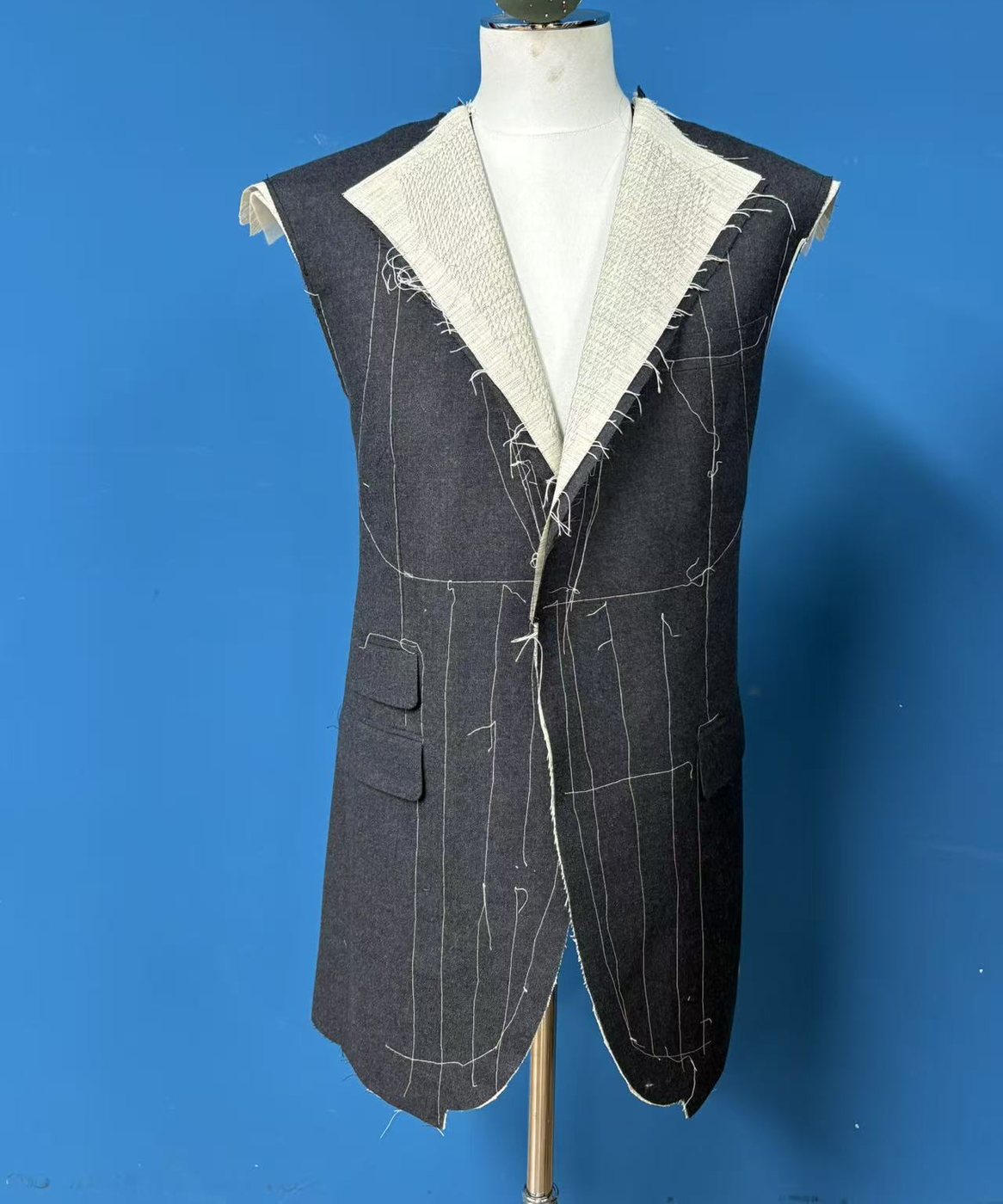
Machine padded: the same tension and spacing, every row identical to the one above it.
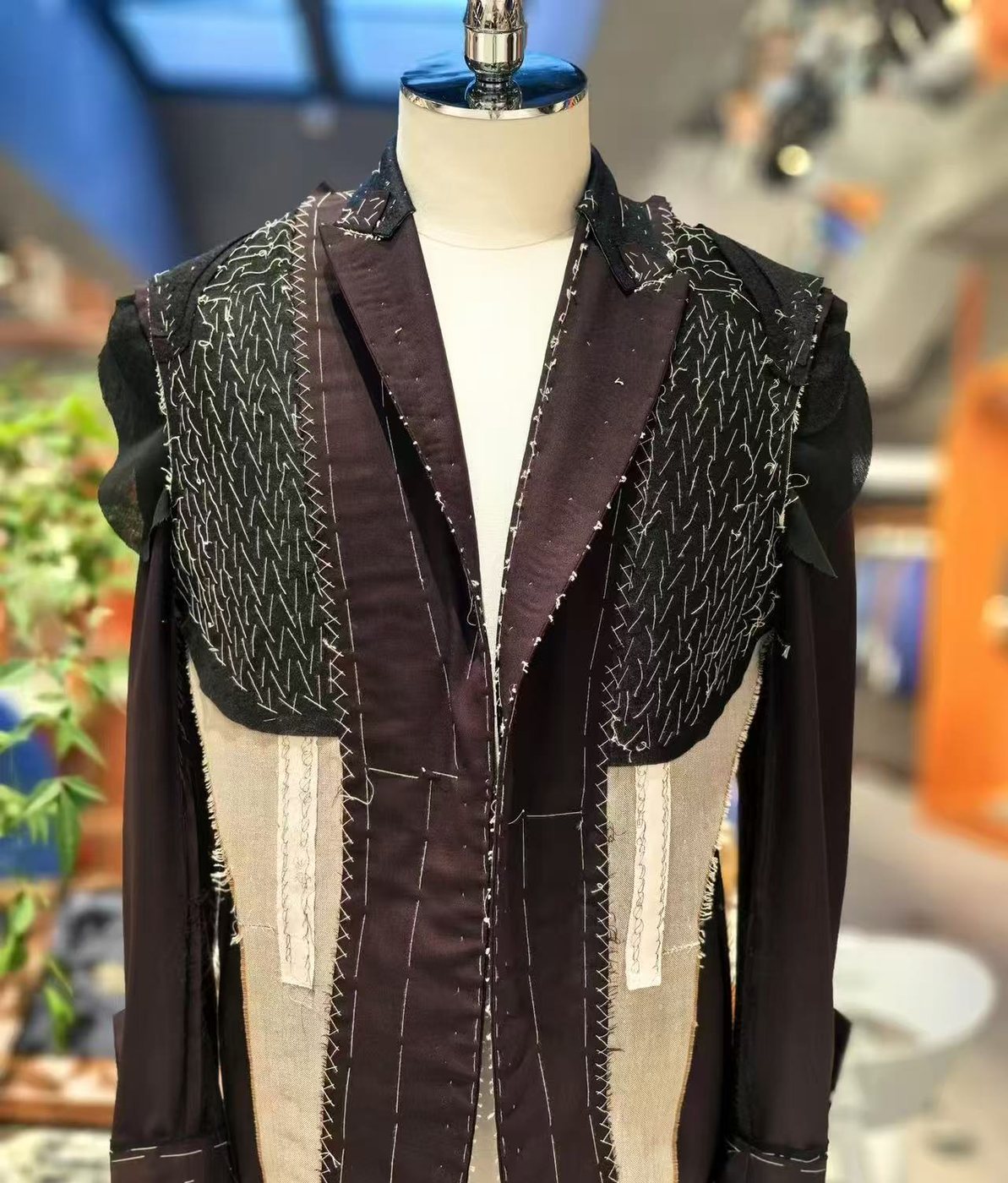
Hand padded: the rows wander, and the wandering is the point, since the tension is being changed on purpose rather than held steady.
That regularity, or the lack of it, is the only reliable tell, and it is the one we point buyers toward on our guide to full canvas, half canvas and fused construction, where the same two panels sit beside the earlier stage of the jacket. A flat hand tells most people very little; which way the stitches drift tells them almost everything, once someone has pointed at it.
Where it stops mattering
Below the chest line, canvas is not being shaped into anything. Its job there is to lie flat against the wool, not curve into the form the chest piece builds at the breast and lapel roll. A machine's fixed tension is the right tool down there, because there is no varying shape for a varying pull to build.
The back and the sleeves never enter this conversation at all. There is no chest-piece equivalent running through either one, so there is no padding stitch to be hand-done or machine-done. A supplier who tells you a jacket is hand padded throughout, including the back, is describing a garment we would not know how to cut, since the back of a jacket carries no canvas panel to pad.
Weight matters more than either of those. Canvas, however it is padded, only holds a shape the cloth underneath is heavy enough to support, and that is a narrower range than most price lists admit. 240 to 300 grams is where it earns its keep, and 597 of the 822 fabrics we carry with a weight tag sit inside that band. Push full canvas onto something lighter and the cloth settles back down within a season regardless of who padded it, so do not pay the hand-padding premium under that floor. The cloth was the limiting factor there, never the stitching.
Then there is the part a first-time buyer rarely hears from a shop: the shop's own pressing undoes some of this. Every steam press a jacket goes through after it leaves our workshop, in your shop or at a tailor's, flattens some of the shape hand padding spent hours building. Wool has memory and the canvas holds most of its form, so it is far from all of it, and how much goes depends on the press and the presser; I would not put a number on it. But a chest pressed hard and often reads flatter than the one that came off our table, and nobody selling the jacket tends to bring that up, since it is an awkward thing to say about your own showroom habits.
Which means most of the hand padding below the chest line is being paid for by someone who is never going to feel it, and some of what was built above it does not survive being ironed. Charge for the part that is real, and leave off the part that photographs well on a hang tag and fades the first time the jacket goes under a press.
Which panel, rather than whether
Stop asking a supplier if a jacket is hand padded. It is a yes-or-no question about something that is routinely both at once: the same front can run machine-padded through the body and hand-padded at the chest and lapel, so "yes" is true and "no" is also true, depending on which panel you are standing in front of. A supplier who answers "yes, hand padded" has not lied to you. They have answered a question that does not have the shape of a useful answer.
Ask instead which panels are hand and which are machine, and expect a reply as specific as chest and lapel by hand, body by machine. It is the same habit we have argued for on the cloth side, asking a mill for a bunch number instead of settling for "Italian wool". Construction works the same way cloth does: a word is not a specification, a panel is.
If you are building a price list from scratch, padding method belongs on the same short list as the rest of what is worth asking before you commit to a supplier or a construction ladder. Most shops write down canvas type and stop there. Write down padding method too, panel by panel.
What a full canvas quote tells you
A full-make two-piece in our cloth, fused, starts from USD 155 ex works Shanghai, or from USD 100 CMT with your own cloth. Full canvas is quoted by specification. Both the starting price and the full canvas quote describe canvas type. Neither one describes padding method, because our price list is built around what is floated inside the jacket, not around who stitched it there. A full canvas quote gets you into the full canvas tier. It does not tell you whether the chest in front of you was padded by machine, by hand, or by a mix of the two, and if nobody asks, nobody has to say.
Every jacket we quote, whichever tier, runs 14 days, and that number does not stretch to make room for a harder job. A machine panel that comes out wrong gets pulled off and rerun before the kettle has boiled. A hand panel that comes out wrong means a tailor sits back down and works the row over by hand, inside the same 14 days everything else is quoted on. Choose the harder tier and you have spent some of your own slack before the jacket leaves the cutting table, which is worth knowing before a rush order lands on it.
A buyer working through the kind of model behind the one number worth building a margin model on is going to want canvas and padding split into two line items rather than one, because the two carry different labour. We will split it if you ask. Most people do not, which is how two full canvas jackets with different chests inside them end up on the same price list at the same price.
This is also the argument for buying strangely small. Our minimum order is one piece per style, so you do not need a production run to find out which tier your own customers respond to. Cut two, same cloth, same block, one machine padded and one hand padded, and put them on your rail. Most of your customers will need to be shown where to feel it before they can feel it at all, which is normal and no failure of the pitch.
The sentence that doesn't hold up
A shop we know priced a jacket "fully hand padded, shoulder to hem" well above its half-canvas neighbour on the same rail. A customer who had clearly done some reading asked him to show her exactly where that money went below the third button. He had a good jacket in his hands. He did not have an answer, and by the time he found something to say, she had set the jacket down and moved to the next rail.
I do not think he was trying to mislead anyone. He almost certainly believed what he was told when he bought the stock, because nobody had ever shown him the difference between the two. His mistake was reselling a sentence he had never been asked to defend.
We are not neutral about this by accident. We cut fused, half canvas and full canvas ourselves, and within full canvas we pad by machine, by hand, or by a mix of the two, whichever a customer orders. Telling you that most of a jacket does not need the expensive version costs us nothing, since we sell all of it. That is the only reason this argument is worth listening to, rather than just another supplier insisting their own tier is the one to trust.
So, two refusals. I would not sell a jacket described as fully hand padded from shoulder to hem without being able to name the panels that earned the phrase, and neither should you. And I would not recommend paying a hand-padding premium on anything under about 240 grams, because the cloth gives up the shape before the stitching gets a real chance to hold it, whatever the hang tag says. A heavier cloth, an Australian merino at the top of our weight range or a European wool at the same mark, can carry that tier. A summer-weight cloth cannot, no matter who padded it.
Where we build both
We cut fused, half canvas and full canvas out of our own workshop in Shanghai, with our own tailors doing the padding by hand where a jacket calls for it and by machine where it does not. The two panels photographed above are ours, shot flat before the lining went in, not a supplier's marketing set. If you are adding made-to-measure behind an existing fitting room rather than building a line from nothing, padding method belongs in the same conversation as everything else in our guide to production for tailor shops.
Ask us which panels are hand and which are machine before you decide how to word your own price list. Or tell us what is currently on your price list and we will go through it with you, tier by tier, until you know what each line is charging for.
Frequently asked questions
Does hand-padded canvas feel different from machine-padded canvas?
At the chest and lapel, yes, once you know where to press. Most people cannot tell by running a flat hand across the front. They can tell by checking which way the padding stitches drift inside the canvas layer. Below the chest line, on the back, and on the sleeves, there is no reliable difference to feel, because those areas either do not need the canvas reshaped or do not carry a padded panel at all.
How can you tell if a jacket's canvas was padded by hand or by machine?
Open the front panel, before the lining goes in if you can, and look at the padding stitches rather than feeling for them. Machine stitching is small, even and identically spaced on every row. Hand stitching wanders slightly in spacing and angle, because the tailor is deliberately varying the tension row by row to build the chest and lapel shape. It takes a few seconds to see once someone shows you where to look.
Is it worth paying more for hand-padded canvas?
Only at the chest and lapel, and only on cloth heavy enough to hold the shape the padding builds, generally 240 grams and up. Hand padding below the chest line, on the back, or on a lighter cloth is mostly paying for something that was never going to be felt or held onto, whatever the price list implies.
Should a boutique sell a jacket labelled fully hand padded from shoulder to hem?
Only if you can say exactly which panels earned that description and can defend it to a customer who asks. A supplier who answers hand padded or not hand padded as a single yes or no has not told you anything usable. Ask for the answer panel by panel instead, chest and lapel separately from the rest of the jacket.
Does pressing or dry cleaning affect hand-padded shaping?
Some, over time. Repeated hard steam pressing flattens part of the shape hand padding builds into a chest, which is one more reason not to treat the technique as a permanent, one-time premium. It is something a jacket keeps losing a little of every time it goes under a hot press, not something it locks in forever at the moment it is made.