Journal Entry
Black Tie Orders Arrive in November and Panic in December
Black tie orders for a platform or a chain cluster into the same six weeks every year, and the panic that follows is almost always the same mistake: reading a working-day window as a calendar-day one. What the math actually says, and the cutoff calendar to set before November starts.
The message that started this one came in on a Tuesday in the second week of November, three lines long, from a buyer who runs corporate accounts for an online formalwear platform. Forty tuxedos, the invitation said December 12th, could we make it happen. I did the arithmetic on the spot rather than later, because the honest answer depends entirely on which Tuesday in November it is, and that Tuesday left twenty-three working days before the twelfth if every measurement and every fabric choice landed on our table that same afternoon. They did not. The first batch of confirmed measurements arrived four days after that message, which is the point the clock actually starts, and by then the honest answer had already changed.
Nobody on that account was careless. The invitations had gone out to their own clients only a week earlier, the clients had a week to reply, and forty tuxedos is not a small order to coordinate across that many people at once. The scramble was not a mistake anyone made. It was the shape the category takes every year, and it lands on our dispatch desk the same way each time: a wave of black tie orders in November, all chasing the same six weeks of December, most of them started later than the buyer thinks.
The six weeks nobody plans around
Corporate holiday parties, product launches, industry dinners: most of the black tie a platform or a chain sells in a given year clusters into the same stretch, roughly the middle of November through the last days of December. A wedding date gets set a year out and the order follows a long, calm lead time we wrote about separately. A holiday party gets confirmed on a company calendar in October or November, and the order behind it is reactive from the start, because the invitation and the deadline arrive together.
We see the same pattern on our side every year without fail. Requests for satin-faced lapels and evening construction climb sharply from the first week of November, cluster hard around orders that need to land in the first three weeks of December, and then drop off almost entirely the week before Christmas, because nobody is receiving parcels that week regardless of how fast we cut. That compression is not a planning failure on any single buyer's part. It is what the category does every year. What turns it into a scramble is treating "sometime in November" as one open date rather than a shrinking number of production slots, and not passing that shrinking number down to the person actually placing an order through your checkout or your order desk.
Working days are not calendar days, and this is where it goes wrong
Our own production for a made-to-measure tuxedo runs the same 14 to 20 working days as a suit, start to finish, counted from the moment an order is genuinely confirmed on our table. Twenty working days is four calendar weeks before anything leaves the workshop, not twenty days on a wall calendar, and that gap between the two numbers is the single most common reason a "November order" turns into a call asking whether December is still possible. Add whatever a courier needs on top of that, plus customs clearance on the receiving end, and a tuxedo confirmed in the third week of November sits closer to the edge of a mid-December event than most buyers assume when they first do the math in their head.
We laid this out in more detail, with the same working-day arithmetic applied to a suit, on how long does it take to make a suit, and the honest version repeats here without much change: the production window is one part of a longer chain, and quoting it to a customer as though it were the delivery date is where the promise breaks, not where the cutting does.
What "confirmed" actually means on a tuxedo order
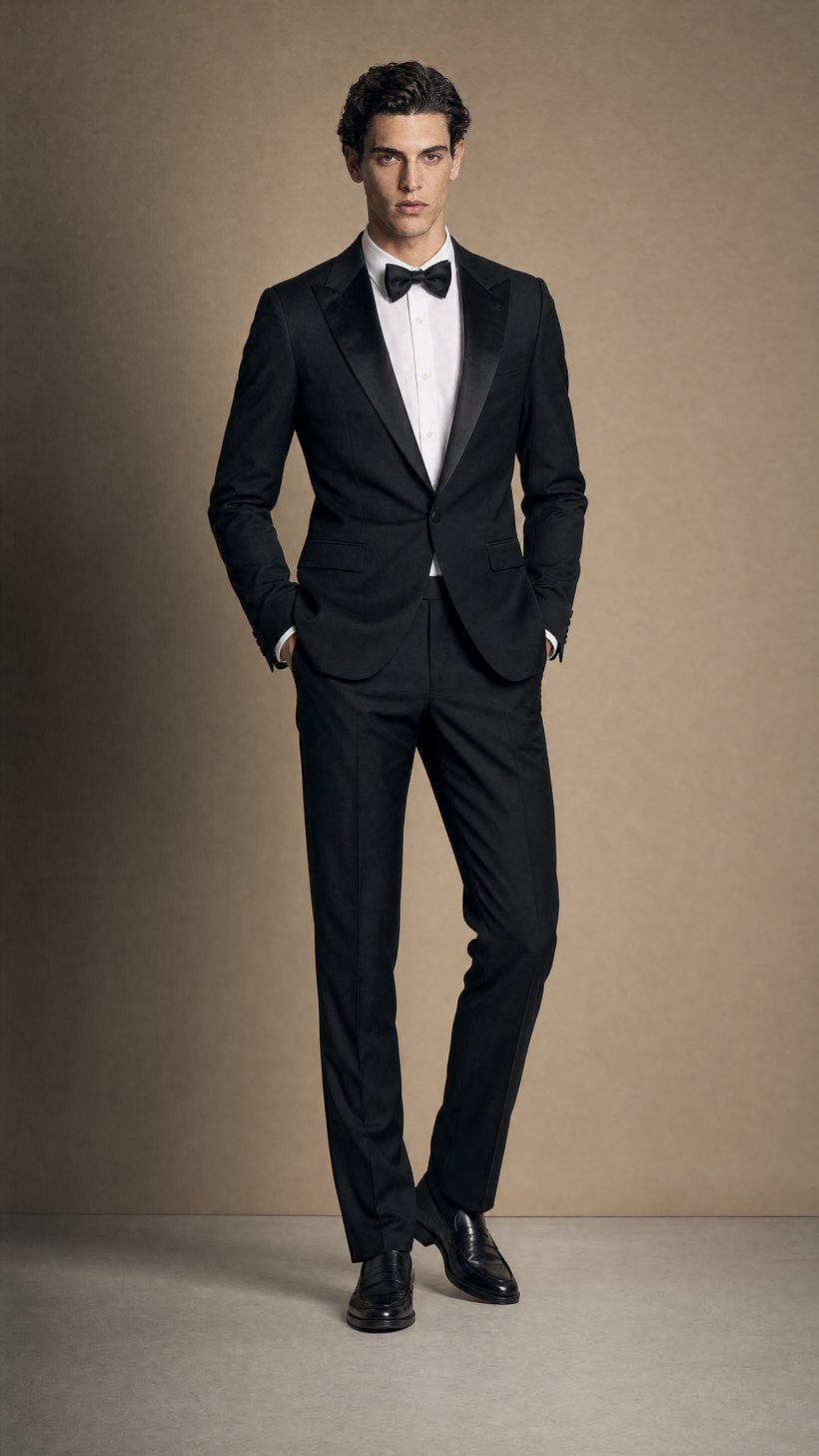
A confirmed order needs three things settled, not one. Measurements first, the same as any made-to-measure garment. Cloth second, checked against a bunch rather than a swatch photo, because a black cloth is not automatically the black cloth a customer picked from a screen. Third, and the one a checkout page can quietly skip past, the evening-wear construction itself: shawl lapel or peak, the silk facing rather than a self-faced lapel, the trouser braid, the button count.
None of those are suit defaults wearing a different label. They are the actual line between a tuxedo and a black suit, and we set them out in full, with the details that separate the two on the garment itself, on tuxedo vs suit. An order that arrives on our table with any one of those three still open has not started its clock yet, whatever date sits on the confirmation email a customer already received. On a forty-piece corporate order this matters more than it does on a single tuxedo, because one undecided lapel style at the top of the order can hold every jacket in the batch at the same starting line, not just the one it belongs to.
Rush buys a fixed date, not lost time back
Once an order is genuinely confirmed and the date is still tight, rush production exists for exactly this. We offer 5-day rush at a 50% surcharge and 3-day rush at a 70% surcharge across most collections, and it is worth being precise about what that buys. Rush compresses whatever production time remains after confirmation. It does not recover days that were already spent before confirmation happened, deciding on a lapel style or waiting on the last three measurement sheets in a forty-piece order. If two weeks passed between the first message and the last confirmed measurement, rush shortens what is left of the clock from that point forward. It cannot un-spend the two weeks that already went by.
That distinction is the one we make plainly when a date is genuinely too tight, rush included. We would rather say so at the point of confirmation than let an order sit in a queue on the promise that speed alone will close a gap that arithmetic already says it cannot.
The cutoff calendar worth setting before November starts
This is the list we would hand a platform or a chain before the season opens, not after the first panicked message arrives.
- A standard-production cutoff date, worked backward from your last acceptable delivery date: subtract 14 to 20 working days, then freight, then customs clearance, then a small buffer, and mark the date that falls out the other end.
- A 5-day rush cutoff, a later date than the one above, with the 50% surcharge shown to whoever is ordering before they commit, not discovered afterward.
- A 3-day rush cutoff, later still, with the 70% surcharge shown the same way.
- A date after which the answer is no. Decide it in writing before the season starts, so it is a policy your own team can quote calmly rather than a decision made live on a call with a customer already anxious about a date.
- One sentence for your own customers: the event date decides which line applies, standard or rush, and the order date only matters in relation to it.
A calendar built from that list before the first request lands is the difference between a scramble reaching our dispatch desk as an order we can plan around, and reaching us as a phone call asking whether forty jackets in three weeks is possible.
What this looks like from where we sit
We wrote a version of this same backward-planning logic for a chain staggering a year-end order across multiple stores and batches, where the discipline was counting the production window twice instead of once. Black tie season asks for the same discipline compressed into six weeks instead of a year-end programme, and it asks a platform or a chain to build the calendar itself, because unlike a wedding, which tends to book a season out on its own, a holiday party rarely gives anyone that kind of notice. We wrote about the wedding side of that same clock separately, in spring weddings booked months ahead, and the contrast is the point: one category books itself early, the other has to be planned around on purpose or it will not happen at all.
If you are already fielding November requests for a December date and are not sure which line they fall on, tell us the event dates and the volume and we will tell you plainly whether standard production, rush, or neither is the honest answer, before an order goes any further than that conversation.
Frequently asked questions
How many working days does a made-to-measure tuxedo take to produce?
The same 14 to 20 working days as a suit, from a confirmed order to a finished garment leaving our workshop. A tuxedo is not a faster or slower garment to cut and sew than a suit; the satin facing, the braid and the extra buttonhole work add detail, not days. Twenty working days is roughly four calendar weeks, not twenty days on a wall calendar, which is the gap that catches most buyers out.
When is it too late to order a standard-production tuxedo for a mid-December event?
Work backward from the event date rather than forward from today. Count 14 to 20 working days for production, then add however long freight and customs clearance actually take on your route, then add a buffer for any local finishing. If that arithmetic lands after the event date, standard production is already too tight, and the honest next question is whether rush closes the gap or whether the order needs to be declined.
Does rush production recover time that has already been lost?
No. Rush buys a fixed date, not lost days back. We offer 5-day rush at a 50% surcharge and 3-day rush at a 70% surcharge on most collections, and both compress whatever production time remains once an order is confirmed. If measurements and cloth were only settled two weeks after the order first landed on our table, rush shortens what is left of the clock. It does not un-spend the two weeks already gone.
What has to be locked before a tuxedo order's production clock actually starts?
Measurements, cloth, and the specific evening-wear construction choices: shawl or peak lapel, the silk facing, the trouser braid, the button count. These are not suit defaults with a different name; they are the details that separate a tuxedo from a black suit, and an order that arrives with any of them still open has not actually started, whatever the confirmation email says.
What should a platform or a chain tell its own customers about black tie order deadlines?
Quote the event date's real requirement, not the bare production window: production plus freight plus customs plus a buffer, with rush shown as a separate line and its own later cutoff. Set that calendar once before the season starts, so a customer ordering in the first week of December is told the truth about standard versus rush before they commit, rather than finding out three weeks later that the math no longer works.