Journal Entry
Groom in a Tux, Groomsmen in Suits: How a Shop Specs the Party
The most common mixed wedding party request a factory sees: groom in a tuxedo, groomsmen in suits. What a shop needs to decide before the spec sheet goes in, from lapel facing and cloth to the measurement deadline that actually matters.
The order came through as a single line: five suits, navy, wedding. I asked whether everyone was wearing the same thing. No. The groom wanted a tuxedo. The groomsmen wanted suits. The colour story from the bride's group chat was "the same family, not the same garment." A groom in tux and groomsmen in suits is the most common mixed wedding party request we cut now, and it is not harder than five identical suits. It is differently organised. The production runs the same 14 days from a confirmed order. The minimum is still one piece per style. What changes is what a shop has to decide before the spec sheet reaches us, because nobody in our workshop is going to guess which man gets the satin lapel and which gets the horn buttons.
What a groom in tux and groomsmen in suits changes on the spec sheet
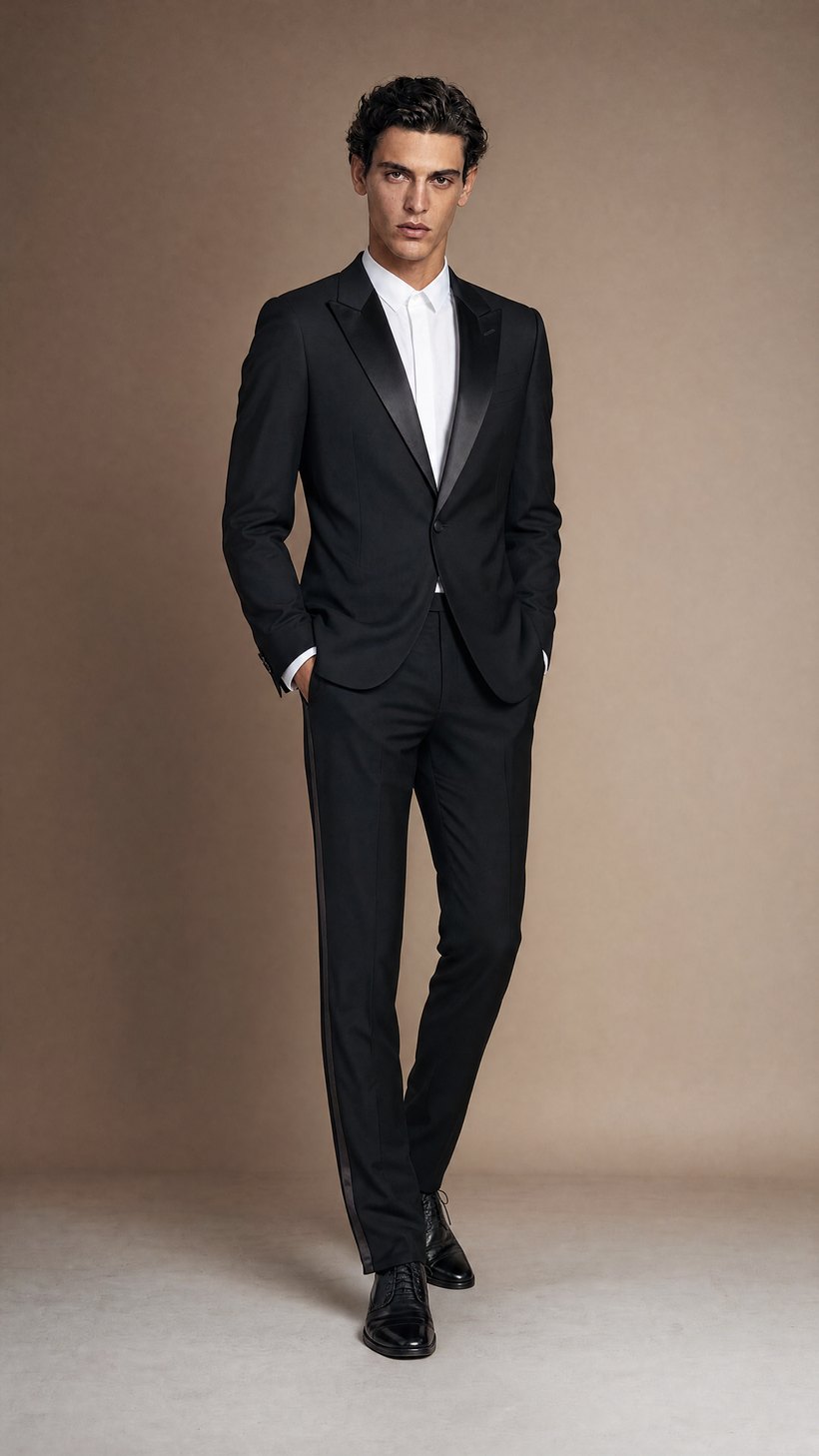
The difference between a tuxedo and a suit, from the factory side, is not a difference of formality. Both run through the same cutting table and the same 14 days. The difference sits in four spec fields that a shop needs to lock before anything is cut.
| Spec field | Tuxedo (groom) | Suit (groomsmen) |
|---|---|---|
| Lapel facing | Satin or grosgrain, on a peak or shawl lapel | Self-fabric, on a notch or peak |
| Buttons | Covered in matching satin or self-fabric | Horn, corozo, or uncovered |
| Trouser stripe | Satin braid along the outseam | None |
| Pocket style | Jetted, no flap | Jetted or flap, shop's choice |
None of these fields affect lead time. All of them need to be on the spec sheet before the order goes in. The mistake we see most often is a shop sending one spec for "the wedding party" and assuming the factory knows which man gets which detail. We do not assume. If the spec sheet says peak lapel with satin facing, every jacket in the order gets peak lapel with satin facing.
A shop that takes custom wedding suits for men regularly will already have a default party template. A shop handling its first mixed order needs to write two separate specs and label them.
Cloth and colour: keeping two garment types in the same family
The question most couples bring to a shop is whether the groom's tuxedo and the groomsmen's suits should come from the same bolt or not. Both answers work. What does not work is leaving it undecided.
Same cloth, different details. A navy wool in the 260 to 280 gram range works for both garment types. The groom's tuxedo gets satin-faced lapels, covered buttons and a trouser braid. The groomsmen's suits get self-fabric lapels, horn buttons and no braid. The formality separation comes entirely from the trim. This is the simplest version for a shop to spec, because one fabric reference covers the whole party and dye-lot consistency is guaranteed across every piece.
Same colour family, different cloths. The groom wears a darker navy or midnight barathea with a matte finish, while the groomsmen wear a mid-navy worsted. The colour family reads as shared but the textures differ, which looks deliberate under evening light. The risk is that two different fabric references from two different mills may not sit in the same shade of navy once they are cut and pressed. Order swatches of both and check them side by side under warm light before committing the party.
Either way, the cloth decision starts with the groom. His tuxedo is the anchor. The groomsmen's suits are built outward from that reference, not the other way around. Of the fabrics we hold in Shanghai, the Zegna Trofeo at 240 grams and Traveller at 250 grams (162 styles between them) and Vitale Barberis Canonico Four Seasons at 280 grams (40 styles) ship without an ordering delay. Everything else from our 33 mills and cloth merchants, 26 of them in Europe, is ordered in against the confirmed order and adds the mill's own lead time on top.
Groom and groomsmen suit ideas that start at the fabric rack
Wedding styling guides this season describe the dominant trend as coordination, not matching. The Groom's Room Essex notes that grooms are separating from their party through garment type, construction or a waistcoat rather than a different colour. That trend is practical for a shop, because it turns a mood board into factory-ready decisions.
- Groom in a tux, groomsmen in two-piece suits. The cleanest separation. Same cloth family, different garment type entirely. Spec the tux with a shawl or peak lapel, the suits with a notch.
- Groom in a three-piece, groomsmen in two-piece. Same cloth, same lapel, but the groom wears a waistcoat that sets him apart. We wrote about the fit risk of that third piece in the waistcoat gap.
- Groom in a darker shade, groomsmen in a lighter one. Midnight navy against mid-blue, or charcoal against mid-grey. Two fabric references, same construction.
- Groom in a double-breasted jacket, groomsmen in single-breasted. Same cloth, same colour, different silhouette. The double-breasted guide covers the four numbers that change.
All four work as a single factory order. None requires anything outside a standard spec sheet.
The shop's measurement and delivery checklist
A mixed wedding party order fails more often in scheduling than in cutting. The groom shows up to be measured first. The groomsmen follow weeks later, sometimes one at a time. The cloth arrives before the last groomsman does. Here is what a shop should lock before placing the order.
- Two spec sheets, not one. One for the tuxedo, one for the suits. Label each with the garment type, lapel style, facing, button type, pocket style and trouser details.
- One cloth decision for the whole party. Same bolt or same colour family, decided with swatches, before anyone is measured.
- Every man measured individually. Against the full field list. Our system runs 47 measurement fields, 31 required. Do not adjust a groomsman's measurements from the groom's sheet. Every tape session is independent.
- A measurement deadline. Set one, and tell the couple it is real. Production does not start until all measurements are confirmed. A party of five where one man has not been measured is a party of four with a stalled order, unless the shop decides to split the delivery.
- Decide on split or single delivery. We can ship each piece as it is ready (one-piece minimum means every suit is its own order if needed) or hold everything and ship together. Single delivery means the couple sees the full party at once. Split delivery means the groom's tux can arrive for an early fitting while the last groomsman finishes his measurements. Choose before the order goes in.
- Construction per garment type. The groom's tuxedo does not have to match the groomsmen's construction. A full canvas tux with half canvas suits is a common and sensible split. Our full canvas vs half canvas vs fused guide shows the difference with photographs of our own fronts.
- Timeline. Production runs 14 days from a confirmed order, shipping extra. Work backwards from the wedding date: shipping, one fitting appointment, one round of minor alterations if needed, and a buffer week. The measurement coordination on the shop's side typically takes longer than anything on ours.
For shops running this kind of order regularly, the step-by-step guide to group suit orders for tailor shops breaks the logistics into a repeatable process. Shops stocking a display tuxedo for walk-in fittings can explore wholesale tuxedos as a showroom starting point.
Before the couple's date is on the calendar, your spec sheet should be
A mixed wedding party order is not a complicated order. It is a clearly specified one. Two spec sheets, one cloth decision, five independent measurement sessions and a delivery plan. Everything else is production, and production is 14 days.
See prices and your margin, 3 min, or tell us what the party looks like and we will send back two specs with cloth recommendations before anything is cut.
Frequently asked questions
Can the groom's tuxedo and the groomsmen's suits be made from the same cloth?
Yes. A navy wool in the 260 to 280 gram range works for both a tuxedo and a suit. The groom gets satin-faced lapels, covered buttons and a trouser braid. The groomsmen get self-fabric lapels, horn buttons and no braid. The cloth is identical and dye-lot consistency is guaranteed. The formality separation comes entirely from the trim, not from the fabric.
What is the minimum order for a wedding party with one tuxedo and four suits?
One piece per style. Each man's garment is its own order. A shop can place the groom's tuxedo first to confirm the cloth and construction, then add the groomsmen's suits once all measurements are in. There is no batch minimum and no surcharge for ordering one at a time.
Should the groom's tuxedo and the groomsmen's suits use the same construction?
They do not have to. A full canvas tuxedo with half canvas suits is a common and sensible split. The anchor garment gets the heavier structure, the supporting suits get a lighter build at a lower price point. Both constructions run through the same 14 days in production.
How far ahead should a shop order a mixed tuxedo and suit wedding party?
Work backwards from the wedding date. Production runs 14 days from a confirmed order, shipping extra. Add the time for every man to be measured, one fitting appointment, and a buffer for alterations. The measurement coordination on the shop's side usually takes longer than anything on the factory side. Three to four months from first consultation to wedding day is a safe window.
What happens if one groomsman's measurements arrive weeks after the others?
The order does not have to wait. With a one-piece minimum, a shop can send the first four garments into production and add the fifth as a separate order when the measurements are ready. The cloth reference stays the same. The late groomsman's suit runs through the same 14 days as the rest.