Journal Entry
Wide Trousers Are a Rise Decision First
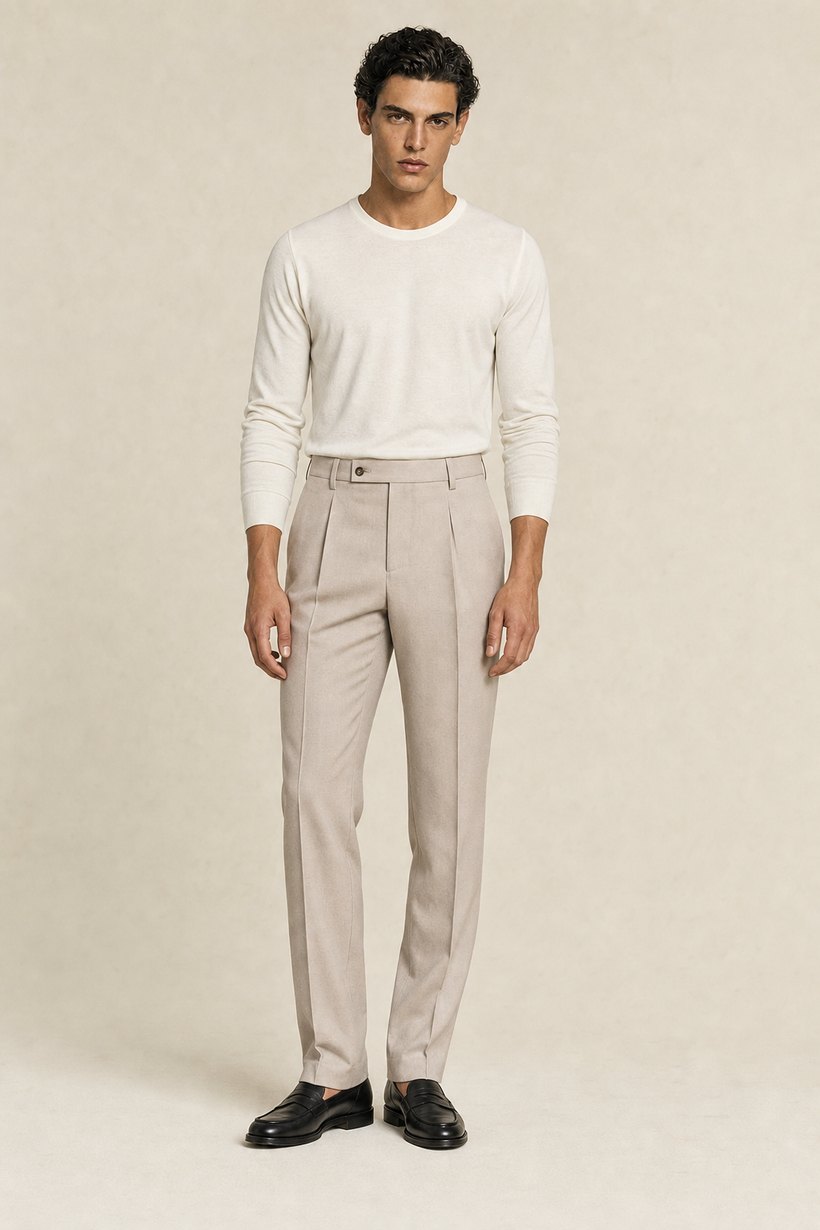
Wide-leg trousers are back on the order sheets, and most buyers spec the change as a bigger leg opening. On our cutting table it is a rise decision first. What the pattern actually needs, and the field online forms leave out.
A shop we work with sent through a repeat order last month, same customer, same style he had ordered twice before, one change requested: make the leg wider this time, everyone's wearing it fuller now. The measurements that came with it were the old set, untouched, with a note in the leg opening field bumped up by three centimetres. Nothing else moved. The trousers went out on schedule, and two weeks later a photo came back showing exactly what you would expect: a wide leg swinging from a waistband still sitting where a slim trouser sits, the extra cloth pooling at the front instead of falling straight, the whole thing reading as a mistake rather than a look. The leg opening was right. The rise never got touched, and the rise was the actual decision.
This is not a rare mistake. It is the mistake, and it happens because a wide leg looks like a leg-opening change from across a shop floor, in the same way a relaxed jacket looks like a shoulder change from across the same floor. Neither is true. What decides whether a fuller trouser hangs the way the reference photo hung is where it starts, not how wide it gets by the time it reaches the ankle.
What "wide" changes, and what it does not
Lay a current slim block next to a genuinely wide one and the leg opening is the difference everyone names first, because it is the number that is easiest to point at. It is also the smallest part of the actual pattern change.
The rise is where the real work happens. Total rise, the trouser field labelled u_crotch on our own form, sets the length of the whole seam from waistband to crotch along the seat. Front rise is a separate measurement, and together the two decide where the waistband sits on the body and how much drop there is before the leg proper begins. A wide leg needs more room to fall cleanly through that drop, which means the rise usually needs to move too, not stay pinned to whatever a slimmer block used.
The thigh and knee open in proportion to the leg opening, carried on a straighter line rather than tapering hard from hip to hem. None of that is visible from a leg opening number on its own, and none of it is optional if the goal is a trouser that hangs the way the photo showed rather than one that has simply been let out.
Our own fit guide puts trousers last in the checking order for a reason: the waistband should hold without a belt, the front should sit clean with no horizontal pull, and there should be one soft break where the hem meets the shoe. All three of those checks are rise checks before they are width checks. A wide leg with the wrong rise fails every one of them, no matter how correct the leg opening is.
Where the online form loses the rise
Here is the part worth saying plainly, because it is the gap that turns up on our cutting table more than any other on a wide-leg order.
Most intake forms, ours included when a shop is filling one out fast, put waist and inseam front and centre and treat total rise and front rise as fields to fill in later, or to leave at a default because nobody thinks to ask what they change. That works fine on a slim, current block, where the rise sits inside a narrow range and small drift gets absorbed by the fit. It stops working the moment a customer asks for a fuller leg, because the rise is now doing more visible work than it was before, and a defaulted number is no longer a safe guess.
Our own trouser measurements run to nine fields: waist, hip, total rise, front rise, thigh, knee, calf, leg opening and trouser length, out of 47 fields across a full order, 31 of them required. Total rise and front rise are two of the nine, and on a wide-leg spec they carry more of the outcome than any other field on that list bar the waist itself. Leave them at whatever a previous, slimmer order used, and the extra cloth in the leg has nowhere correct to hang from.
We wrote up the full field list, and which fields are forgiving and which are not, in how to measure someone for a suit. The short version for a wide-leg order: leg opening and trouser length are the easy ones, recoverable with a local alteration if they land slightly off. Total rise and front rise sit in the harder middle, expensive but fixable rather than a quick fix, because correcting them means opening the crotch seam and reworking the front rather than moving a hem. Spec them properly before the cloth is cut, and there is nothing to fix at all.
The cloth has to hold the fall
Take the taper out of a trouser leg and the fabric is what is left to keep the line from collapsing into a bag of cloth around the ankle. This is the same principle we wrote about for soft-shouldered jackets earlier this season: structure and cloth trade off against each other, and a wide leg asks more of the cloth precisely because it is asking less of the seams.
Most of our business trousers sit in the same 240 to 300 gram range we hold for jackets. Of the 822 fabrics we carry with a stated weight, 597 sit in that band, out of a wider range running from 98 grams up to 440. A wide leg cut from cloth in that band falls straight and recovers its line after the wearer sits down. The same cut in something noticeably lighter tends to crease at the knee and cling rather than drape, which reads as cheap on a garment that was ordered specifically to look easy.
Trouser lining plays a smaller but real part here too. Our trousers are lined to the knee as standard, not fully lined, which is worth knowing before a shop assumes the fuller cut needs more lining rather than less. A knee lining gives the top of the leg a clean line over the seat and thigh while leaving the lower leg, where the extra volume of a wide cut actually falls, free to move with the cloth rather than against a second layer. We go through the three separate lining decisions, body, sleeve and trouser, on our suit lining guide, and the trouser section there is worth reading before a shop promises a customer something our own production does not offer.
What to put on the spec sheet for a wide-leg order
If a customer or a client brand asks for the fuller leg, this is what should reach the factory, in this order, rather than a leg opening number and a note to leave everything else the same.
- Total rise, stated as its own number, not carried over from a slimmer block.
- Front rise, separate from total rise, because the two together decide where the waistband actually sits.
- Seat and hip, checked rather than assumed, since a wider leg without enough room through the seat will pull horizontally no matter how open the hem is.
- Thigh and knee, opened in proportion to the leg opening rather than left narrow above a wide hem.
- Leg opening, the number everyone already sends, now correctly the smallest decision on the list.
- Break preference, since a wider leg pools differently at the shoe than a slim one and the usual one-soft-break default may need saying out loud.
- Cloth weight, ideally in the 240 to 300 gram band, with the bunch number attached rather than a colour name.
Send that set and the trousers in your reorder will match the ones in the photo. Send a leg opening change on top of an old spec sheet and you will get exactly what that shop got: a wide leg hanging from the wrong point.
What it costs to get right the first time
Nothing extra, and that is the part worth repeating to a buyer who assumes a bigger pattern change means a bigger invoice. Our production runs 14 days from a confirmed order to shipment, wide leg or slim, from a one-piece minimum. A rise correction taken properly on the spec sheet costs nothing beyond the two extra fields it asks a fitter to fill in. The same correction taken after the fact, as an alteration on a finished pair, means unpicking the crotch seam, which is a real repair rather than a hem adjustment, and it is a repair with a limited amount of fabric to work with either way.
If a shop is moving a customer or a whole line from a slim block into a wider one this season, the sensible order is one piece in the new spec, checked against a proper rise and against the relaxed tailoring notes we put together for the jacket side of the same shift, before fifty pairs go into production on the strength of a leg opening number alone. Send us the spec sheet and we will tell you before the cutting table does whether the rise is doing what the width needs it to do.
Frequently asked questions
What does 'wide' actually mean on a trouser pattern?
It means more room in the leg opening, thigh and knee, carried on a straighter line down from the seat. On its own that is a small pattern change. The change that decides whether the trouser reads as wide and easy or wide and wrong is the rise, both total rise and front rise, because that is what sets how much fabric hangs from the waistband before the leg even begins.
Do wide-leg trousers need different measurements than a slim pair?
The same nine fields exist on both: waist, hip, total rise, front rise, thigh, knee, calf, leg opening and trouser length. What changes is which ones matter. On a slim trouser, leg opening does most of the work. On a wide one, total rise and front rise decide whether the extra cloth falls from the right point or bunches at a waistband that is sitting wherever a default put it.
What happens if the rise is wrong on a wide-leg order?
The waistband sits at the wrong point on the body, and a wide leg makes that far more visible than a slim one does, because there is more fabric hanging from the mistake. Too short a rise pulls the crotch seam up and drags the extra volume into a bunch at the front. Too long a rise drops the whole leg lower than the wearer expects, and the break stacks in folds nobody asked for.
Can a tailor fix the rise after the trousers are made?
Only within a small margin. Total rise and front rise sit in the middle of our own cost table, expensive but fixable rather than a straightforward alteration, because moving them means unpicking the crotch seam and reworking the front, not simply taking in a side seam. It is a real repair, not a hem. Getting the rise right on the spec sheet costs nothing. Fixing it afterwards costs a seam that was never meant to move.
Do wide-leg trousers need a heavier cloth?
Usually yes, for the same reason a soft, unstructured jacket does. Take the tailoring out of a garment's silhouette and the cloth is what is left to hold the line. Most of our business cloth sits in a 240 to 300 gram band, and a fuller leg in that range falls clean and recovers after sitting. The same cut in something under 200 grams tends to crease and cling rather than drape.