Journal Entry
Grey, Navy or Brown Groomsmen Suits: Which Cloth a Shop Should Offer
A tailor shop filling a groomsmen order has to choose a colour before anything else, and the colour decides the cloth. Grey, navy blue and brown compared from the fabric rack, with the weights and weaves that work, the seasons each colour belongs to, and how to keep six men in the same shade.
The message came through on a Monday. Six groomsmen, outdoor wedding, late September. What colour? I asked what the bride's side was wearing. She sent a palette board with four shades of eucalyptus. That told me everything about the flowers and nothing about the suits. I asked the question a different way: does the groom want to stand out from his men, or blend in? Stand out. Then the groomsmen need one colour and he needs another. Which one for the six? Grey. She said it like the question had already been settled, but grey is three conversations, not one. Grey groomsmen suits are the second most common wedding party order we cut, behind navy, and the part that stalls every time is not the colour itself but which grey, in which weight, in which weave.
The same conversation plays out in navy and in brown. A shop that sells custom wedding suits for men has to answer the colour question before anything else reaches the factory, because the colour is what decides the fabric, and the fabric is what decides the season, the construction and whether six men can all end up in the same shade.
Grey groomsmen suits: three shades and what the cloth needs to do
Grey splits into three useful categories at the fabric rack, and they are not interchangeable.
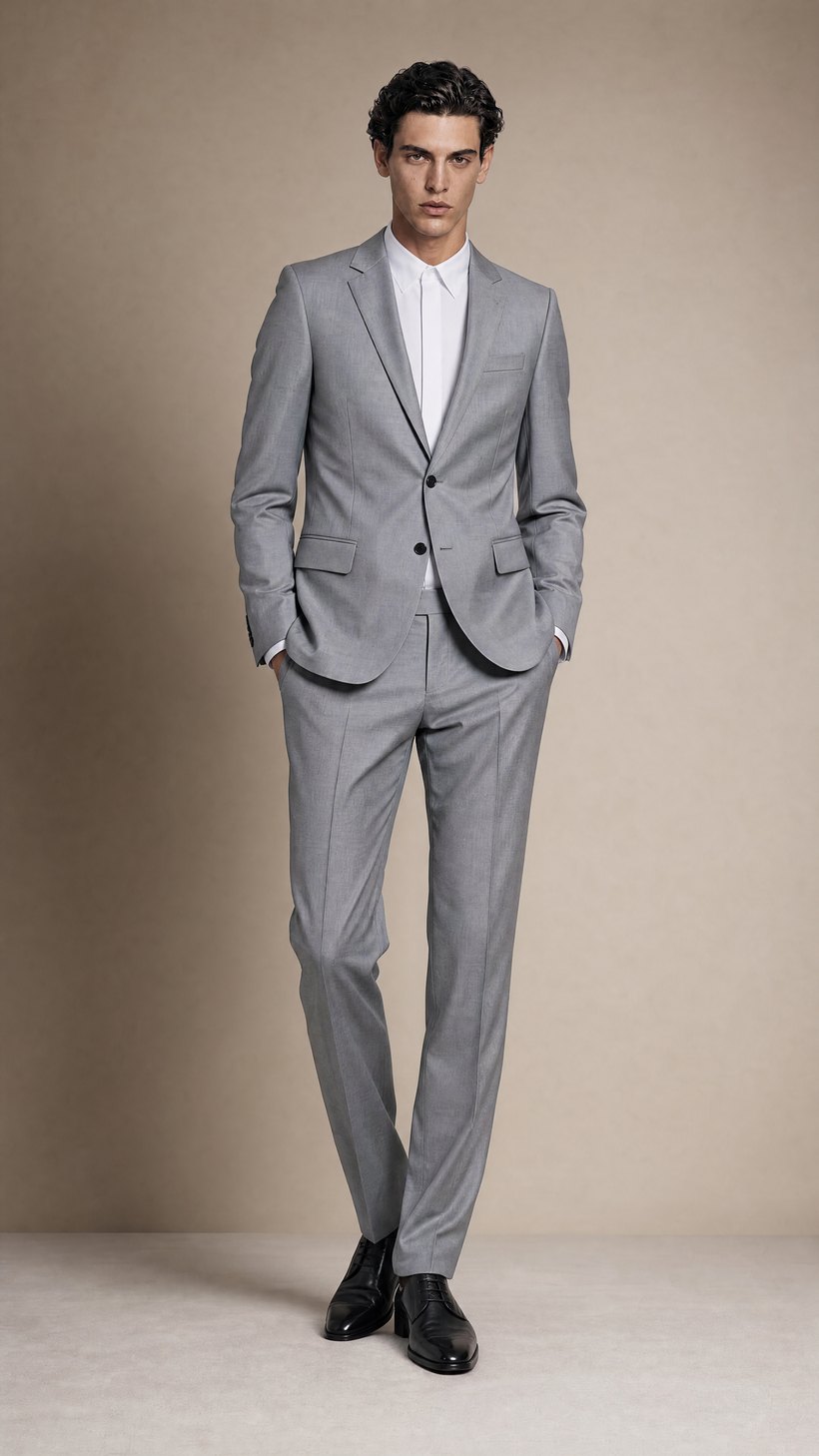
Light grey (silver to pale ash): photographs well outdoors in flat light, reads formal against a white shirt and pale tie, and creases visibly by the second hour. It is a spring and summer cloth. Below 240 grams it looks paper-thin under direct sun. In the 240 to 260 gram band it holds up. A hopsack or open weave works better than a flat worsted here, because the texture breaks up the surface and hides the first wrinkle.
Mid grey: the safest single recommendation a shop can make. It handles indoor and outdoor light equally well, pairs with every shirt colour a groomsman is likely to own, and still separates the party from the groom if he wears charcoal or navy. In a plain weave worsted at 260 to 280 grams it travels well, sits well and photographs well. Of the 822 fabrics we carry with a stated weight, 597 sit in the 240 to 300 gram band. Mid grey in that range is where most of our wedding party orders land.
Charcoal: reads as a winter colour. It absorbs light rather than reflecting it and needs a heavier cloth to match the tone. A charcoal flannel at 280 to 300 grams is a strong autumn or winter groomsmen suit. Push it into a July garden party and it will look as if the men came from a different event.
| Shade | Season | Weight range | Best weave | Risk |
|---|---|---|---|---|
| Light grey | Spring, summer | 240 to 260 g | Hopsack, open weave | Creases fast, washes out in direct sun |
| Mid grey | Year round | 260 to 280 g | Plain worsted, twill | None serious; can read generic |
| Charcoal | Autumn, winter | 280 to 300 g | Flannel, herringbone | Too dark for summer, absorbs heat |
A shop stocking one grey for wedding parties should stock mid grey. A shop running all three should talk the couple through the season before pulling a swatch.
Navy blue groomsmen suits: the default and its one risk
Navy is the volume colour. It works indoors and outdoors, in daylight and under evening lights, in every season, with every skin tone. A mid navy worsted in the 260 to 280 gram band is the closest thing to a universal groomsmen suit, and it is the colour that Paperlust's 2026 groom styling guide still names as the most popular choice for coordinated parties.
The risk is not in the cloth. It is in the photographs. Navy is so common that a wedding party can look indistinguishable from every other group in the album. That is not a factory problem, but it is a conversation a shop should have before the order goes in.
If the groom wants to separate from his men, a darker shade of navy or a midnight worsted works well as the anchor garment. The groomsmen stay in mid navy. The colour family reads as shared but the groom stands forward in the group shots. We covered this same-family-different-garment approach in the groom in tux, groomsmen in suits guide.
Blue groomsmen suits outside the navy range, mid blue or powder blue, are a different conversation. They read as more casual, need a lighter weight in the 240 to 260 gram range, and require more careful handling of the tie and shirt to avoid looking like a uniform from a rental fleet. A shop should keep those as a second recommendation after the couple has already decided against navy, not as a first suggestion.
Brown groomsmen suits: the seasonal question
Brown is the colour that demands the most from the cloth. In a flat worsted it can look dull. In a flannel or a textured weave it comes alive, because the surface catches light at different angles and the colour shifts rather than sitting flat. Suitablee's 2026 groomsmen guide notes that earth tones are gaining ground across outdoor and autumn weddings, and what we see on the cutting table confirms it: brown is no longer an outlier for groomsmen.
The shade range is wide. Tobacco brown, chocolate, tan, and camel all land under the same colour name and produce entirely different results.
- Tobacco and chocolate (deeper browns): suit autumn and winter. Flannel at 270 to 300 grams, herringbone or plain. These hold their colour under warm and low light.
- Tan and camel (lighter browns): suit spring and summer. A hopsack or linen blend at 240 to 260 grams. These need careful pressing because the lighter the shade, the faster a wrinkle shows.
The construction split matters here too. A half canvas build gives a brown jacket enough structure to hold a clean line without looking stiff, which is the right balance for a celebration. Our suit fabric guide maps weight ranges to construction recommendations across every colour, and the same logic applies to a wedding party of six as to a single client order.
How six men end up in the same colour
This is where the factory side of the conversation starts. A shop can choose the right colour, the right shade and the right weight, and still end up with six suits that do not match if the fabric sourcing is wrong.
The rule is simple: one fabric reference across the whole party. One reference means one mill, one dye lot, one shade. Every piece cut from that reference will match. The risk appears the moment a shop splits the order across two references. Two different fabrics in what looks like the same colour on a swatch card can diverge once the cloth is cut, pressed and sewn, because each mill's dye process has its own character. A mid grey from one mill and a mid grey from another may sit a full shade apart under evening light.
What to check before committing a party to a colour:
- Confirm one fabric reference for all six suits. Write the reference number on the spec sheet for every man.
- If two references are being considered in the same colour from different mills, order swatches of both and check them side by side under warm light, not under a shop's fluorescents and not from a screen photograph.
- Decide whether the groom will wear the same reference as the groomsmen or a different one. If different, accept the shade gap as deliberate and style around it.
- Set a measurement deadline for the party. Production runs 14 days from a confirmed order, shipping extra. With a one-piece minimum, a late groomsman can be sent as a separate order and still match the others, because the reference stays the same. But the shop needs every man measured before the couple's timeline runs out.
- If a held fabric removes a scheduling risk, use it. Of the fabrics we hold in Shanghai, the Zegna Trofeo at 240 grams and Traveller at 250 grams (162 styles between them) and Vitale Barberis Canonico Four Seasons at 280 grams (40 styles) ship without an ordering delay. Everything else from our 33 mills and cloth merchants, 26 of them in Europe, is ordered in against a confirmed order and adds the mill's own lead time on top.
Before the colour goes on the mood board
A groomsmen colour is a cloth decision first and a styling decision second. Grey, navy or brown each work, but each asks for a different weight, a different weave and in some cases a different season. The part a shop can control completely is the dye lot: one reference, one shade, six suits that match.
See prices and your margin, 3 min, or tell us what colour the party is wearing and we will pull the references and weights before anything is cut.
Frequently asked questions
Which grey works best for groomsmen suits at a spring or summer wedding?
A mid grey in a plain weave worsted, 240 to 260 grams, reads clean in daylight and photographs well against white shirts. Light grey is harder to control: it shows creasing faster and can wash out in bright sun. Charcoal suits a winter wedding better than a summer one. If a shop can recommend only one grey for spring and summer, mid grey is the shade to stock.
Can navy blue groomsmen suits work year round?
Yes. A plain navy worsted in the 260 to 280 gram range covers every season. It handles indoor and outdoor light equally well, and it is the one colour a shop can recommend without asking about the venue first. The risk is that every other wedding party may choose the same colour, so the group does not stand out in the photographs.
What fabric weight should brown groomsmen suits be?
For autumn and winter, 270 to 300 grams in a flannel or textured weave. For a summer outdoor wedding, 240 to 260 grams in a plain weave or hopsack. Brown below 240 grams reads thin rather than warm, and above 300 grams it gets heavy for a celebration. The surface of the cloth matters more in brown than in grey or navy, because brown lives or dies on texture.
How do you guarantee that six groomsmen suits are the same shade?
Cut all six from the same fabric reference. One reference means one dye lot, so shade consistency is guaranteed across every piece. The risk appears when a shop uses two different fabric references in a similar colour from two different mills. The shade may look identical on a swatch card and diverge once the cloth is cut and pressed. Order swatches of both and check them side by side under warm light before committing the group.
Can one groomsman order weeks after the others and still match?
Yes. With a one-piece minimum, a shop can send five suits into production and add the sixth as a separate order when his measurements arrive. The fabric reference stays the same. Production runs 14 days from a confirmed order, shipping extra. As long as the late order names the same reference, the cloth comes from the same mill and the dye lot match holds.