Journal Entry
Private Label vs White Label vs OEM: Nobody Asks Who Owns the Pattern
Private label, white label, OEM and CMT get used loosely enough to mean whatever a factory needs them to mean that day. Here is what each one actually implies, and the one question about who owns your pattern that decides more than any of the four words do.
I took a call in March from a brand owner with three years of orders behind him. He wanted a second factory, partly for capacity, partly to test whether his numbers held up anywhere else, and sent his measurement sheet asking us to match what he already had, exactly.
The jacket arrived close enough that a stranger would not have noticed, and different enough that he did the moment he tried it on next to the one he already owned. Same navy, same lapel width, same buttons, the shoulder sitting differently by what looked like a centimetre. He sent me a photo of both jackets on the same hanger. Every measurement matched. What did not match was the pattern underneath the numbers, the block his original maker had built around his body over three years of small corrections that never made it onto any spec sheet.
He was comparing two different patterns wearing the same measurements as a disguise. That is the part almost nobody asks about when sorting private label from white label from OEM from CMT. Price gets asked about, so does turnaround, so does minimum order. The question that decides what happens the day you want to leave rarely does.
Every factory says yes
Ask ten factories whether they do private label and ten will say yes. Ask about OEM, white label, CMT, same answer every time. The four words describe different things in principle. In practice every maker uses them however suits that week's pitch, so the question tells you nothing about the factory, only how badly it wants the order.
Here is what the words mean.
| Who designs it | Whose name is on it | Who usually keeps the pattern | Best when | |
|---|---|---|---|---|
| White label | Factory, already made | Yours | The factory, always | Fast launch |
| Private label | Built to your spec | Yours, exclusively | Factory's house block, adjusted for you | A real brand, no pattern engineering |
| OEM | You, finished design | Yours | Depends on the contract | You have a design already |
| CMT | You (design and cloth) | Yours | You, since you supplied it | You buy cloth well already |
Look at the third column. It is the one that changes hands, and almost nobody negotiates it before signing anything. Getting the rest of the vocabulary straight first matters too, but this piece is about the column the glossary skips.
Whose pattern is this?
A pattern, sometimes called a block, is the shape a factory cuts every piece of your garment from. It is not your measurements. Measurements describe a body, and a pattern describes the shape that factory has decided fits that body well, refined over as many fittings as it took.
Most private label and OEM work happens on the factory's own house pattern, adjusted to you, rather than a pattern you separately own and could hand to a competitor tomorrow. There is no trick in that. Building a pattern from zero for every new brand would be slow and expensive for everyone. But the intelligence built up over your first year, the correction that fixed the shoulder, the adjustment nobody wrote down because it just became how your jackets are cut, lives inside the factory's pattern library, not in a file you hold.
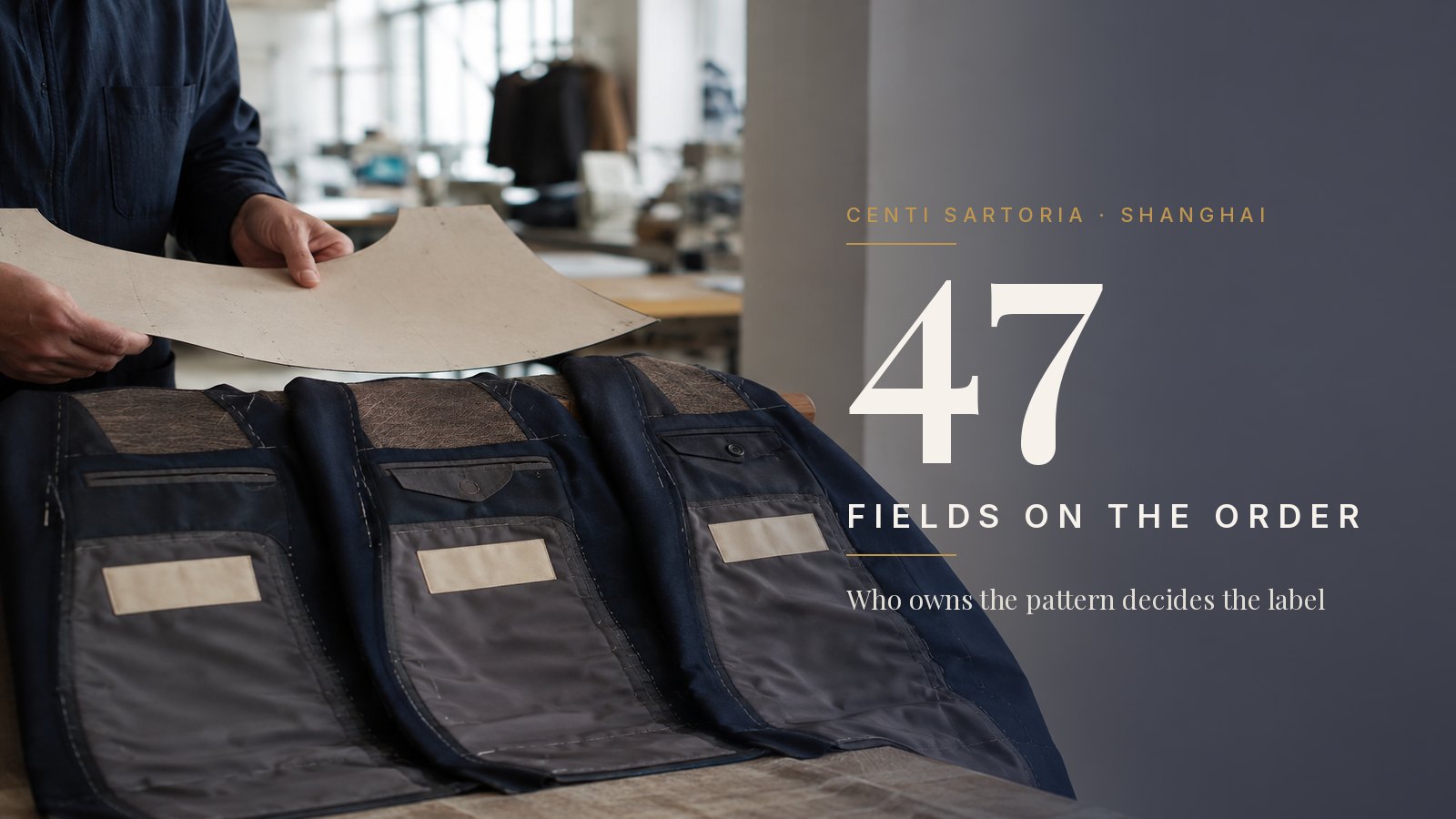
Our own measurement sheet asks for 47 fields, from chest and waist to shoulder, sleeve length and neck. Those numbers describe a body precisely. They do not describe the fourth fitting, the one where a pattern maker moved a shoulder seam a centimetre and never touched it again because it was right. That decision lives in the block, and the block is what does not travel, even when every number on the sheet does. We publish exactly what our own sizing system asks for and does with it, and the same question is worth putting to anyone else you are considering.
What starting over costs
Every choice that made your product yours, cut, lapel width, lining, construction, whether that is full canvas or fused, was a decision made once and folded into a pattern once. Our own system carries 347 style options: 159 for the jacket, 76 for the trouser, 66 for the waistcoat, 46 for the shirt, each decided once and then forgotten, because the result simply became how the jackets turned out.
Move to a new factory and none of that is inherited. All of it is redecided, whether you remember the original choice or not. Most brand owners cannot recite the decisions behind their own product after three years, only that the result was right. Switching factories turns into relaunching the product line under the same label, and nobody writes that into a request for quotes.
There is also the part no quote ever mentions: customers who already own one and are due a second. Cut the second jacket on a different pattern, however competently made, and a returning customer will notice, fit before anything you tell him about the cloth.
What to ask instead
Retire "do you do private label." Ask this instead.
Is this pattern mine or yours? If I leave, what do I take with me, the pattern itself, digital or paper, or a good wish and a blank page?
I would put that question before price, before minimum order, before anything else on the call.
The answer, from most makers including us, is that private label and OEM work usually happens on a house pattern, adjusted to you rather than one you separately own. That is the standard arrangement, and worth confirming in writing before you order rather than assuming afterwards. Ask what happens to the pattern if the relationship ends, and whether corrections made in your first year are logged anywhere you could take with you. A maker who cannot answer in one sentence, who answers with warmth instead of a mechanism, is one to walk away from.
The same test applies after delivery. Do not accept a vague promise from any supplier, us included. Ask, in writing, what counts as their fault, what counts as a measurement you supplied that turned out wrong, and who pays for the remake and shipping either way. A promise costs nothing and a written answer costs something. The rest of the questions worth putting in writing before you send a deposit cover the rest.
When CMT saves money
Do not choose CMT because the quote looks cheaper. A cut-make-trim price beats private label only if you already buy cloth well, in quantities that get a mill's attention, and already hold the pattern, there it is again, to hand over. Miss either and CMT does not remove cost. It removes the factory's cloth margin and hands you the sourcing job instead, unpaid, your own money sitting in a warehouse before a single customer has ordered.
I have watched brand owners choose CMT expecting it to be cheaper and spend their first year doing a factory's sourcing job for free instead. Be clear with yourself about when it pays off: after you already have the volume and mill relationships to use it well, not before.
A private-label two-piece in our own classic construction starts at 108 euro ex-works. Full canvas construction asks for more hand work and behaves differently over years of wear, not better, just different, and starts at 254 euro ex-works. Neither number is what lands in a customer's hands. Freight sits on top, and so do duty and payment fees, and a quote is not comparable to another until both convert to the same terms. Normalising a quote to landed cost matters more in a CMT negotiation than anywhere else, since in CMT you price the cloth yourself, for the first time.
The one thing that travels with you
Cloth is portable in a way a pattern is not. Specify it precisely, mill, bunch reference, composition, weight in grams per metre, and you can ask for the same cloth or its closest match elsewhere, because a bunch reference is a fact that exists outside any one factory's walls. Spec a Zegna Trofeo bunch at 240 grams or a Vitale Barberis Canonico Four Season cloth at 280, and that reference travels with you even when nothing else does.
Across the 831 fabrics in our own catalogue, 822 carry a stated weight, 597 of those between 240 and 300 grams, the band most business suiting wears well day after day, out to 98 grams at the lightest and 440 at the heaviest, every line a single declared fibre, not a blend. I would rather a buyer specify cloth this precisely than take anyone's word for what is in the roll, ours included, and the test for checking that is worth running before you order.
A pattern does not work that way. There is no reference number for the shape of your shoulder sitting in someone else's system. Cloth is a fact you can carry. A pattern is a relationship you cannot, and that asymmetry is why the pattern question matters more than any of the other three.
Where white label and OEM fit
White label rarely belongs in a premium line: a generic garment with your label sewn in looks and wears like what it is, fine at the bottom of the market, wrong the moment construction and cloth are meant to be doing the selling.
OEM and private label overlap enough in tailoring that most people use the words interchangeably. For a first order the difference rarely matters; the pattern question above matters regardless of which word sits on the quote.
Minimum order quantity gets treated as though it settles the decision, and it does not. A factory that will make from a single piece, ours included, removes the volume problem entirely: a low or no minimum means private label no longer requires guessing a size run and funding it before a customer exists. Production on an order like that runs 14 to 20 working days once the spec is confirmed, shipping separate.
None of that touches the pattern question. Start on a single-piece minimum and you can still be building your entire product on someone else's house block, no more portable at order one than at order one thousand. So retire the filter and stop asking a factory whether it does private label, since every factory says yes and the answer has never once told a brand owner anything useful. Ask about the pattern instead, before the first order rather than after the third year.
Which model fits you
No design capability yet, speed above everything: white label gets you there, if you accept the product is generic. Want a brand that is your own without engineering a pattern from zero: private label is the answer for most people starting a suit line. Private label suit manufacturing covers what that looks like in practice.
Already have a finished design: OEM builds it exactly, same pattern question applying. Already buy cloth well and hold a pattern of your own: CMT gives the most control, and only pays off once you have the volume to use it well.
Whichever model fits, ask three questions: what happens to the pattern if I leave, what is the landed cost rather than the quoted one, who is responsible in writing when a garment comes back wrong. The fuller walk-through of starting a suit brand covers the rest of the launch; the guide to choosing a manufacturer covers how to vet one before you send a deposit.
We build made-to-measure and private-label suits under a brand's own label in our own workshop in Shanghai, cloth from European and Australian mills. Cut and sewn by our own tailors, not somewhere the label declines to mention. I would not sign a contract silent on what happens to the pattern if the relationship ends, and I would rather you ask us before you order than after your third year.
Building a suit line and weighing private label against CMT? Talk to the atelier and ask the pattern question directly. We will tell you whether what we build together sits on our own house block or on something you could take with you, before you place the first order rather than after the third year.
Frequently asked questions
Is private label the same as OEM for clothing?
In tailoring, the terms overlap enough that most people use them interchangeably, and for a first order the practical difference rarely matters. The usual distinction is that OEM means you arrive with a finished design and specification for the factory to build, while private label means the manufacturer makes a product to your spec, often helping you develop it, and sells it exclusively under your name. What matters more than either label is who owns the pattern once it exists, which is a separate question from what the arrangement is called.
What is the difference between white label and private label?
A white-label product already exists and is generic. The same item is sold to many brands, each adding its own label, and the factory keeps the pattern regardless of who buys from it. A private-label product is built to your specification and sold only under your name, though the pattern built to make it usually still belongs to the factory unless you have negotiated otherwise. Private label gives you a distinct product. White label gives you speed and nothing that is really yours.
What is CMT in clothing manufacturing, and does it save money?
CMT stands for cut, make, trim. You supply the design and the fabric, and the manufacturer only cuts and sews. It gives you the most control of any of the four models, but it only saves money if you are already buying cloth well and already hold a pattern to hand over. Without both of those in place, CMT does not remove cost, it moves the sourcing work onto you and calls it control.
Who owns the pattern when a factory makes my private label or OEM garment?
Ask before you order, because the default varies and the answer rarely appears on a quote. Most private label and OEM work happens on the factory's own house pattern, adjusted to your measurements, rather than on a pattern you separately own and could take elsewhere. That is standard practice rather than a red flag, though it means switching factories later can mean starting your fit history over rather than moving your existing product. Get the answer in writing, from any factory including us, before you place the first order.
Can I start a private label suit line with a small order?
Yes, if you choose a manufacturer that will make from a single piece, which removes the volume problem entirely. What a low minimum does not solve is who owns the pattern your product is built on, so a small first order is also the right size to test that question before you commit a whole collection to one factory. Ask it on order one rather than order one hundred.