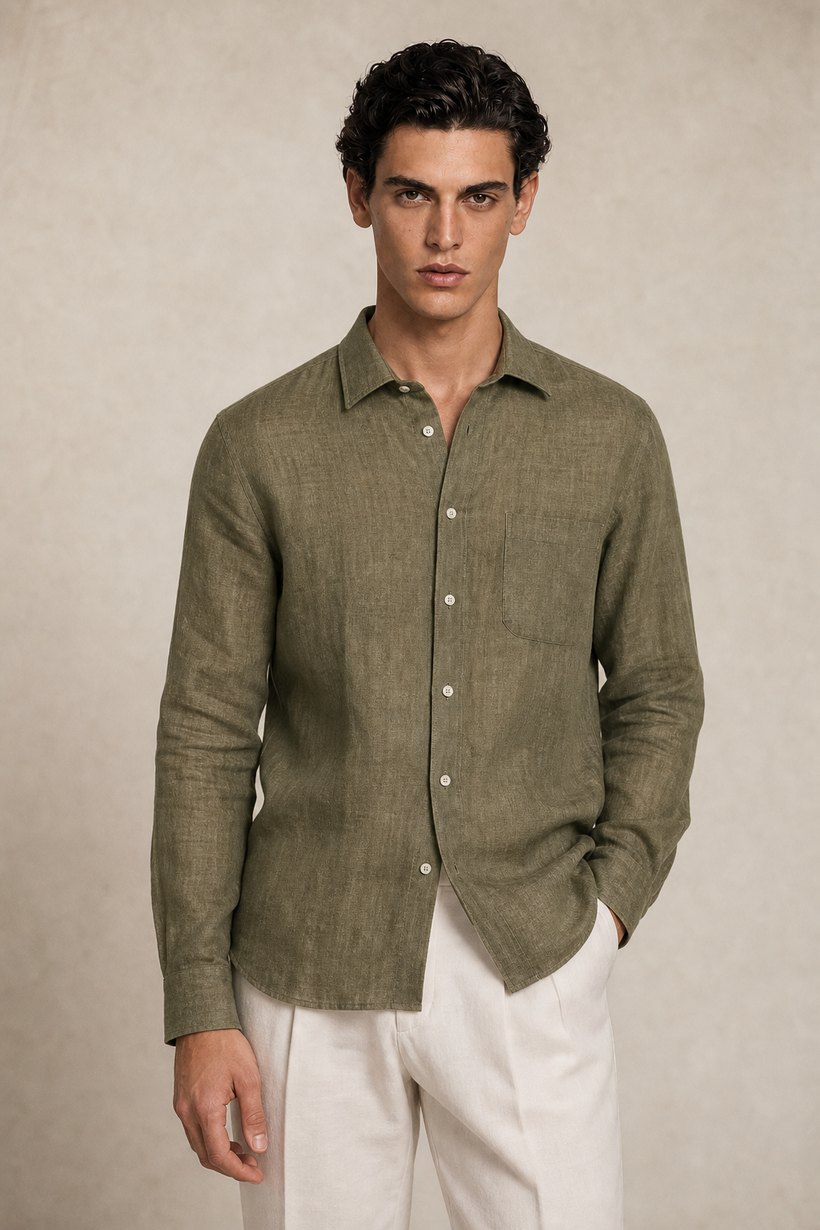
Journal Entry
Shirts Are the Reorder Product: Why a Suit Shop Should Sell the Shirt
A suit shop that only sells suits is leaving its easiest reorder on the table. What changes, and what does not, when a boutique already running made-to-measure adds the shirt: a shorter measurement sheet, the same minimum order, and no new supplier to manage.
The dispatch clerk pulled the file up because I asked her to, not because anything on it was wrong. Three years on the books, one client, two orders: a navy suit in year one, a grey suit in year two, nothing since. I asked her to scroll to the part of the file that had never once been touched. The shirt tab. Ten required fields, every one of them blank, sitting under a jacket and trouser order the shop had placed twice.
That client had been measured, fitted, invoiced and shipped to, twice, by a shop that never once asked him for a shirt. Not because he did not want one. Because nobody at the counter had connected the factory making his suit to the garment he was still buying somewhere he had never been measured at all.
I see that file more often than I would like. A shop that sells made-to-measure suits has already done the hard part of this business, which is getting a stranger to stand still for a tape measure and trust the number that comes back. Most of what it takes to sell that same stranger a shirt is already sitting in his record. What is missing is not a new client. It is a shorter form and a decision to hand it to him.
The file is already half built
Our suit system runs to 47 measurement fields, 31 of them required, across a jacket and trouser. A shirt order arrives on a much shorter sheet: 13 fields, 10 required and 3 optional. Neck, shoulder, chest, waist, stomach, seat, bicep, front length and back length make up the required ten, with sleeve cuff, front chest and back chest as the three a shop adds when the man's build calls for them.
Nothing on that shirt sheet duplicates the suit sheet exactly, because a shirt and a jacket are measured to different ease and fail at different points. But the relationship the shop is drawing on is the same one. A client who has already sat through a suit fitting is not being asked to trust a stranger with a tape measure for the first time. He is being asked for nine or ten more numbers, in an appointment that can run at the end of the second fitting rather than as a booking of its own. The shoulder measurement is the one worth taking slowly either way. On a jacket it sets the whole silhouette. On a shirt it decides where the yoke seam lands, and it is the one measurement neither garment lets a tailor correct afterwards.
The reorder rhythm a suit cannot give you
A suit is an occasion purchase even for a good client. A shirt is not. It gets worn more, washed more, and it wears out at the collar and cuff on a schedule that has nothing to do with how many suits the man owns. That is the entire commercial argument for adding it, and it does not need a number attached to be true: the product a client buys three or four times for every suit he buys once is a different kind of relationship with the shop than the suit alone can build, and it is a different kind of conversation to have with him at the counter.
We wrote about the capital side of a made-to-measure programme in the honest arithmetic on adding it to an independent shop: nothing is cut until a client has paid, so a shirt reorder ties up no more of the shop's capital sitting on a rail than the suit did. The margin conversation looks the same for both garments. What changes is the frequency of the conversation. A client who orders one suit every two years and a shirt every few months is on the books far more regularly than the suit alone would put him there, and every one of those visits is a chance to talk about the next suit before he has gone looking anywhere else.
The same logic that makes a one-piece minimum useful for testing a suit supplier applies here, and we set it out at more length in wholesale suits against made-to-measure for a boutique: a shop does not need to commit to a shirt programme to find out whether it works. It needs one client, one order, and a look at whether he comes back for the second shirt faster than he came back for the second suit.
What actually changes at the cutting table
Almost nothing about how the shop operates changes. The order goes to the same factory, on the same terms, through the same 14 to 20 working day production window from a confirmed order to shipment. The minimum is the same single piece. The garments are cut and sewn in the same Shanghai atelier of 200 house tailors, under whatever label the shop already sells its suits under, and nobody claims they were made anywhere else.
What is genuinely different is the fabric library sitting behind the order. Our suiting runs across 33 European mills, with 822 fabrics carrying a recorded weight and 597 of those sitting in the 240 to 300 gram band most business suiting occupies. Shirting is a separate, narrower book: 118 cloths across poplin, twill and oxford weaves, held and ready to cut in Shanghai rather than drawn from the wider suiting range. A shop asking for a shirt in a cloth outside that book is asking for a special order, the same as a suit cloth we do not hold, and it carries the supplier's own shipping time on top of production rather than inside it.
The styling choices are wider than the fabric choices. There are 47 live shirt style options across collars, cuffs, plackets, pockets, backs and monograms, which is more scope for a shop's counter staff to differentiate a client's order than most suit tickets allow, and none of it changes the production timeline.
None of this requires a second point of contact either. A shop that already has an order sheet, an invoice format and a dispatch process for suits is running the same process for shirts, on the same account, through the same production floor. There is no separate onboarding, no second minimum to negotiate, and no new relationship for the shop's operations team to manage on top of the one it already has.
The first shirt order, on one sheet
For a shop placing its first shirt order behind an existing suit programme, this is what changes hands and what does not.
- Required measurements (10): neck, shoulder, chest, waist, stomach, seat, bicep, front length, back length, sleeve length.
- Optional measurements (3), taken when the build calls for them: sleeve cuff, front chest, back chest.
- Style decisions per order: collar, cuff, placket, pocket, back and monogram, chosen from 47 live options.
- Cloth: one shirting book of 118 cloths, poplin, twill or oxford, held in Shanghai. A named mill outside that book is a special order with its own added lead time.
- Minimum order: one piece, the same as a suit.
- Production window: 14 to 20 working days from a confirmed order, the same window as a suit, whether the cloth is held or specially ordered.
- Label: the shop's own, unchanged from how suits are already branded.
Nothing on that list requires a new supplier relationship, a new production timeline to learn, or a new minimum to negotiate. It requires a shop deciding to hand the second half of a measurement appointment to a client it has already measured once.
The client whose file the dispatch clerk pulled up is still on our books, two suits in three years, no shirt. He was never asked. If your own shop has been running a suit programme without a shirt line behind it, the fastest way to see what the second product changes is to place one order against a client you have already measured and watch what a shorter appointment and a faster reorder actually look like. Tell us what you are working with and we will walk you through the sheet before you commit to more than one piece.
Frequently asked questions
Does a boutique need to stock shirt inventory to sell made-to-measure shirts?
No. Our shirt production runs on the same terms as suits: a one-piece minimum and nothing cut until an order is confirmed. A shop can offer shirts from a swatch book and a measurement sheet without holding a single finished unit, the same model most boutiques already run for suits.
Do we need a separate fitting appointment for a shirt if the client already has a suit measurement file?
You need a short one, not a new relationship. Our shirt sheet runs to 13 fields, 10 of them required, against 47 fields on a jacket and trouser order. A returning suit client has already agreed to be measured and trusted the shop with the result, which is the harder part. The shirt appointment is the ten or so numbers a suit ticket never asked for: neck, shoulder, chest, waist, stomach, seat, bicep, front length and back length.
Does the shirt take longer to produce than the suit, since it is a different product line?
No. Shirts run through the same 14 to 20 working day production window as a suit, from a confirmed order to shipment. There is no separate supply chain to onboard and no second lead time to explain to a client who is used to the suit's timeline.
What shirting does the factory actually hold, and can we request a specific mill?
We cut from one shirting book, 118 cloths across poplin, twill and oxford weaves, held and ready in Shanghai. If a client wants a named mill outside that book, we can special order the cloth against a confirmed job, the same way we do for suiting outside our held range, but it adds the supplier's own lead time on top of production.
Can shirts be made under our own shop label rather than a generic one?
Yes. Shirts are cut and sewn to order the same way suits are, under whatever label the shop is selling under. Nothing about adding shirts changes who the garment is branded for.