Journal Entry
The Three-Minute Price Check: What a Tailor Shop Gets Back, and What Happens Next
A walkthrough of the free three-minute check at b2b.centisartoria.com/start: seven quick choices, the wholesale price sheet, your margin per suit, and what follows.
A shop owner in Madrid filled out the check on a Tuesday afternoon between two client fittings. He told us later that he almost closed the tab at question four because he assumed a login wall was coming. There was no wall. Seven choices later, he had a price sheet, a margin number built on his own retail figure, and a booking link. He used it the following week. That sequence, from tab to first call, is the path the check was built for.
Most factory websites put a contact form between a shop and a price. The form goes to an inbox, someone replies when they reply, and the shop still does not know whether the numbers work before it has spent a week waiting. We built the three-minute check to skip that week. Seven questions, no account, no login, and the wholesale price sheet opens on the same screen.
What the seven questions cover
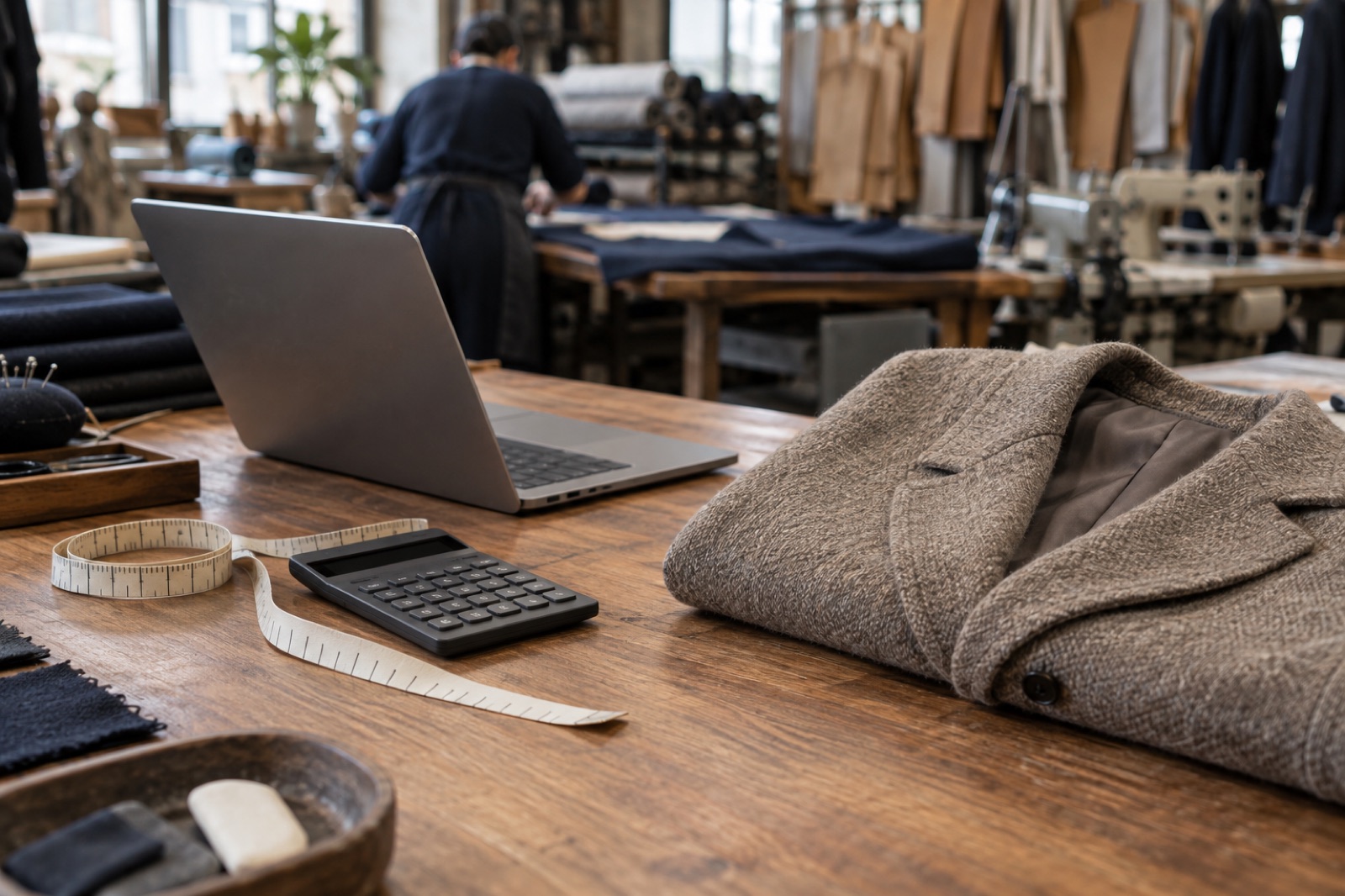
An illustration of a shop counter with a laptop, tape measure and calculator. Not a photograph of our factory or a real client.
The questions are all multiple choice. They ask what kind of business you run, which market you sell in, what construction and cloth range you want, and what retail price you charge. None of them require you to dig up a number you do not already know. A shop owner who sells suits knows their price point, their preferred construction tier, and whether they source cloth themselves or want it included. That is the entire input.
Why those questions and not others: the price sheet is the same for everyone, but the margin calculation only works if we know what you charge. A shop selling at EUR 900 and a shop selling at EUR 1,500 buy from the same list, but their per-suit margin sits in a different place, and the check shows each one its own number.
What comes back
Four things land on your screen when you finish:
1. The wholesale price sheet. Every construction tier, every cloth category, in USD, ex works Shanghai. The starting prices: CMT (your own cloth) from USD 100, full make from USD 167, half canvas from USD 197, all per two-piece suit. The full sheet breaks it down by cloth mill and construction level. Shipping and import duties are the buyer's cost, not included.
2. Your margin per suit. The check takes the retail price you entered and subtracts the ex-works cost. That gives you the spread before freight, duty and your own shop costs.
An illustration of someone working out numbers on paper beside a fabric swatch. Not a photograph of our staff or a real order.
Here is a worked example. A shop sells a half-canvas two-piece at USD 1,150 retail. The ex-works starting price for half canvas is USD 197. That leaves USD 953 between the factory gate and the till. Freight, import duty and the shop's own running costs come out of that number, not out of the factory price. We do not quote those costs because they depend on the destination, the shipping method and the shop's own overheads. But the check gives you the factory side of the split so you can calculate the rest against your own books.
For comparison, published online configurator prices for a similar specification sit between USD 799 and USD 2,145. Those are the prices your customers see elsewhere. The gap between your ex-works cost and that range is where the margin lives.
3. A direct line to a partner manager. Not a sales queue, not a chatbot. A named person with a booking link. You pick a time on the booking page when it suits you.
4. An account on the AI ordering system. The system suggests a starting size from height and weight, holds 47 measurement fields (31 required), and sends orders straight to our Shanghai factory. A shop can place its first order the same week it finishes the check if the measurements are ready.
A worked example: what the numbers look like
Take a single-store shop that sells ten suits a month at an average retail price of USD 1,150. If all ten are half-canvas full-make suits at the starting tier, the ex-works cost is USD 197 each. That is USD 1,970 for the batch. The gross spread, before the shop's own freight, duty and overhead, is USD 9,530 on ten suits.

A peak-lapel one-button blazer in oatmeal from our range.
Now change one variable. The same shop switches five of those ten suits to full-make fused construction at the starting price of USD 167. The other five stay at half canvas, USD 197. The batch cost drops to USD 1,820, and the gross spread rises to USD 9,680. That difference, USD 150 a month, comes from knowing which construction tier fits which sale, and the price sheet is what makes that decision possible.
The minimum order is one piece. Most shops start with a single trial suit, confirm the fit against their own patterns, and scale from there. Production runs 14 days from confirmed measurements and cloth, shipping extra.
What happens after the check
Nothing, unless you want it to. There is no automatic follow-up, no drip sequence, no call you did not book. The check is a self-service tool. A shop that just wants the numbers can take them and leave.
If the numbers work, the next step is usually a call with the partner manager. You pick the time on the booking page. Most shops use that call to walk through the price sheet, ask about a specific cloth or construction, and discuss a trial order.
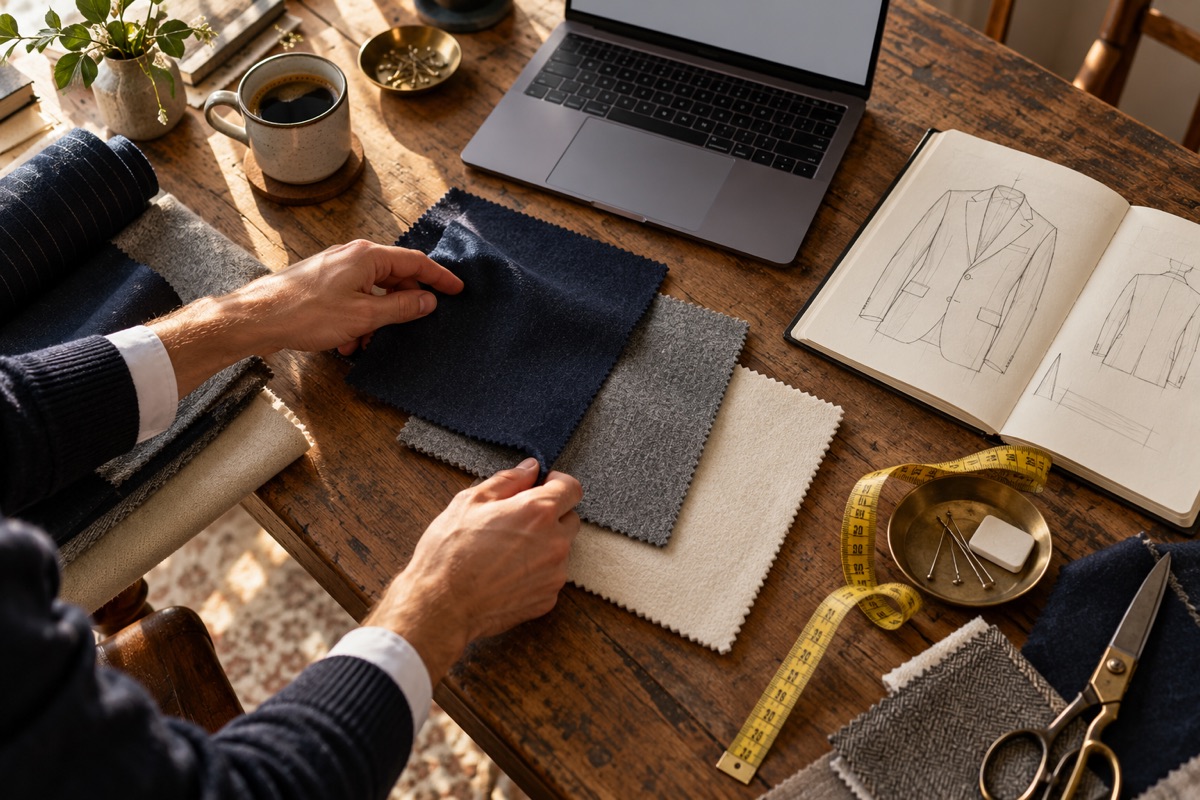
An illustration of someone selecting a fabric swatch at a desk with tailoring tools. Not a photograph of our factory.
After the call, a shop can send a garment it already sells as a reference, and we make one trial piece to match it. That trial piece is priced at the same rate as a batch order. There is no sample fee and no separate sample pricing. A shop that orders one suit and a shop that orders fifty pay the same per piece.
The check exists because the first question every shop asks is what does it cost, and the usual answer in this industry is send us an email and we will get back to you. We would rather the shop have the price sheet before it decides whether to write that email.
Why the check asks about construction
The price sheet is not a single number. It is a grid. One axis is construction: fused, half canvas, full canvas, each with a different labour cost. The other axis is cloth: the starting price assumes our entry-level fabric, and the sheet shows the step-up for each mill tier. A shop that sells mainly fused two-piece suits at a moderate retail price and a shop that sells full-canvas jackets in Zegna Trofeo at a premium price both need the same sheet, but they read different rows.
The check asks about construction so the margin calculation can land on the row that matters to you. A half-canvas suit starting from USD 197 and a fused suit starting from USD 167 leave a different spread at the same retail price. That difference is thirty dollars per suit, which is three hundred dollars on a ten-suit month. The check does the arithmetic so you do not have to guess whether the tier you sell is profitable at your price point before you pick up the phone.
The numbers behind the check
We are a made-to-measure suit factory in Shanghai, founded in 1996, with 200 house tailors across two sites making about 3,000 suits a month. Roughly 1,500 go to Europe and 1,500 to the United States. Cloth comes from 33 mills and cloth merchants, 26 of them in Europe. Zegna Trofeo and Traveller (162 styles) and Vitale Barberis Canonico Four Seasons (40 styles) are held in Shanghai. All other mills are ordered in.
We stand behind every piece: if something is not right, we make it right.
The check is at b2b.centisartoria.com/start. Three minutes, seven questions, free. See the full cost breakdown if you want the numbers before you start, or the margin calculator to model your own retail price. Our production page walks through the 14-day timeline from confirmed order to dispatch. If you would rather talk first, leave a message and a partner manager replies.
Frequently asked questions
How long does the Centi Sartoria price check take?
About three minutes. There are seven questions, all multiple choice, and no account or login is needed. You get the results on the same screen.
What does the price check give me?
Four things: the full wholesale price sheet in USD, your margin per suit calculated at your own retail price, a direct line to a partner manager, and an account on the AI ordering system.
Is the price check free?
Yes. There is no cost, no commitment, and no follow-up you did not ask for. If you want to talk, you book a time yourself on the booking page.
What are the starting prices for a two-piece suit?
Ex works Shanghai, a two-piece suit starts from USD 100 for CMT (you supply the cloth), USD 167 for a full-make suit in our cloth, and USD 197 for half canvas. Shipping and import duties are extra.
Can I place just one suit after the price check?
Yes. The minimum order is one piece. Most shops start with a single trial suit before placing a batch, and the price per piece is the same whether you order one or fifty.