
Journal Entry
Atelier Munro and the Independent Tailor Shop: Competing With a 90-Location Made-to-Measure Chain
Atelier Munro runs 90+ made-to-measure locations worldwide. An independent tailor shop competes on pattern control, client depth and a factory-direct supply line. A side-by-side for shop owners weighing their position.
The question tends to arrive the same way. A shop owner reads that a made-to-measure chain just opened another flagship, checks the location count, and wonders what exactly they are supposed to do about it. The chain has a marketing budget, a polished storefront in a good district, and ninety locations lending the name weight before a single sleeve is measured. The shop has one location, a regular client list, and the nagging feeling that scale alone might be enough to pull people away.
It is not. Scale buys reach, but it also fixes things in place. The question worth asking is not whether a chain is a threat but where its model bends and where yours does not.
How can an independent tailor shop compete with a 90-location made-to-measure chain?
By owning what a chain cannot centralise: a house pattern that fits your local clientele, a personal relationship with every buyer, and a supply line whose prices you can publish on your own terms. A chain like Atelier Munro standardises its process so that a fitting in Amsterdam and a fitting in Calgary produce a comparable result, which is exactly the discipline that prevents a single advisor from rewriting a specification for one client without approval from a product team. An independent shop rewrites specifications every day. That is not a workaround. It is the product.

A fitting that starts at the shoulder and adjusts to one person, not to a standard process.
The gap between a chain and an independent shop is not quality or range. It is decision speed. A chain moves slowly because consistency across ninety locations demands it. A shop moves fast because the person measuring the client is also the person who decides what to do about a sloping left shoulder, and that decision does not need a second signature.
What Atelier Munro publishes, and what it does not
A fair comparison starts with what is actually on the table. We reviewed ateliermunro.com/made-for-you on 2026-10-22 and recorded what the page states. Here is what a shop owner can learn from the public site, and where the page goes quiet:
| Detail | Published? | What the page says |
|---|---|---|
| Locations | Yes | 90+ worldwide; flagships in Amsterdam, Rotterdam, Maastricht, Toronto, Calgary, Vancouver |
| Product range | Yes | Suits, jackets, shirts, trousers, coats |
| Fitting process | Yes | Book an appointment with a style advisor in store |
| Retail price | Not published | No pricing visible on the page |
| Production lead time | Not published | No lead time stated |
| Fabric mills or sources | Not published | No mill or merchant names listed |
| Production location | Not published | Not stated |
None of that is a criticism. A consumer-facing brand has no obligation to publish its supply chain. But a shop owner comparing business models needs those numbers, and where they are missing, the comparison stops. What a shop can do is compare the terms it actually has: its own factory-direct account, where prices, lead times and fabric sources are published, against whatever a chain quotes across a counter.
Five things a single-location shop controls
A chain trades control for scale. An independent shop keeps control and looks for scale in other places. Here is what stays in your hands when you run your own fitting room:
-
Your house pattern. A chain runs one base pattern across all locations. You run yours, adjusted to the posture and preferences you see every week. If your clients skew toward a higher gorge or a softer shoulder, you change the block. Nobody needs to approve it.
-
Client history. You know that a returning client gained weight since last autumn, prefers a slightly longer jacket, and will ask for working cuffs. A chain advisor meeting that client for the first time starts from zero, even if the system has a file.
-
Home visits and trunk shows. A chain fills its stores. An independent shop goes to the client, whether that means a trunk show at a hotel, a fitting at an office, or a house call on a Saturday morning. A chain cannot send its Amsterdam advisor to a client's living room in Antwerp without a logistics conversation that costs more than the margin.
-
Group orders with individual specs. A wedding party of six, each measured separately, each with a slightly different shoulder or trouser rise, all in the same cloth. A chain can do this, but a shop that knows all six from previous orders does it faster and with fewer remakes.
-
Fabric sourcing freedom. A chain locks its fabric offer to what the product team selects each season. An independent shop can source its own cloth from any merchant, send it to a factory on a CMT basis starting at USD 100 per two-piece suit, and sell a fabric that no chain carries. That is a genuine differentiator, not a talking point.

A navy pinstripe from our range. A shop that sources its own cloth can offer exclusives a chain cannot match.
What a factory-direct account changes
The five points above describe what you already have. A factory-direct account strengthens each of them by removing the middleman and making cost transparent. Here is what ours looks like, as a concrete reference for any MTM supplier comparison:
-
One-piece minimum. You do not need to commit to a batch. Order a single trial suit, check it against your house standard, and scale from there. Our factory in Shanghai, founded in 1996, makes about 3,000 suits a month across two sites with 200 house tailors, roughly half for European shops and half for American ones. But the minimum stays at one.
-
14 days in production from a confirmed order. Shipping is extra and depends on destination, but the production window is a single number you can quote to your client. That is the timeline a shop production page can publish, because it does not change.
-
Published prices, ex-works Shanghai. CMT (you supply the cloth) from USD 100 per two-piece suit. Full make (we source the cloth) from USD 167. Half canvas from USD 197. These are starting points, not ceiling prices, and they do not include shipping or import duty. But they let you calculate your margin before you commit.
-
33 mills and cloth merchants, 26 of them in Europe. Zegna (162 styles) and Vitale Barberis Canonico Four Seasons (40 styles) are held in Shanghai for immediate cutting. Everything else is ordered in from the mill, which adds transit time on top of the 14-day production window. A shop that already holds its own cloth skips that wait entirely on a CMT order.
-
47 measurement fields, 31 required. Orders go through an AI system that suggests a starting size from height and weight, then the shop's own measurements override every field. The system sends the order straight to the cutting room. No middleman, no retyping, no lost forms.
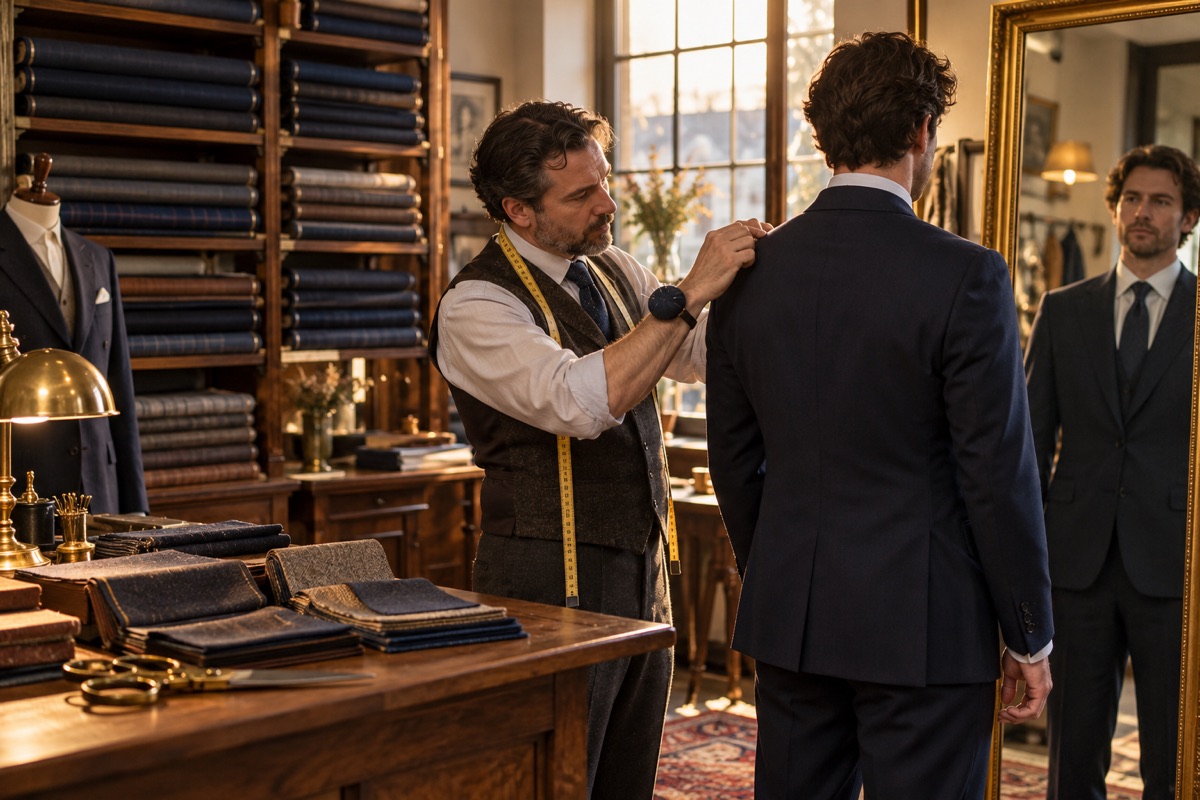
An independent fitting room where the person measuring is also the person deciding.
None of this makes a chain disappear. What it does is remove the cost disadvantage that makes a single-location shop feel like it cannot compete. A shop that knows its cost of goods, controls its pattern, and owns its client relationship is not competing from behind. It is competing from a position a chain cannot occupy, because the chain already chose scale over depth.
How to check your own position
If you run a shop and want to see where you actually stand, here is a starting checklist:
- Do you know, to the dollar, what your current suits cost you landed?
- Can you change a specification on a single order without approval from a supplier's product team?
- Do you hold any fabric a competitor within 20 kilometres does not carry?
- Have you run a trunk show or off-site fitting in the past six months?
- Can you quote a client a production timeline in days, not "a few weeks"?
If any of those answers is no, the gap is not between you and a chain. It is between you and a supply line that would let you say yes. We stand behind every piece: if something isn't right, we make it right.
Frequently asked questions
How can an independent tailor shop compete with a large made-to-measure chain?
By controlling three things a chain cannot replicate at scale: a house pattern refined over years of local fitting, a direct relationship with every client, and a factory-direct supply line with published prices and a one-piece minimum. Chains standardise for consistency across dozens of locations, which means speed but also rigidity. An independent shop can change a specification on a single garment without waiting for a head-office policy update.
What does Atelier Munro offer that an independent shop does not?
Scale and brand recognition. Atelier Munro lists 90+ locations worldwide, with flagship stores in Amsterdam, Rotterdam, Maastricht, Toronto, Calgary and Vancouver. Their made-for-you page covers suits, jackets, shirts, trousers and coats, and clients book an appointment with a style advisor in store. Their prices, lead times, fabric sources and production location are not published on the site (source: ateliermunro.com/made-for-you, read 2026-10-22).
What is the advantage of a factory-direct account for a small tailor shop?
A factory-direct account removes the middleman and publishes the cost of goods. At our factory the minimum order is one piece, production takes 14 days from a confirmed order, and ex-works Shanghai prices start at USD 100 per two-piece suit for CMT, USD 167 for full make and USD 197 for half canvas. A shop that knows its cost of goods can set its retail price with confidence rather than guessing a margin against an opaque wholesale quote.
Can a single-location shop run trunk shows the way a chain does?
Yes, and often more effectively. A trunk show at an independent shop puts the owner or head fitter in front of every client, which builds trust faster than rotating advisors. The shop controls the fabric selection, the fitting process and the follow-up. We cover the logistics of planning one in our trunk show guide.
Does a chain like Atelier Munro use its own factory?
Atelier Munro does not publish its production location or factory details on its made-for-you page (source: ateliermunro.com/made-for-you, read 2026-10-22). Without that information, a shop owner cannot compare production terms directly. What a shop can compare is what is published: its own factory-direct prices, lead times and fabric access against whatever a chain quotes in a retail setting.