Journal Entry
Pitti Uomo 111 Is in January: What to Decide Before You Go
Pitti Uomo 111 runs January 12 to 15, 2027, under the theme WILD. From the factory side, the decisions worth locking in before you fly are about construction, cloth weight and a sample in hand, not a mood board you finish on the plane.
The calls start in September most years, and this year they started with the same word in almost every one of them: wild. Pitti had just named the theme for the January edition, and three separate people forwarded us the announcement within the same week, each one asking some version of the same question. What does this mean for what I should order? I understood the excitement. A theme like that reads like permission to throw out whatever was on last season's mood board. It is also, from where we sit, the least useful thing to be thinking about four months before a trip that only pays off if you come home with decisions a factory can actually act on.
Pitti Uomo 111 runs January 12 to 15, 2027, at the Fortezza da Basso. The edition is named WILD, announced in early September and framed publicly by Pitti as "Pitti Goes Wild," built around a "Refined Punk" idea, tailoring that keeps its precision but stops apologising for having a personality. It is a good direction for a show. It is not a construction, a cloth weight or a delivery date, and those three things are what actually decide whether the trip produces a sample or a suitcase full of swatch cards nobody can act on.
A theme is a direction, not a spec sheet
We wrote up the floor at Pitti Uomo 110 in June, and the pattern holds again here: whatever language a season's theme uses, the room still runs on the same handful of decisions underneath it. Soft shoulders or built ones. Cloth with weight and drape, or cloth chosen because it photographed well under a stand's lighting. A one-piece order you can test against a real customer, or a case of stock you committed to before anyone tried the block on.
If this is your first time walking away from Pitti with an idea rather than an order already placed, we laid out that whole path in from a stand you loved to a shipped sample. The short version repeats here because it matters more with a theme this open-ended: write down the one specific thing you cannot stop thinking about, not "I want a wilder collection." A cutting table cannot execute a mood. It can execute a shoulder line, a cloth weight and a stitch.
Decide construction and cloth weight before you are standing at a stand
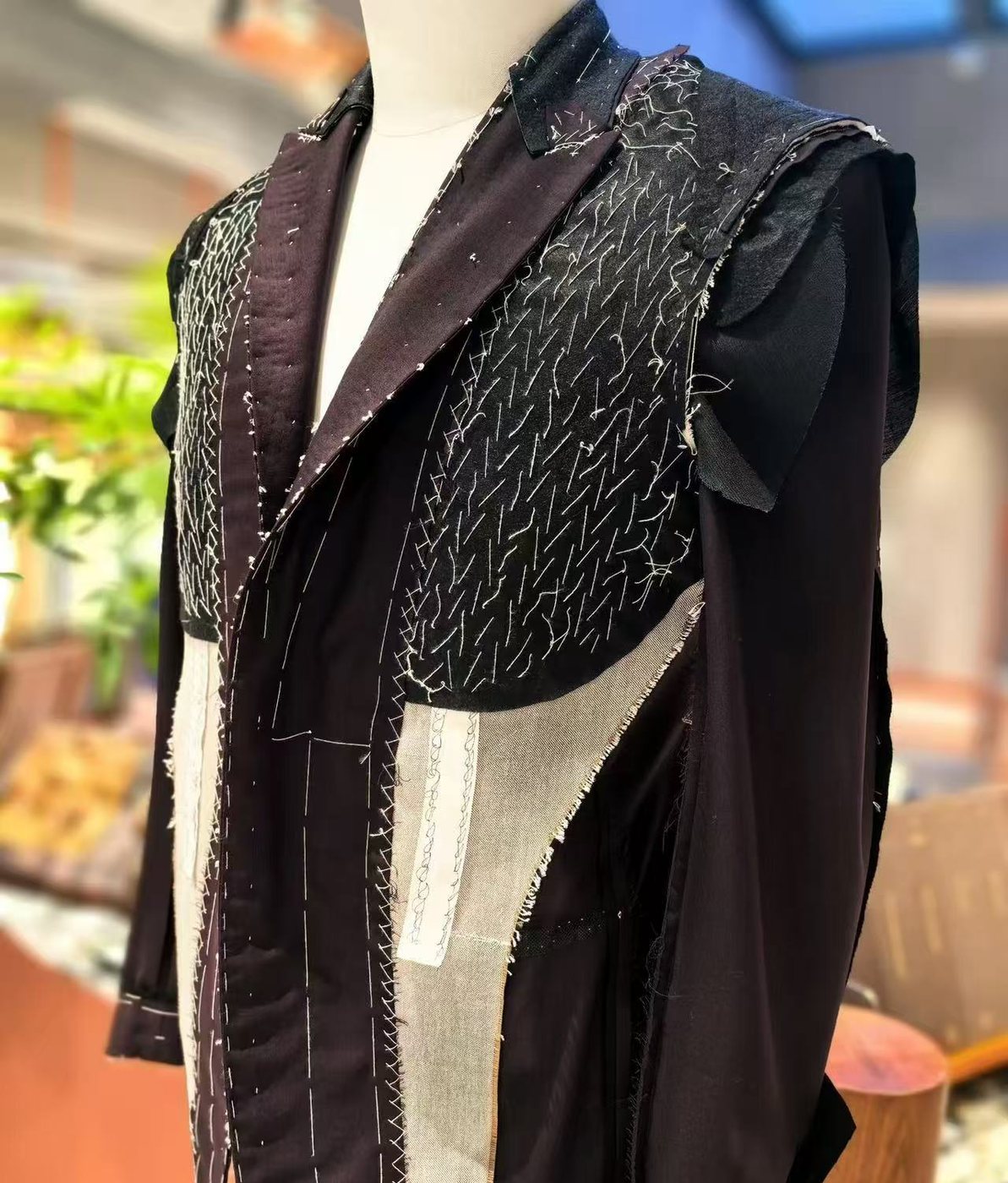
This is the part that gets skipped when a theme is exciting, and it is the part that actually determines what the finished garment will be. Full canvas, half canvas or unstructured is a decision about how the jacket will hold its shape and how it will age, not a style preference you settle by feel in a crowded hall. We set the three out side by side, with our own fronts opened up and photographed, on full canvas versus half canvas versus fused. Walk in already knowing which one you want and you can spend your floor time on cloth and colour instead of relearning construction basics between appointments.
Cloth weight deserves the same advance decision. Most business suiting sits between 240 and 300 grams, out of a range that runs as wide as 98 to 440 grams across the fabrics we carry with a recorded weight. A "wild" colour or a heavily textured surface can still sit in that working band, or it can be a novelty weight that looks striking folded over a stand rail and creases within the hour on a body. Knowing the number you are aiming for before you touch a bunch book means a mill's cloth gets judged against your actual garment, not against how good it feels between two fingers for a few seconds.
A short list worth having settled before you land in Florence:
- Construction: full canvas, half canvas or unstructured, and the shoulder that goes with each
- Cloth weight band, most business suiting between 240 and 300 grams
- Whether the piece is a suit, a jacket alone or something outside tailoring entirely
- Your own fit reference, so a cloth or construction decision can be checked against a real block rather than a guess
- What you actually need to leave the stand with: a bunch number, a swatch, or a firm order
Work the calendar backward from January 12
Here is where most of the disappointment happens, and it has nothing to do with taste. Production runs 14 days from a confirmed order to shipment, from a one-piece minimum, and that window starts once your specification and cloth choice are both locked, not the day you first mention wanting a sample. Shipping and any customs clearance sit on top of that, and they belong to the carrier's schedule, not ours.
If the goal is a sample in hand before you fly to compare against what the mills are showing, count back from January 12 and give yourself real margin, not the fourteen days alone. Confirming a specification by early December is a comfortable target. Waiting until the new year means arriving at Pitti with an idea and no piece to test it against, which puts you back in the position of judging cloth by hand feel under a stand's lighting instead of against a garment you already know fits.
There is a cheaper way to test this than most people expect. A full-make two-piece sample starts from USD 155 ex works Shanghai, or from USD 100 CMT if you supply the cloth yourself, priced the same whether it is your only order or your fiftieth, because a one-piece minimum exists precisely so a single sample does not carry a premium for being small. We wrote a longer answer on what a suit sample actually costs, including what that price does and does not prove before a larger order.
What a mill's stand can answer, and what waits for the factory
A mill on the floor can tell you the fibre, the weave and which colours exist in a book today, and that is worth having directly from the source rather than secondhand. What a stand cannot tell you is whether that specific cloth is sitting ready to cut or needs to be ordered in against a confirmed order, because that answer lives with whoever is doing your cutting and sewing, not with the mill selling the yardage. We buy from 33 mills and cloth merchants, 26 of them in Europe, and every one of those relationships has its own answer to that question, which is exactly why it belongs to the factory conversation that happens after the show, not the stand conversation during it.
The practical habit is a small one: write the bunch number and the mill's name next to anything you like, before the next stand replaces it in your memory. A bunch number is something a factory can quote against immediately. A description like "the green tweed near the entrance" is not, and four days of stands blur faster than anyone expects on the flight home.
Before you book the flight
None of this is complicated, which is exactly why it is easy to skip in favour of the more interesting question of what the collection should feel like. Decide your construction. Decide your cloth weight band. Decide what you actually need to leave a stand with, a bunch number at minimum. And if a sample in hand before the show matters to you, start that order now, because January 12 is closer than four months of planning makes it feel.
If you want to walk into Pitti Uomo 111 with a sample already made and something real to compare against the floor, tell us the specification and we will quote it against our 14-day production window before the theme gives way to whatever comes after it.
Frequently asked questions
When is Pitti Uomo 111 and what is this edition's theme?
Pitti Uomo 111 runs January 12 to 15, 2027, at the Fortezza da Basso in Florence. Pitti Immagine has named the edition WILD, framed publicly as 'Pitti Goes Wild,' with a 'Refined Punk' aesthetic running through the campaign. It is a direction for the show, not a construction spec, which is the distinction this piece is about.
Should I bring back a fabric swatch from Pitti, or ask a mill for a full sample right away?
Write down the bunch number and the mill's name before you leave the stand. A swatch card without that reference is a colour you liked, not a cloth your factory can order. Whether you go straight to a full sample or wait depends on how firm your construction decision already is, but the bunch number is the one thing that has to travel home with you either way.
How far ahead of the show should I order a sample if I want one in hand before I go?
Count back from January 12. Production runs 14 days from a confirmed order to shipment, and shipping and any customs clearance sit on top of that window, not inside it. Confirming your specification and cloth choice by early December gives a comfortable margin. Waiting until the new year to start means walking the floor with an idea instead of a piece to compare it against.
What construction decisions should be locked in before I walk the floor?
Full canvas, half canvas or unstructured, and the shoulder that goes with it: natural, lightly padded or built up. Decide the cloth weight band too, most business suiting sits between 240 and 300 grams, so you know whether what a mill hands you at a stand is close to what you actually need or simply pleasant to hold for thirty seconds.
What can a mill's stand at Pitti answer, and what has to wait for the factory?
A mill can tell you the fibre, the weave and what colours exist in a book right now. Only your factory can tell you whether that cloth is already held and ready to cut or has to be ordered in against your confirmed order, how the two constructions you are weighing will actually sit on your fit block, and what the finished piece lands at once it is cut and sewn rather than draped over an arm.