Journal Entry
Hardy Minnis: What the Name on the Bunch Tells a Shop
Hardy Minnis is a Scottish cloth merchant inside a merged English catalogue. What the name means for a tailor shop ordering through a made-to-measure factory, and how to read a bunch reference that says HFW on the cover.
A shop owner in the north of England emailed us last month asking whether we could make a jacket in Hardy Minnis cloth. She had a client who had seen the name in a magazine feature on country tweeds and wanted that name on the order, no substitutes. The question behind her question was simpler: what exactly is Hardy Minnis, and how does the name on the bunch connect to what actually gets woven?
That question comes up more often than most cloth names warrant, because Hardy Minnis carries a story that reaches further than the cloth itself. It is worth understanding what the name means before you quote it to a client, because the answer involves a merchant, a merger, a Royal Warrant, and a catalogue that covers far more than country tweeds.
A Scottish merchant inside an English merger
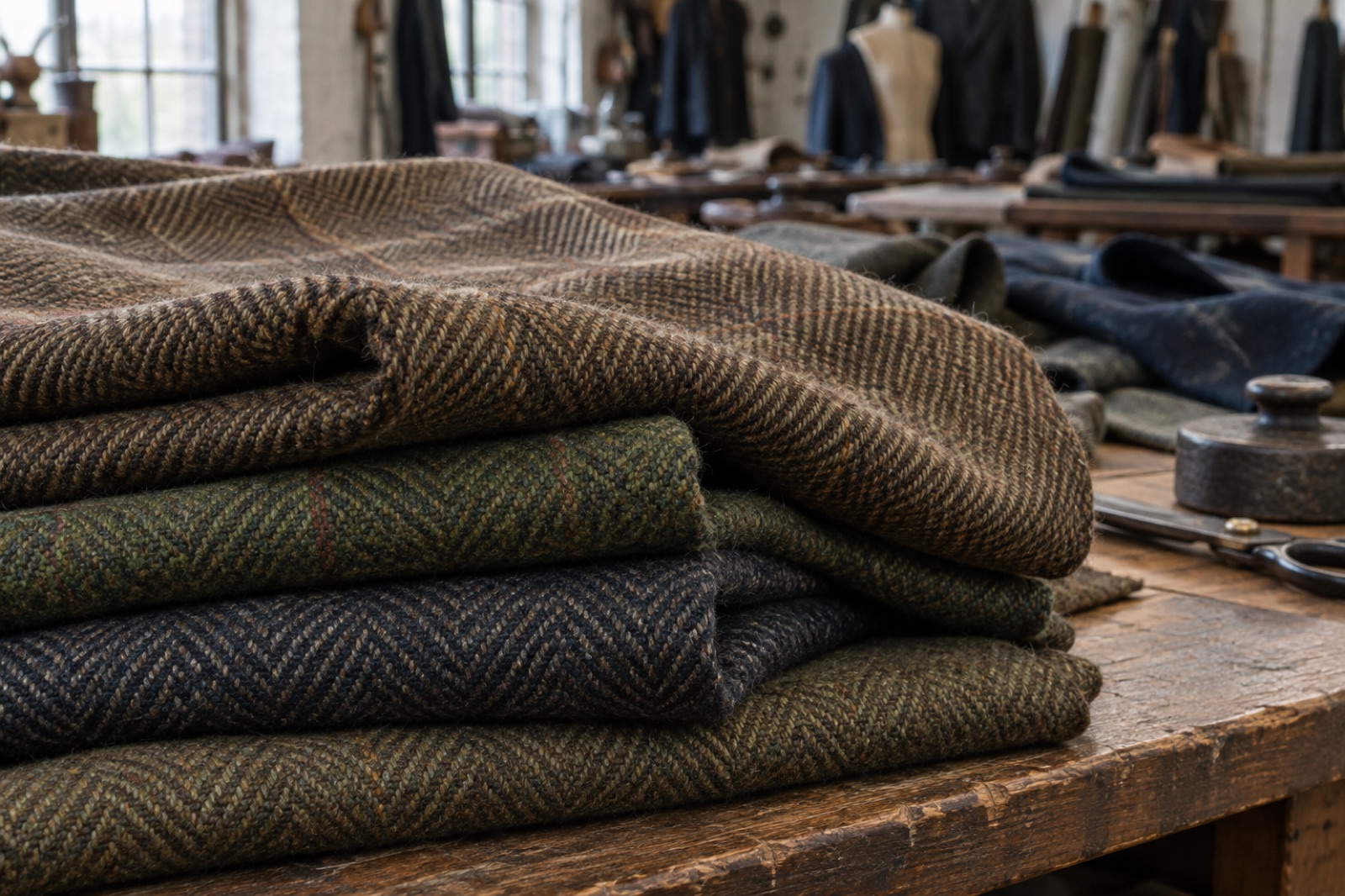
Tweed and country cloth of the kind Hardy Minnis built its name around, long before the HFW merger.
Hardy Minnis was founded in Scotland in 1890 as a cloth merchant. It did not weave. It selected cloth, bound it into bunches, and sold it under its own name. By the 1930s the house held a Royal Warrant to supply cloth to the Royal Household, a distinction it has carried since.
In 1976, Hardy Minnis merged with a group of other historic Yorkshire cloth houses to form Huddersfield Fine Worsteds. The merger brought together names with very different histories: Hunt & Winterbotham, whose original Gloucestershire mill site has recorded weaving cloth since 1532, and Martin Sons & Co, whose heritage runs back to the 1840s. Each kept its own bunch identity inside the merged catalogue.
Then in 2009, a New York fabric company called HMS International bought Huddersfield Fine Worsteds. HMS International also owns Gladson, a New York cloth merchant trading since 1948. That is how a Scottish merchant founded in 1890 ended up inside an English catalogue owned by a New York company with a separate American merchant as a sister business. None of that is hidden. It just rarely gets explained to the shop placing the order.
What the bunch cover actually tells you
The practical point for a shop is this: when a swatch says HFW on the cover, you need to know which house inside the catalogue the bunch traces back to. A Hardy Minnis bunch and a Hunt & Winterbotham bunch can differ in weight, use and origin even though both sell under the HFW name.
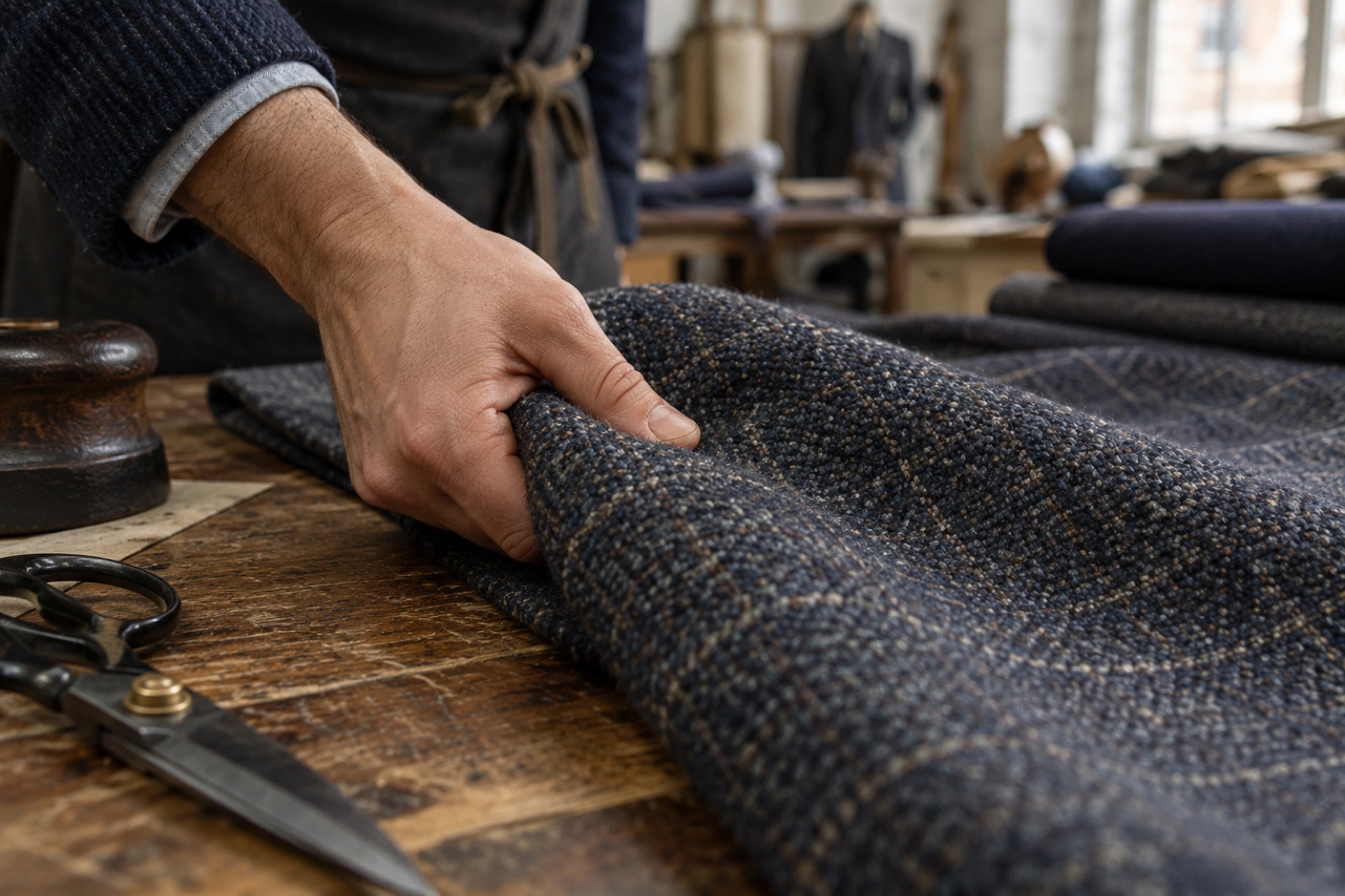
Heavy tweed tested between thumb and finger. Weight is the quickest way to tell country cloth from business suiting.
Ask for three things before you quote:
- The bunch reference, not just the house name. HFW's current catalogue runs to around 188 bunches, and they span everything from tweed-weight country cloths down to lighter suiting.
- The weight. Hardy Minnis's best-known cloth, Alsport, is a thornproof weave running 16 to 22 ounces (500 to 700 grams). That is field and shooting cloth, built for a wet moor, not a desk. Most business suiting sits in a 240 to 300 gram band. A client who says "Hardy Minnis" because they read about Alsport may not realise the weight rules it out for daily office wear.
- Whether the bunch is a Hardy Minnis original or another house's cloth under the HFW umbrella. The catalogue is wide because it absorbed several older catalogues. Knowing the source changes what you can honestly tell the client about the cloth's heritage.
The same test we apply to any merchant applies here: a name on the cover describes who curated the book, not necessarily who wove what is inside it. We push shops to ask for the bunch, not the country, and the same logic holds for a merged catalogue. Ask for the bunch reference, and everything downstream becomes traceable.
Alsport and the Royal Warrant
Hardy Minnis's Alsport is the cloth that carries the name furthest. In 1929 the Duke of York, later King George VI, chose a Hardy Minnis cloth for the Brigade of Guards regimental tweed, and the Royal Warrant followed in the 1930s.
That history sells, but it does not change the cloth's weight. At 500 to 700 grams, Alsport belongs in a country jacket, a heritage commission, or a shooting suit. If your client's brief is a year-round business suit, steer them toward the lighter end of the HFW range or toward a different mill entirely. Offering Alsport for an office suit because the Royal Warrant sounds impressive is a disservice to the client and to the cloth.
For comparison, across the 822 fabrics we carry with a recorded weight, 597 sit in a 240 to 300 gram band, out of a wider range that runs from 98 grams up to 440. Business suiting lives in that band. Alsport lives above it.

A tweed suit from our range. Country cloth like this sits at the heavier end of the spectrum, closer to where Alsport lives than to a standard business worsted.
How to order it through us
We do not hold HFW cloth in our Shanghai stock. We special order it against a confirmed job and add HFW's own lead time on top of our 14 days in production. That means a Hardy Minnis order takes longer than one cut from the Zegna or VBC cloth we hold in Shanghai, where production starts the week the order is confirmed.
If your shop already holds Hardy Minnis or any other HFW cloth, you can send it to us and we make it up as CMT (cut, make, trim) from USD 100 per two-piece suit, Shanghai ex works, shipping extra. That skips the ordering wait entirely. The same applies to any cloth from a house we do not buy from: if you have it, we cut it. We wrote more on that route in our piece on English cloth vs Italian cloth and what a shop's customer notices.
We buy HFW cloth as a customer of the merchant, the same way any tailoring house does. We are not an authorised dealer, a licensee, or a representative of Huddersfield Fine Worsteds or Hardy Minnis.
What to tell the client who asks for it
A client who walks in asking for Hardy Minnis by name has already done some reading. That is a good sign. Here is how to make the conversation useful:
- Confirm what they actually want. "Hardy Minnis" covers everything from 500-gram thornproof tweed to lighter worsted suiting. The name is not a specification. The bunch reference is.
- Be honest about the timeline. HFW cloth is special order for us. If the client needs something within a month, point them toward what we hold in stock: 162 Zegna styles and 40 VBC Four Seasons styles ship on day one.
- Explain the heritage without overselling it. A Royal Warrant held since the 1930s is a real distinction. It does not make every cloth in the merged catalogue suitable for every commission.
- Name the merchant, not just the country. Saying "English cloth" tells the client less than saying "Hardy Minnis, a Scottish merchant inside the HFW catalogue, bunch number such-and-such, woven in England." Specificity builds trust. Vagueness invites the kind of questions you cannot answer on the spot.

Herringbone tweed from our range, showing the weave structure up close. This is the kind of cloth a client pictures when they say "Hardy Minnis."
A checklist before you quote Hardy Minnis to a client
| Question | Why it matters |
|---|---|
| Which bunch reference? | HFW has around 188 bunches. The name alone is not enough. |
| What weight? | Alsport runs 500 to 700 g. Business suiting sits in 240 to 300 g. |
| Which house inside HFW? | Hardy Minnis, Hunt & Winterbotham and Martin Sons each have their own history. |
| Does the client need it fast? | HFW is special order. Zegna and VBC are in our Shanghai stock. |
| Does the shop already hold the cloth? | If yes, send it to us as CMT from USD 100 per suit, 14 days in production. |
| What construction? | Lighter HFW worsted takes half canvas well. Heavier country cloth wants full canvas. |
The name Hardy Minnis carries more history than most cloth names a shop will encounter. What it does not carry is a shortcut past the same questions every order needs answered: bunch reference, weight, lead time, construction. Answer those, and the heritage sells itself.
Frequently asked questions
Is Hardy Minnis a fabric mill or a cloth merchant?
Hardy Minnis is a cloth merchant, founded in Scotland in 1890. It does not weave. It became part of Huddersfield Fine Worsteds in the 1976 merger, and the combined business was bought by HMS International in 2009. The bunch you are holding was curated by a merchant, not woven in a Hardy Minnis mill, and that distinction changes how you trace it.
Does Centi Sartoria hold Hardy Minnis cloth in stock?
No. We special order it against a confirmed job and add HFW's own lead time on top of our 14 days in production. We buy HFW cloth as a customer of the merchant, not as an authorised dealer or representative.
What is Alsport cloth, and is it suitable for a business suit?
Alsport is Hardy Minnis's thornproof country cloth, woven at 16 to 22 ounces (500 to 700 grams) for field and shooting wear. It is far heavier than business suiting and not suited to an office wardrobe. Most business cloth sits in a 240 to 300 gram band.
How many bunches does the HFW catalogue carry?
Around 188 bunches in the current catalogue, spanning tweed-weight country cloths down to lighter suiting. That breadth is the direct result of the 1976 merger folding several older houses into one catalogue.
What should a shop tell a client who asks for Hardy Minnis cloth?
Tell the client it is a respected name with a Royal Warrant history, and then ask which bunch they actually want. Hardy Minnis is one house inside a merged catalogue. Knowing the bunch reference and the weight matters more than repeating the house name, because that is the detail you need to place the order and quote a realistic timeline.