Journal Entry
Which Made-to-Measure Factories Publish Their Prices, and What to Ask the Ones That Don't
A side-by-side look at which trade MTM suppliers publish a starting price and which leave it behind a form, plus the four questions a shop should ask before shortlisting either kind.
Last month a shop owner forwarded us two quotes he had collected the same week. One said USD 165 per two-piece suit, the other said "competitive pricing, enquire for details". He wanted to know which was cheaper. The honest answer was that neither quote told him enough to decide, because the first did not say what cloth or construction the number covered, and the second did not say anything at all.
That exchange is more common than it should be. A shop shortlisting a made-to-measure supplier usually starts by comparing whatever numbers it can find, and in this trade most of the numbers are simply not there. Knowing which MTM suppliers publish their prices, and what to ask the ones that do not, saves a week of emails that could have been one table and four questions.
Which MTM Suppliers Publish Their Prices?
Of the trade-facing made-to-measure suppliers a tailor shop is likely to compare, only a few put a starting price on their own website. The table below uses each supplier's own published pages as the sole source, read in September and October 2026. Where a site does not state a number, the cell says not published. That is not a criticism. It is a question the shop still needs to ask.
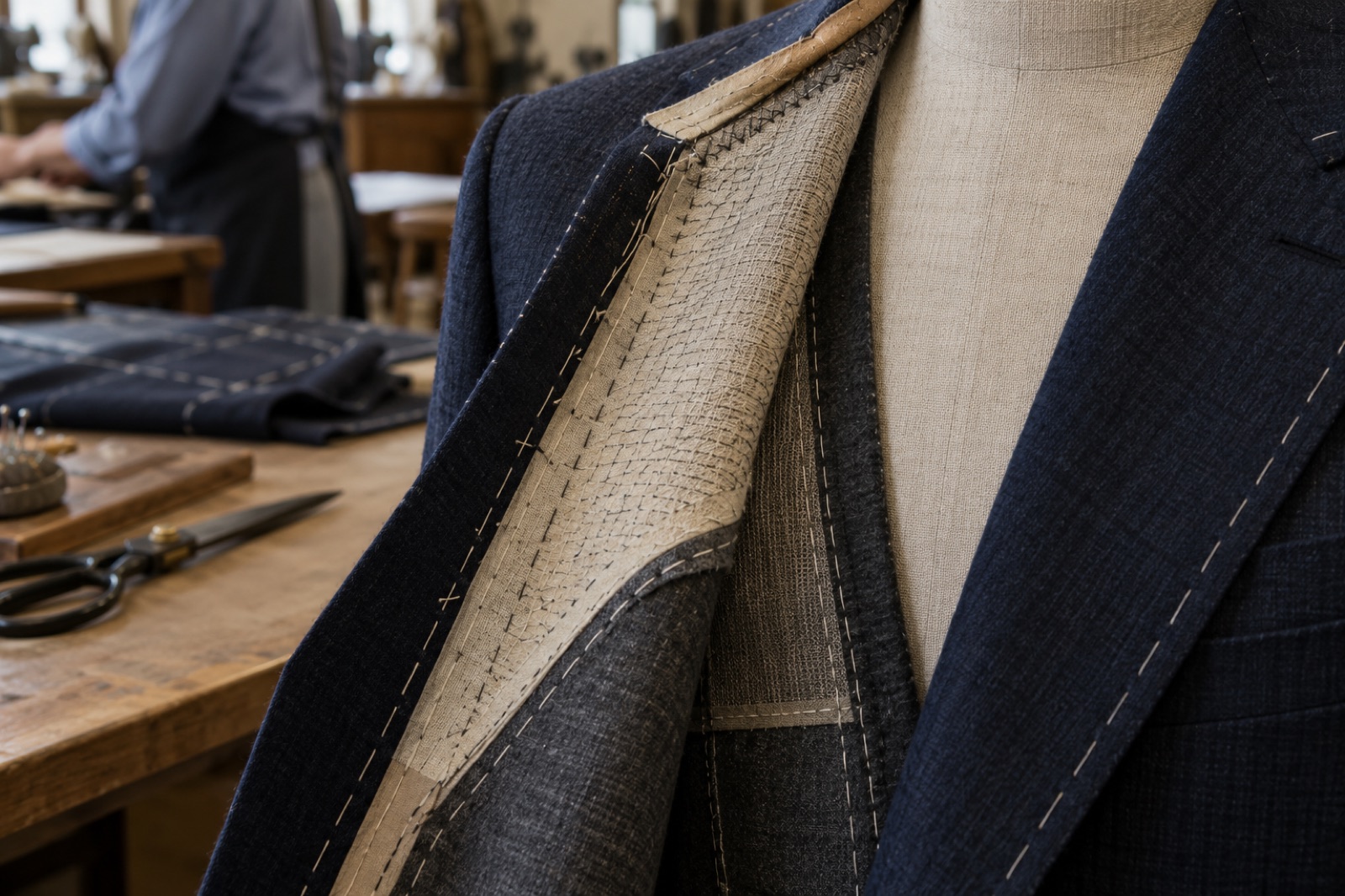
An opened jacket front showing the canvas layer. Construction tier changes the price, which is why a starting number alone does not tell the whole story.
| Supplier | Starting price as published | What the number covers |
|---|---|---|
| Centi Sartoria | CMT from USD 100, full make from USD 167, half canvas from USD 197 (two-piece, ex works Shanghai) | Three tiers separated: own cloth, factory cloth fused, factory cloth half canvas. Shipping extra |
| RJ MTM | Two-piece suiting from USD 165 | Enterprise tier. System kit USD 998, one-time. Construction and cloth details not stated on the pricing page |
| Italian Artisan | Service fees from EUR 950 and EUR 1,450 | Service fee only. Production cost not published. Minimum 50 units |
| Kutetailor (Kutesmart) | Membership: free, USD 59 or USD 169 per month | Platform access tiers. Garment prices not published |
| Formens | Not published | Standard lead time usually 10 business days. Cloth stock from more than 40 fabric suppliers |
| Bosinno (Baoxiniao group) | Not published | 1-piece minimum and 5-day lead time stated, but no price |
| Steven Tailoring | Not published | Based in Qingdao. No pricing, lead time or minimum on the pages read |
| Dayang Group (Trands USA) | Not published | Become a Retailer programme and own USTYYLIT platform. CMT accepted |
A shop scanning this table for the lowest number will land on either our CMT at USD 100 or RJ MTM at USD 165. But those two numbers describe different things. Ours is a two-piece cut and sewn from cloth the shop already owns, ex works Shanghai. RJ MTM's is a two-piece in their own cloth, and the page does not state whether that is fused, half canvas or full canvas. Without that detail, the two numbers sit on different shelves.
For a longer side-by-side of every supplier's minimum, lead time, cloth source and construction, see MTM suppliers for tailor shops compared.
What a Published Price Actually Tells You
A starting price is useful, but only if you know the four things it is built on. Two suppliers can both write "from USD 165" and mean entirely different garments.
Construction tier. Fused, half canvas and full canvas cost different amounts to make. A starting price almost always means the lowest tier. If the page does not say which tier that is, the number is a floor with no ceiling attached to it.
Cloth. Some prices include the factory's own cloth. Others assume the shop sends its own. A full-make price and a CMT price are not the same comparison, even when the number looks close. Our own split is deliberate: CMT from USD 100 means the shop sends cloth and we cut and sew; full make from USD 167 means we supply the cloth as well, starting from the most affordable option in our range; half canvas from USD 197 adds the canvas upgrade. Three lines, three different products.

A two-button suit from our range. The starting price depends on the cloth and the construction behind the lapel.
Shipping and duties. Ex works means the price stops at the factory gate. Freight, customs clearance and import duty are the shop's cost. A quote that says "delivered" or "DDP" bundles those in. Comparing the two without adjusting is the most common mistake we see in forwarded quotes.
Volume. Some prices hold at one piece. Others kick in at a minimum. Italian Artisan's service fee, for example, starts from 50 units. Our own prices apply from one piece, the same whether a shop orders one suit or fifty.
For a deeper breakdown of what sits inside a factory quote, see made-to-measure suit cost.
Four Questions to Ask When the Price Is Not Published
A supplier that does not publish a starting price is not necessarily hiding anything. Some tie the number to the cloth chosen or the volume committed, so a single figure would mislead. But a shop that asks for a quote without framing the question will get back a number just as opaque as no number at all.
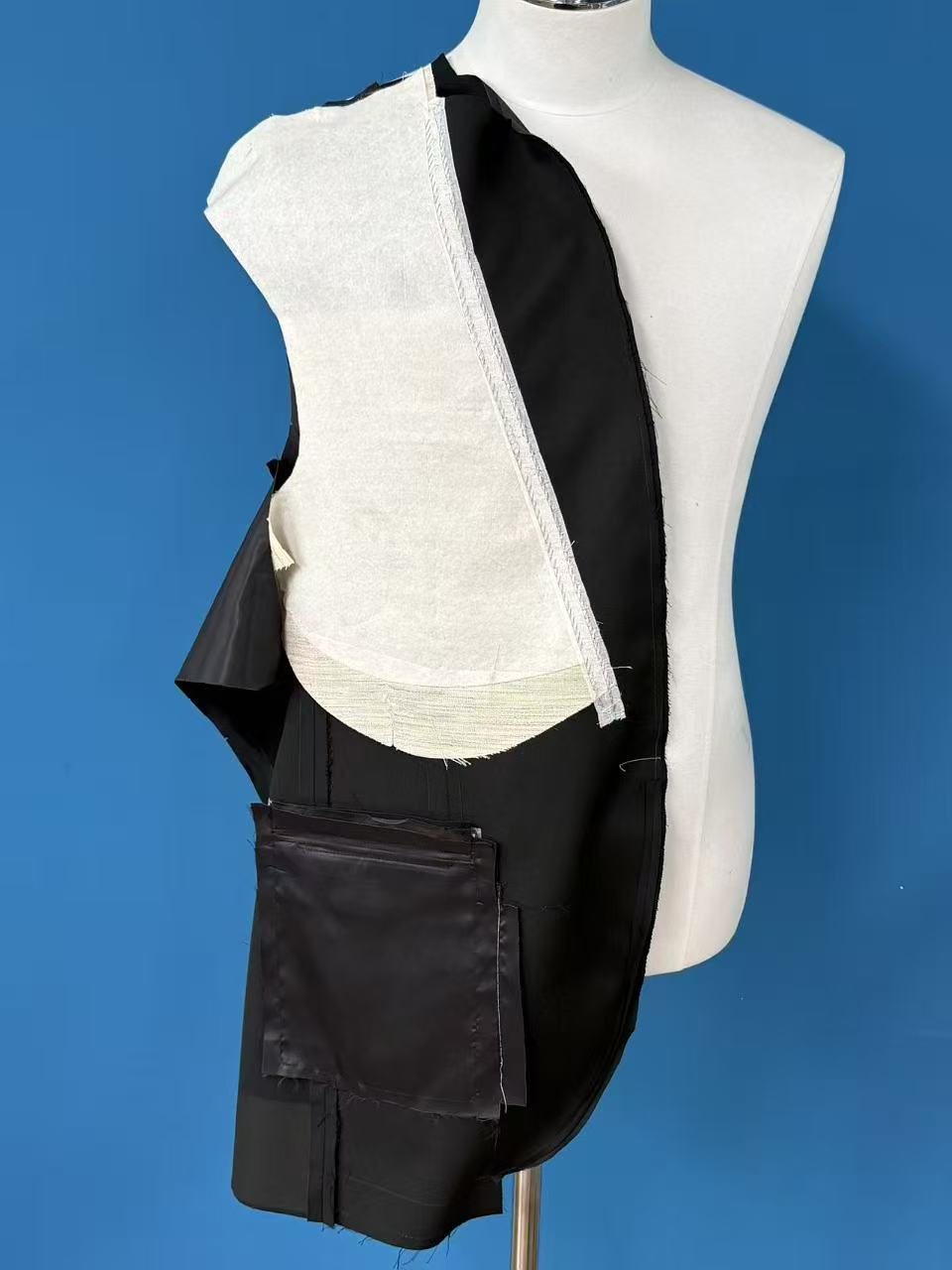
Fused construction: the interlining bonded flat to the wool. This is the tier most starting prices assume unless they say otherwise.
Ask these four before you compare any quote against the table above:
- What construction does the starting price cover? Fused, half canvas or full canvas. If the answer is "full canvas" ask whether that is machine padded or hand padded, because those are two separate specifications and two separate prices.
- Does the price include cloth, or is it CMT? If it includes cloth, ask which cloth and whether the shop can choose a different one without the price changing. If it is CMT, ask what the factory charges per garment for cut, make and trim alone.
- What sits outside the quoted number? Shipping, duties, platform fees, membership fees, system kits, setup charges. A garment price that does not mention any of these has not answered whether they exist.
- Does the price change at different volumes? Some factories offer a volume discount. Others hold a flat rate from one piece. Either is fine, but a shop placing three suits a month and a shop placing thirty need to know which model they are in.
A supplier that answers all four quickly, whether the price is on its website or not, is telling you more than a published number ever could on its own.
What a Shop Loses by Not Asking
The risk is not overpaying. The risk is comparing two numbers that describe different products and choosing on a difference that does not exist. A shop that picks a supplier because its published price is ten dollars lower, without checking whether that price covers the same construction, the same cloth source and the same shipping terms, has not saved ten dollars. It has deferred the discovery to the first invoice, where the gap will be larger and harder to walk back.
Every figure about another company in this post comes from that company's own website, read in September and October 2026. Where a site does not say, the table says not published. A shop can verify every cell by visiting the same page. That is the point of publishing: not that the number is always the lowest, but that it can be checked before the first email.
Our own prices are public because we think a shop should be able to run the margin arithmetic before it picks up the phone. CMT from USD 100, full make from USD 167, half canvas from USD 197, per two-piece suit, ex works Shanghai, shipping extra, one-piece minimum, 14 days in production from a confirmed order. The complete price sheet, broken down by cloth and construction tier, comes back inside three minutes: see prices and your margin, 3 min. Or get in touch and we will walk through the numbers together.
Frequently asked questions
Which MTM suppliers publish their prices?
RJ MTM publishes two-piece suiting from USD 165. Centi Sartoria publishes CMT from USD 100, full make from USD 167 and half canvas from USD 197 per two-piece suit, ex works Shanghai. Italian Artisan publishes service fees from EUR 950 and EUR 1,450 but not production cost. Kutetailor publishes membership fees but not garment prices. Formens, Bosinno, Steven Tailoring and Dayang Group (Trands USA) do not publish a starting price.
Why do some made-to-measure factories not publish prices?
Some factories tie garment cost to the cloth chosen, the construction tier or the monthly volume a shop commits to, so a single number would not apply to every order. Others keep prices behind a form because they want to qualify the buyer first. Neither reason is suspicious on its own, but a shop should still ask the four questions in this post before committing to a trial order.
What does ex works mean on a suit factory quote?
Ex works means the price covers production only, collected at the factory gate. Shipping, import duties and any local taxes are the buyer's responsibility. A quote that says delivered or DDP includes those costs. Comparing an ex works price with a delivered price without adjusting for freight and duty will make one factory look cheaper than it is.
Is a lower published starting price always the better deal for a tailor shop?
Not necessarily. A starting price usually covers the lowest construction tier and the cheapest available cloth. A shop needs to compare like for like: same construction, similar cloth weight and origin, same minimum order, and same definition of what the lead time includes. A ten dollar difference in the headline number can disappear once those variables line up.
Should a tailor shop avoid suppliers that do not publish prices?
No. Some of the largest and most established trade suppliers do not publish a number on their site. What matters is whether you can get a clear answer quickly once you ask, and whether that answer includes the four details in this post: what the price covers, what sits outside it, how cloth cost is handled, and whether the quote changes at different volumes.