Journal Entry
Italian Suit Fabric for a Shop's Core Range: VBC, Reda and Drago Compared
A shop asked us to help relabel its whole premium wall as "Italian wool," one banner for three different mills. Vitale Barberis Canonico, Reda and Drago are all genuinely Italian and genuinely different in what they weave, own and ship. What each one actually offers a shop's core range, weight by weight.
A shop we work with wanted to redo its whole premium fabric wall under one banner for spring: "Italian Wool." One story, one sign, three mills' worth of swatches underneath it. When we asked which mills the wall actually held, the buyer read off three names: Vitale Barberis Canonico, Reda, Drago. All three are genuinely Italian. All three sit within a few miles of each other in the Biella wool district of Piedmont. The similarity mostly ends there, and a single banner cannot honestly describe what a client is actually buying from each one.
We hold one of those three cut and ready in our own atelier in Shanghai. The other two we order in against a confirmed bunch. That difference by itself would be reason enough to stop treating "Italian" as a single spec, but it is not even the most important one. What each mill weaves, owns and can promise a shop's client is different enough to matter on the cutting table, not just on the invoice.
What we actually hold, and what we order in
Vitale Barberis Canonico's Four Seasons book is one of only two mills we keep cut and ready in Shanghai, the other being Zegna. Forty styles, sitting on our shelf, running through our own 14 days in production from a one-piece minimum, plus shipping. That is the fast lane, and it exists because Four Seasons and Zegna's Trofeo and Traveller books both live in the same 240 to 300 gram band where most of what we actually cut sits.
Reda and Drago are not on that shelf. Both are genuine mills in the strict sense of the word, not merchants reselling somebody else's weave, and both are still special order for us. We buy from each as an ordinary customer, not as an authorised dealer or a representative of either name. Order against a confirmed bunch and reference, and the mill's own release and shipping time from Biella runs before our own clock starts, on top of the 14 days we quote for cutting and construction. We wrote the mechanics of that gap in more detail in held versus ordered-in cloth, and the same rule applies to any name that is not one of our two held books.
Three mills, three different builds
The weight and fineness numbers are where the comparison actually pays off, because "Italian wool" hides real differences a client will feel even if he cannot name them.
| Mill | Book we cite | Weight | Fineness | Held in Shanghai |
|---|---|---|---|---|
| Vitale Barberis Canonico | Four Seasons | Around 280 g/m | Super 100s to 130s | Yes, 40 styles |
| Reda | 130's Suit | 260 to 275 g/m | Super 130s | No, special order |
| Reda | 150's Suit | Around 245 g/m | Super 150s, mostly virgin wool | No, special order |
| Drago | House range | Varies by article | Super 130s up to Super 210s | No, special order |
VBC's Four Seasons is the book we would put in front of a shop building a core range that has to hold up to weekly wear across three seasons. It is not a special-occasion cloth and never tries to be one: the name describes the job, a year-round weight in the same band our own fabric guide sets out as ordinary business suiting.
Reda splits its own suiting cleanly by weight rather than by occasion. The 130's Suit, at 260 to 275 g/m, is the everyday spec, the one we would send a shop's client into a five-day work rotation wearing. The 150's Suit is a genuinely different cloth at around 245 g/m, finer and softer against the collar, and it is worth saving for a client's second order rather than his first, once he already owns something to rest it against.
Drago is the outlier on structure rather than on weight. It runs a wider fineness range than either of the other two, from Super 130s up to Super 210s, using Australian and New Zealand wool plus Mongolian cashmere at the top end. That range is a genuine strength for occasion pieces and a genuine trap for daily wear: a Super 200s cloth is extraordinary against the skin and it will not survive being balled up in a garment bag between wears the way a Super 130s does. We do not spec anything above roughly Super 160s for a suit a client calls his everyday piece.
The provenance story is not the same story three times
Two of the three own the ground their wool grows on. VBC has held Merino sheep country near Mudgee, in New South Wales, since the early 1980s, spread across three properties rather than one, and has spent decades breeding for fineness with the growers who supply it. Reda's stake is in New Zealand, not Australia, three stations in the Waitaki Valley and Mackenzie District bought between 1993 and 2003, running to roughly 30,000 hectares. That distinction gets flattened constantly, because Australia is the country most people associate with merino by default, and it is worth checking before repeating a provenance claim to a client rather than assuming the flattering version.
Drago does not own pastoral land at all, and its case for depth is a different one: it spins, weaves and finishes cloth on a single site in Lessona, so one company answers for the whole process rather than a spinner in one town and a weaver in another. That single-site model is also why Drago runs smaller: around 1.7 million metres a year, by the mill's own figure, meaning a specific bunch a client wants can genuinely sell out mid-season in a way it would not at a larger house.
None of that makes one mill the right answer and the other two the wrong one. It makes them three different products that happen to share a country of origin, which is exactly why one banner and one label undersell all three.
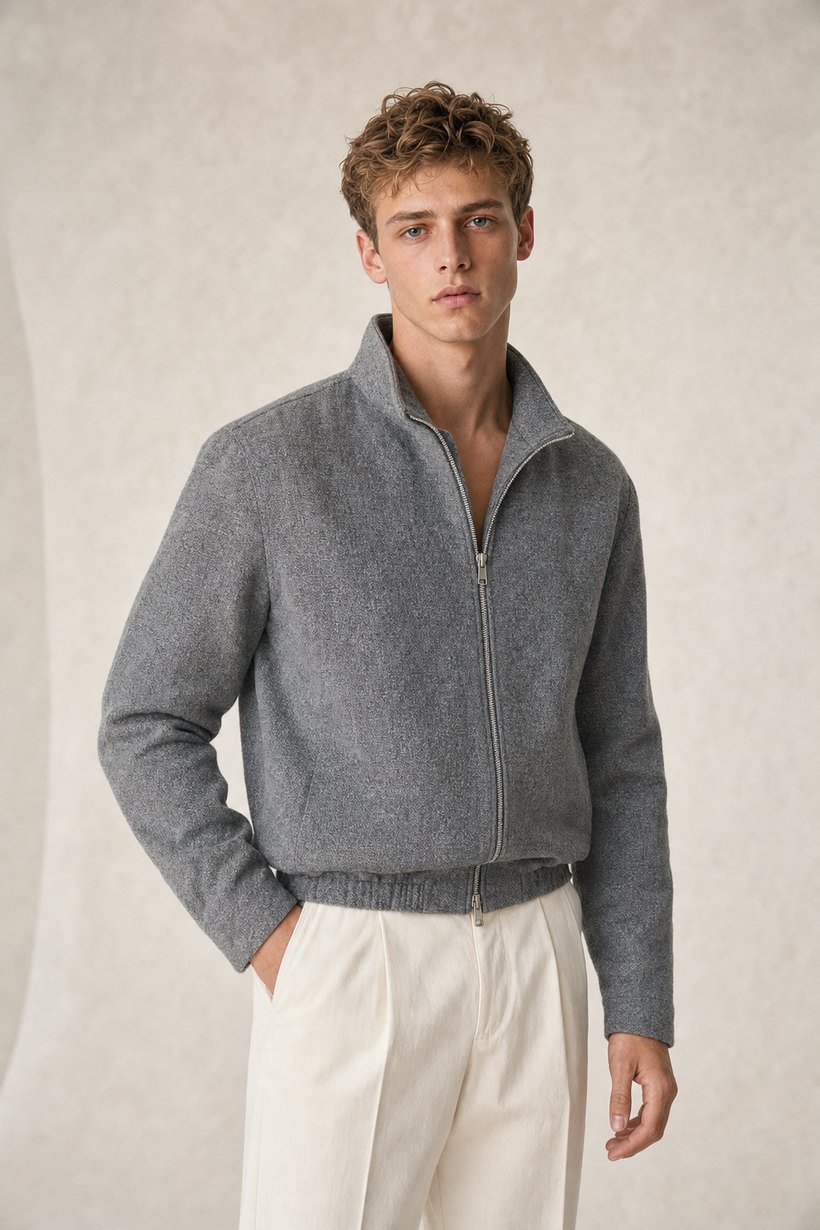
A country on a swatch card is a starting point, not a spec. The weight and fineness underneath it are what a client actually wears.
Building the core range: what to hold, what to name only on request
Run this before you decide what sits on the standing rail and what stays a special order:
- Put VBC's Four Seasons on the core rail if a shop wants an always-available Italian option. It is the one of the three we can turn around in our standard 14 days without a mill's own release time added on.
- Spec Reda's 130's Suit as the default when a client asks for the name by itself, and hold the 150's Suit for a second order once he has a workhorse suit to compare it against.
- Cap Drago at roughly Super 160s for anything going into daily rotation, and treat the finer end of its range as an occasion-piece order, confirmed before you promise a client a date.
- Ask us for the mill's release estimate on the specific Reda or Drago bunch before quoting a delivery date. It is a five-minute question, and skipping it is the most common gap between a shop's promised date and the one we can actually hit.
- Do not promise a rare or finer bunch from either special-order mill as open stock. A length sitting unsold on a shelf for months is a cost a shop pays for a name, not a spec.
Why the wool underneath is worth watching this month
The raw material behind all three mills is moving in a direction worth flagging before a shop commits to a wider Italian range. Australia's Eastern Market Indicator hit 1,890 Australian cents per kilogram in the first week of September 2026, up 46.4 percent on the same week a year earlier, with fine and superfine Merino categories seeing the strongest buyer competition against genuinely tight supply, according to reporting from the Kohan Textile Journal. That is the same fineness band VBC's held book and the finer end of Reda's and Drago's ranges draw from.
We do not publish a price for Italian fabric, held or ordered in, so none of that changes what we quote. What it does change is confidence: a mill facing tighter, more competitive access to the wool it needs is less likely to have every article sitting ready the moment a shop's client asks for it. Check the specific bunch before a client's deposit goes down. That habit costs nothing and it is the difference between a delivery date a shop can promise and one it is guessing at.
Neither name is the wrong answer
VBC, Reda and Drago are not competing for the same order, once you look past the passport they share. VBC earns its place on a core rail because it is held, consistent and cut in the same 14 days as everything else we make. Reda earns its place through a weight split that maps cleanly onto how often a client actually wears the suit. Drago earns its place at the far end of fineness, for the client who wants something none of the other two books offer, ordered deliberately rather than kept on spec.
The cloth in all three cases is Italian. The cutting and sewing happen in our own atelier in Shanghai, under our own 200 house tailors, and the finished garment is made to measure, cut and sewn here rather than in a European workshop, the same claim on this page as on every other. If you are adding any of these three to a shop's core range for the first time, send us the bunches you are considering and we will tell you what is already on our shelf, what needs a mill's own release time, and what that means for the date you promise a client.
Frequently asked questions
Does Centi Sartoria hold Italian suit fabric in stock?
One book, not three. We hold Vitale Barberis Canonico's Four Seasons collection cut and ready in Shanghai, 40 styles, one of only two mills we keep on the shelf at all. Reda and Drago are both genuinely Italian and both special order: we order against the bunch and reference a shop confirms, and the mill's own release time is added on top of our 14 days in production, plus shipping.
What is the actual difference between Reda's 130's Suit and 150's Suit bunches?
Weight and fineness. Reda's 130's Suit runs 260 to 275 g/m and is the safer spec for a client's everyday, five-day suit. The 150's Suit is finer, around 245 g/m, entirely virgin wool apart from one cashmere-blended article, and it rewards a wardrobe that already has a workhorse suit to rotate with rather than one relying on a single jacket.
How fine should a shop spec Drago before it stops being a daily-wear suit?
We do not put anything above roughly Super 160s into a suit a client describes as his everyday piece, even though Drago's own range runs to Super 210s. Past that point the fibre is exceptional against the skin and it will not survive a five-day rotation the way a lower count does. The top of the range belongs on odd jackets and occasion pieces, not the suit he wears every week.
Do Vitale Barberis Canonico, Reda and Drago all own the sheep behind their wool?
Two of the three do. VBC has held Merino country near Mudgee, New South Wales, since the early 1980s. Reda owns three merino stations in New Zealand, not Australia, bought between 1993 and 2003. Drago does not own pastoral land; it buys Australian and New Zealand wool plus Mongolian cashmere on the open market and puts its own investment into spinning, weaving and finishing on a single site in Lessona instead.
Is raw wool getting more expensive right now, and does that change Centi Sartoria's pricing?
The raw material is moving, yes: Australia's Eastern Market Indicator was running 46.4 percent above the year-earlier level in the first week of September 2026, with fine and superfine Merino categories seeing the tightest competition. That is a mill-side cost and an availability signal, not something that changes what we quote, since we do not publish a price for Italian fabric at all. What it does change is how confidently a shop can promise a finer bunch without checking availability first.