Journal Entry
Made to Measure From Shanghai for a Dutch or Belgian Tailor Shop: What Changes and What Doesn't
A Dutch or Belgian tailor shop ordering made-to-measure suits from a Shanghai factory faces shipping, customs and currency questions that a European supplier does not raise. Everything else, from one-piece minimums to public pricing, stays the same.
A shop owner asked us last month whether ordering from Shanghai works the same as ordering from a factory in Romania or Portugal. The short answer took one sentence: the garment and the ordering process are identical. The long answer, the one that matters, is that everything between dispatch and delivery changes, and if the shop does not settle those details before the first order, the invoice at the border will be the surprise rather than the suit.
This post is that long answer, written from the factory side, for a tailor shop in the Netherlands or Belgium placing a first order with a factory outside the EU.
Can a Dutch or Belgian tailor shop order made-to-measure suits from a factory in China?
Yes, and many already do. There is no trade barrier that prevents a Dutch or Belgian shop from ordering made-to-measure suits from a Chinese factory. The process on the ordering side is the same as with any supplier: the shop sends measurements, picks a fabric, specifies the style, and the factory cuts and sews to that specification.
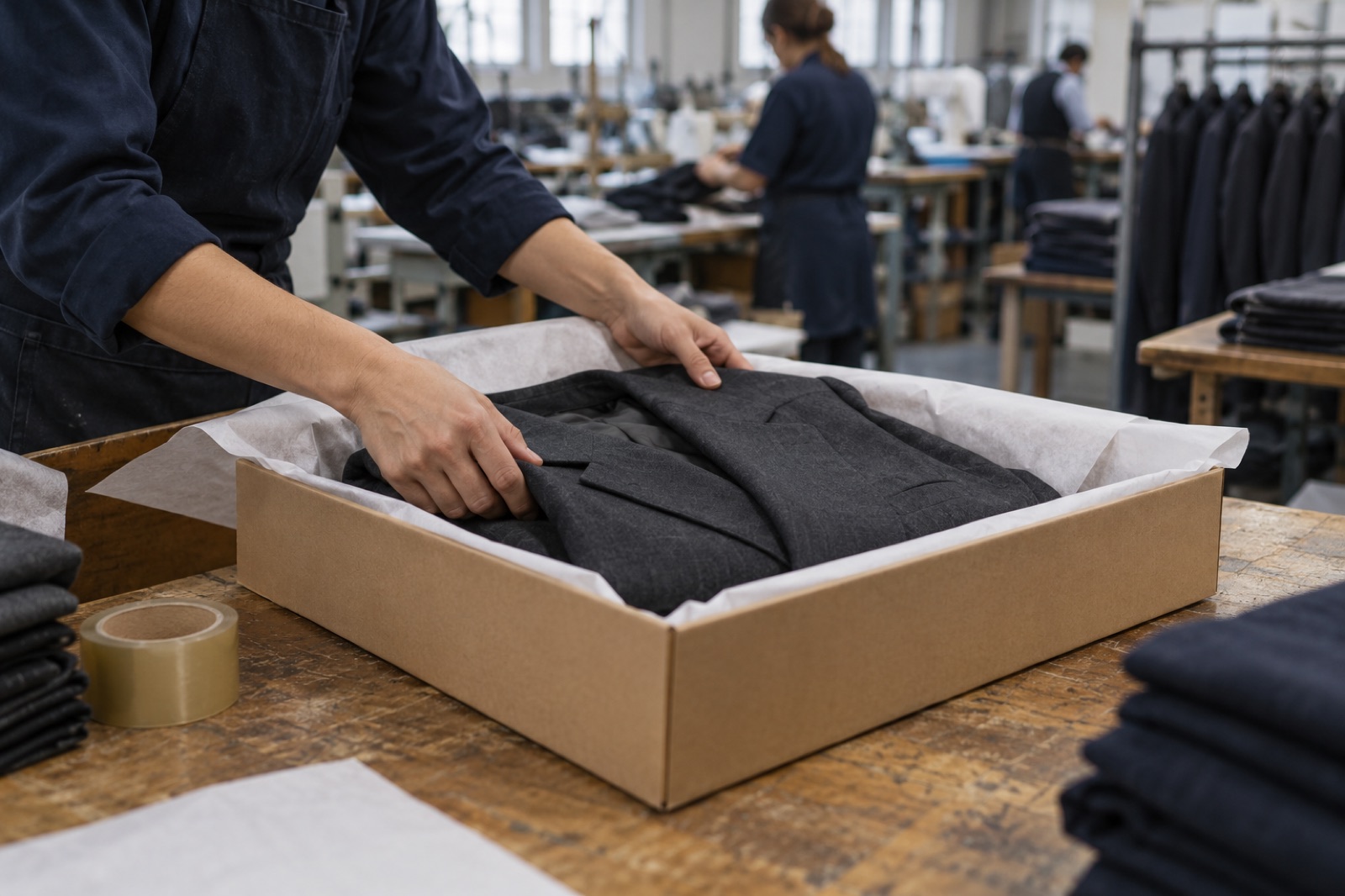
Packing a finished suit for dispatch. What happens after this step is where a Shanghai order differs from a European one.
The difference is not in the suit. It is in the journey the suit takes after it leaves the factory. A garment from Romania or Portugal stays inside the EU, which means no customs declaration, no import duty and no border clearance. A garment from Shanghai crosses a customs border, and the shop is responsible for what that crossing costs.
Our factory is in Shanghai, founded in 1996, with two sites and 200 house tailors producing about 3,000 suits a month, roughly half for European clients and half for the United States. We quote ex works Shanghai, which means the price covers the finished garment at the factory door. Everything after that door is the shop's arrangement.
What changes: shipping, duty and paperwork
Three things sit between an ex works price and the cost of a suit on a Dutch or Belgian shop's own rail.
Shipping. The shop or its freight forwarder arranges pickup from Shanghai and delivery to the shop's address. Air freight is faster and costs more per piece. Sea freight is slower and cheaper but means planning further ahead. The factory does not choose the method; the shop does, based on how quickly it needs the garments and how many pieces justify the cost of each lane.
Import duty and VAT. The EU applies a common external tariff on garments imported from outside the union. The exact rate depends on the HS code for the garment and the current EU schedule. VAT is charged on top of the customs value at the standard rate in the country of import. Both duty and VAT are recoverable for VAT-registered businesses, but both must be paid at the border before the goods clear. A customs broker or the shop's freight forwarder handles the declaration.
Currency. Our prices are in US dollars, ex works. The shop converts at whatever rate its bank or payment provider offers on the day. For a Belgian shop used to paying a European supplier in euros, this adds a step, not a risk, but one that belongs in the landed cost calculation rather than discovered after the fact.
A practical checklist for what the shop needs before the first shipment:
- An EORI number (required for any EU import; most VAT-registered businesses already have one)
- A freight forwarder or customs broker who handles China-to-Benelux shipments
- The HS code for the garments being ordered (the forwarder confirms this)
- A clear agreement on who pays what: our quote is ex works, so freight, duty, VAT and clearance are on the shop's invoice, not ours
We do not quote freight, because the cost depends on the lane, the volume and the method the shop's forwarder selects. We do not estimate duty rates, because that is the customs authority's number, not the factory's. What we do is keep the garment price public and simple: CMT from USD 100, full make from USD 167, half canvas from USD 197 per two-piece suit, ex works Shanghai. The shop builds its landed cost on top of that.
For a full walkthrough of every line that sits between an ex works quote and a landed cost, we wrote a separate post: landed cost is not the factory quote.
What stays the same
Everything about the garment, the ordering process and the production terms is identical for a Dutch or Belgian shop and any other client. The full rundown of how an established shop uses us as a production floor is on our suit production for tailor shops page.

A double-breasted wool overcoat from our range. The same construction, the same specifications, regardless of where the order ships.
- One-piece minimum. A shop can order a single suit to trial the fit and construction. No minimum batch, no sample surcharge. The trial piece costs the same per unit as a larger order.
- 14 days in production from a confirmed order. That is calendar days, not working days, and it is the same number for every destination. Shipping time sits on top.
- Public prices. CMT from USD 100, full make from USD 167, half canvas from USD 197 per two-piece, ex works Shanghai. These are the same starting prices every client sees.
- 47 measurement fields, 31 required. The shop takes measurements the same way it would for any factory. Our AI ordering system suggests a starting size from height and weight, and the shop adjusts from there. Orders go straight to the factory floor.
- 33 mills and cloth merchants, 26 of them in Europe. The fabric selection does not change by destination. Zegna (162 styles) and Vitale Barberis Canonico Four Seasons (40 styles) are held in our Shanghai stock and ship within the 14 day production window. All other mills are ordered in, which adds the mill's own delivery time on top.
- Digital fabric book and swatches on request. No full physical bunch books. Swatches are posted to the shop's address anywhere in the world.
- A reference garment option. A shop can send us a suit it already sells as a fit reference, and we make one trial piece to match it. That is often the fastest way to prove the factory can reproduce the shop's existing silhouette.
When a European supplier may suit the shop better
Not every shop's first priority is price. A factory inside the EU removes the entire shipping-and-duty layer, and for a shop that values proximity and short transit, that is a real advantage.
Formens, based in Botosani, Romania, with additional factories in Ukraine and Morocco, publishes a standard lead time of usually 10 business days. It holds cloth from more than 40 fabric suppliers in its own workshop, ready to cut. It lists showrooms in Paris, Bad Wurzach in Germany, Occhieppo Inferiore in Italy and New York. Its prices are not published on its site. For a full side-by-side comparison, see our Formens alternative page, which uses only what Formens publishes on its own site.

A navy single-breasted suit from our range. Whether it ships to Rotterdam or New York, the production specification is the same.
The honest comparison for a Dutch or Belgian shop is not garment price against garment price. It is landed cost against landed cost: the sum of the garment, the freight, the duty, the VAT and the clearance fee. A European factory may charge more for the suit and less for everything else. A Shanghai factory charges less for the suit and adds the logistics layer. The numbers only compare fairly when every line is on the table, and we wrote a separate guide to building that worksheet: ex works vs FOB. For a broader comparison of trade suppliers on minimum order, lead time, price and cloth, see our MTM suppliers for tailor shops compared page.
Before the first order: what to settle
A checklist for a Dutch or Belgian shop placing its first order from a factory outside the EU.
- Pick a freight forwarder who handles China-to-Benelux textile imports. They confirm the HS code, handle the customs declaration and tell the shop what duty and VAT to expect.
- Decide the shipping method. Air for speed, sea for cost, or a mix depending on urgency. The forwarder quotes both.
- Build a landed cost worksheet. Start with the ex works price, add freight, duty (check the current EU TARIC schedule for the garment's HS code), VAT at the standard rate, and the broker's clearance fee. That total is the number to set a retail price against, not the factory quote alone.
- Send a reference garment if the shop already sells suits and wants the new factory to match the existing fit. We make one trial piece to that reference.
- Place a one-piece trial. Confirm fit, construction and cloth before committing to volume. Our minimum is one piece, so the cost of checking is one suit, not a production run.
- Confirm the fabric lead time. Zegna and VBC stock ships within 14 days. Any other mill adds the mill's own delivery window before production starts.
Everything on this checklist is about the logistics wrapper, not the garment. The suit inside the box is the same suit a shop in London or New York receives. The wrapping, the paperwork and the last mile are what a Benelux shop needs to plan for, and none of it is difficult once a forwarder is in place.
Frequently asked questions
Can a Dutch tailor shop order made-to-measure suits from a factory in China?
Yes. There is no trade restriction preventing it. The shop places the order the same way any other client does, with measurements, fabric choice and style details. The difference sits after the garment leaves the factory: shipping, import duty and VAT are the shop's responsibility, settled through its own freight forwarder or customs broker.
How long does a made-to-measure order from Shanghai take to reach the Netherlands or Belgium?
Production takes 14 days from a confirmed order. Shipping time and cost are separate and depend on the method the shop or its forwarder chooses. Air freight to Western Europe typically adds a shorter window than sea freight, but costs more per piece. The 14 days is the factory time; everything after dispatch is between the shop, its forwarder and the carrier.
Does a Dutch shop need a minimum order to work with a factory in Shanghai?
Not with us. Our minimum is one piece per style. A shop can order a single trial suit to check the fit and construction before placing any larger order. That trial costs the same per piece as a batch, with no sample surcharge.
Who pays the import duty when a tailor shop imports suits from China into the EU?
The buyer pays import duty and VAT at the EU border. The factory quotes ex works Shanghai, which covers the garment and nothing beyond the factory door. Duty, VAT, freight and clearance sit on the shop's side, and a freight forwarder or customs broker handles the paperwork.
Is it cheaper for a European tailor shop to source from a European factory instead of Shanghai?
It depends on what the European factory charges for the garment itself, because that number is rarely published. Our ex works prices are public: CMT from USD 100, full make from USD 167, half canvas from USD 197 per two-piece suit. A European supplier may quote a higher garment price but lower shipping and no import duty. The only honest comparison is landed cost: garment plus freight plus duty plus VAT plus clearance, not the factory quote alone.