Journal Entry
Romania, Portugal or Shanghai: How a European Shop Chooses a Made-to-Measure Maker
Three production countries, three cost structures, three sets of trade-offs. A side-by-side look at what Formens in Romania, Davion in Portugal and Centi Sartoria in Shanghai each publish, so a European tailor shop can compare before it calls.
A shop owner in Germany wrote to us last month asking which factory we thought they should use. They had been ordering from a maker closer to home, liked the work, but had never seen a price list, could not get a clear answer on minimums, and had started wondering what the numbers would look like from somewhere else. They were not unhappy. They just had nothing to compare against.
That is the situation this post is for. Three production countries come up most often when a European tailor shop looks for a made-to-measure supplier: Romania, Portugal and China. Each has a reason to be on the list, and each has something it does not say on its own website. What follows is a side-by-side look at the two European makers shops ask us about most, Formens and Davion, and then our own factory in Shanghai, using only what each company publishes.
Which made-to-measure factory should a European tailor shop use?
There is no single right answer, because the question hides at least four smaller ones. Does the label have to say a European country? How much does shipping time matter relative to price? Do you need a one-piece trial before committing? And can you see prices before the first conversation?
Formens in Romania publishes a standard lead time of usually 10 business days and holds cloth from more than 40 suppliers in its workshop. Davion in Portugal has been making private label clothing since 1993 and added a made-to-measure service for retailers in 2006. We publish our prices, make from one piece and take 14 days in production from a confirmed order, with shipping extra. The rest of this post puts those claims next to each other so you can see where each one fits and where the gaps are.
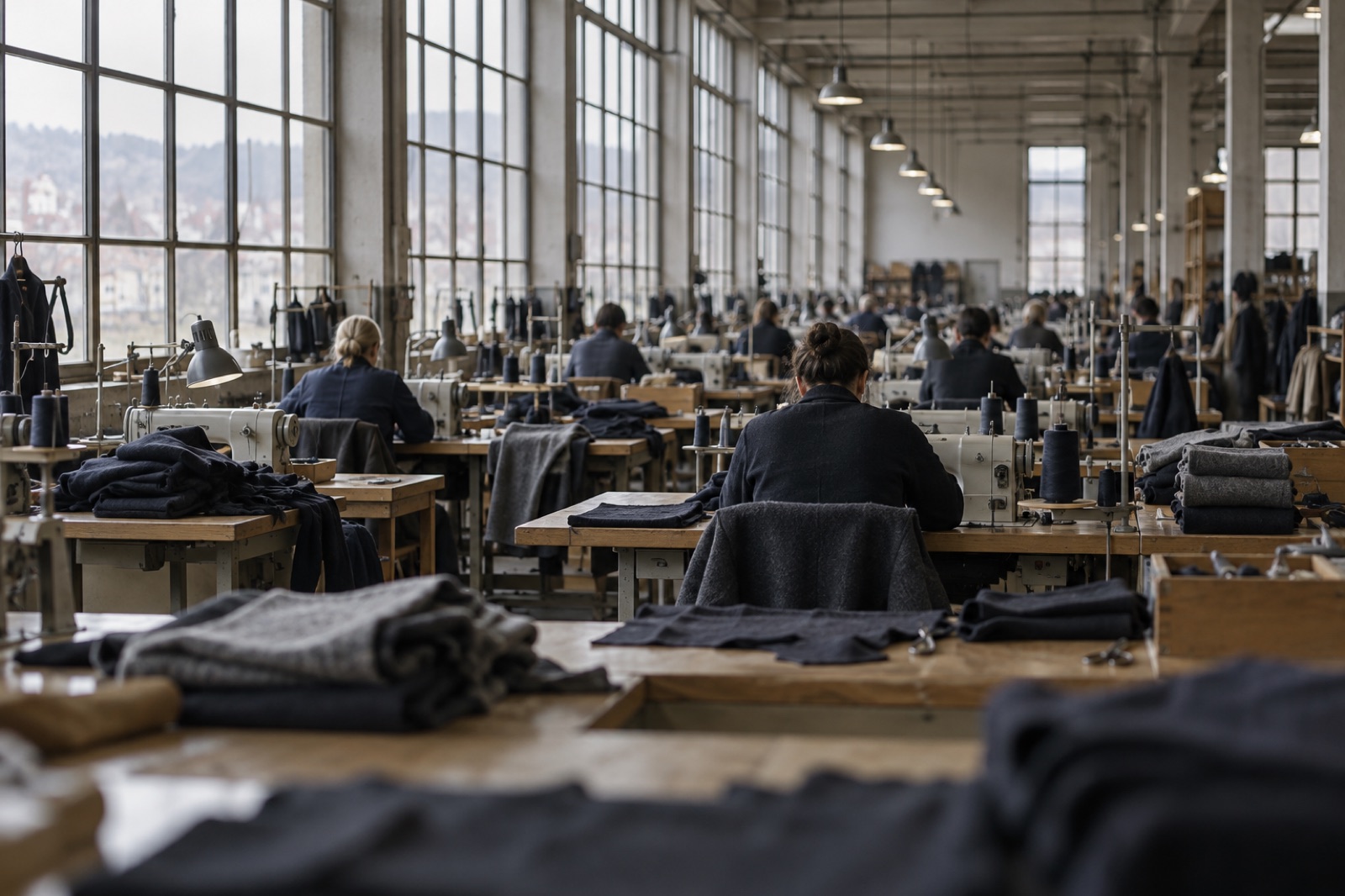
A factory floor seen from inside. Every maker on this list runs its own production, but what each publishes about that production varies widely.
What each maker publishes
All facts in this table come from each company's own website. Formens data was read on formens.ro on 2026-09-26. Davion data was read on davion.pt on 2026-09-30. Where a site does not say, the cell says "not published." That is not a criticism. It is a question to ask.
| Formens (Romania) | Davion (Portugal) | Centi Sartoria (Shanghai) | |
|---|---|---|---|
| Founded | 1997 (Botosani workshop from 1999) | September 1993 (family history from 1957) | 1996 |
| Production | Botosani, Romania; also factories in Ukraine and Morocco | Portugal | Shanghai, two sites, 200 house tailors |
| Published price | Not published (described as "competitive") | Not published | CMT from USD 100, full make from USD 167, half canvas from USD 197 per two-piece, ex works Shanghai |
| Minimum order | Not published | Not published | 1 piece |
| Published lead time | Usually 10 business days | Not published | 14 days in production from confirmed order, shipping extra |
| Cloth | Stock from 40+ suppliers, held in workshop | Not published | 33 mills and cloth merchants (26 in Europe); Zegna 162 styles, VBC Four Seasons 40 styles held in Shanghai; rest ordered in |
| Own cloth (CMT) | Not published | Not published | From USD 100 per two-piece |
| Ordering platform | B2B online platform in nine languages | Contact for information | AI ordering system; height and weight to size, orders direct to factory |
For a full comparison of eleven trade MTM suppliers in one table, see MTM suppliers compared.
When the shorter shipping lane wins
A European origin has real weight in two situations. The first is when the customer's label has to read a European country, whether by regulation, by brand positioning or by a retailer's sourcing policy. Davion makes in Portugal and says so on every page. Formens makes in Romania, inside the EU, so the suits travel a short distance to a European shop with no import duties and no customs clearance on arrival.

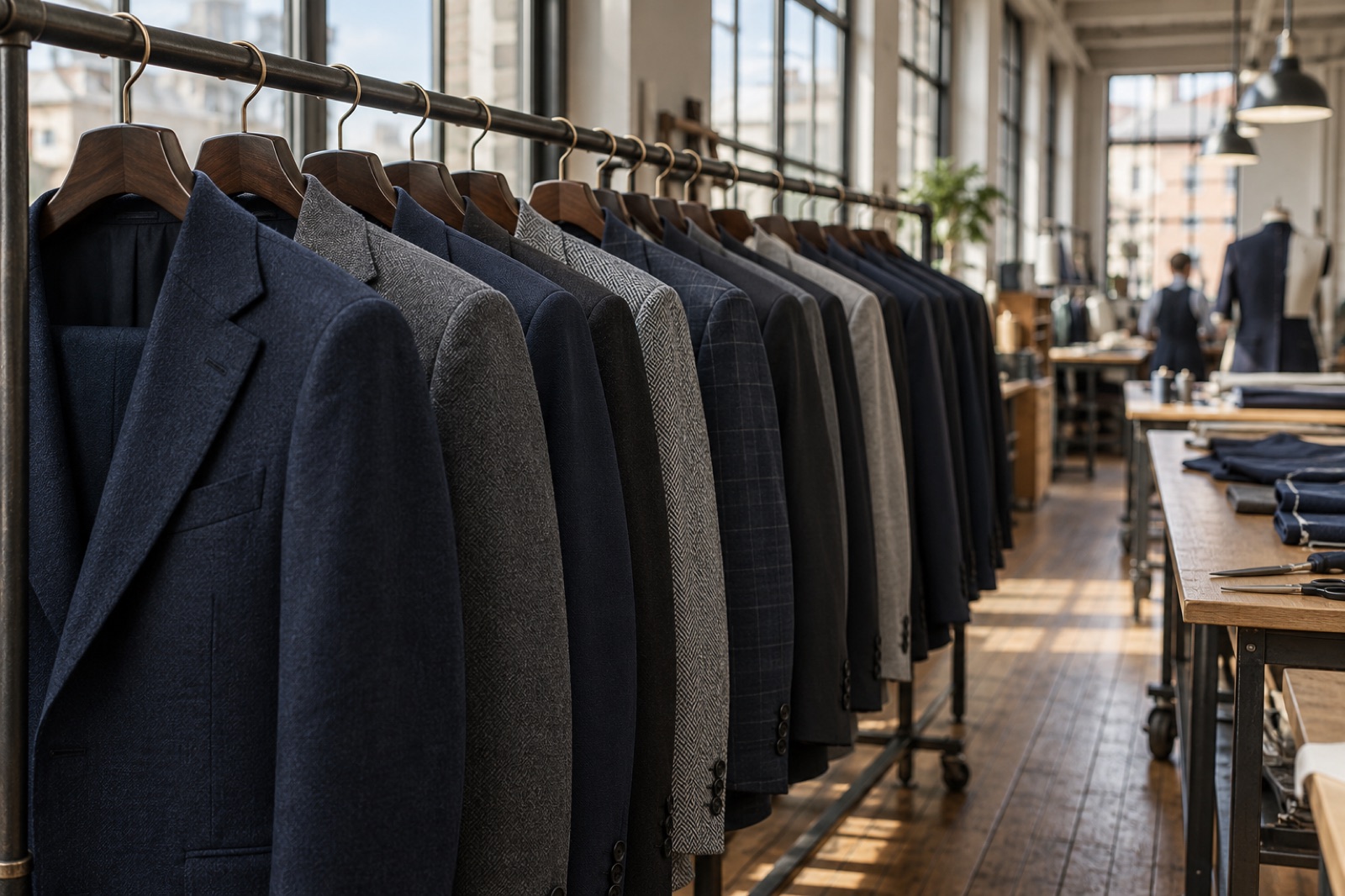
A three-button suit from our range. The label says where the garment was made, and that is a fact a shop's customer can check.
The second is when lead time to the shop door matters more than the price on the invoice. Formens publishes a standard lead time of usually 10 business days, and because it ships within the EU, there is no ocean freight or air cargo leg between the factory and the shop. From Shanghai, our 14 days in production is only the factory side. Shipping, whether by air or sea, adds its own time and cost on top. We break down exactly what sits between an ex-works quote and the price on the shop's shelf on our ex works vs FOB guide.
Formens also lists showrooms in Paris, Bad Wurzach in Germany, Occhieppo Inferiore in Italy and New York, and offers training at its Botosani head office. If being able to walk into a showroom with a customer's cloth in hand matters to the way you sell, that is worth knowing. A full side-by-side of Formens and us is on the Formens alternative page.
Davion was founded for the private label market and has offered made-to-measure to retailers since 2006. Its site does not publish prices, a minimum order or a lead time, so a direct comparison on those points is not possible from published information alone. The full side-by-side is on the Davion alternative page.
When published prices and a one-piece minimum matter more
Some shops do not need a European origin on the label. What they need is a price they can see before the first email, a minimum that lets them test with a single suit, and a factory that will make with cloth the shop already owns.
That is what we publish. Full make from USD 167 per two-piece suit, half canvas from USD 197, CMT with the shop's own cloth from USD 100, all ex works Shanghai. One piece minimum. 14 days in production from a confirmed order, shipping time and cost extra, import duties paid by the buyer. Every number is on the site before anyone picks up a phone.

Our Shanghai factory. Two sites, 200 house tailors, about 3,000 suits a month.
A shop that already holds cloth from a house we do not buy from, whether that is Fox Brothers, Harrisons of Edinburgh or any other, can send it to us and we cut, make and trim it from USD 100 per two-piece. The shop does not have to switch its cloth supplier to switch its factory.
We hold Zegna Trofeo and Traveller (162 styles) and Vitale Barberis Canonico Four Seasons (40 styles) in Shanghai, ready to cut. All other mills are ordered in, which adds the mill's own lead time on top of our 14 days.
A checklist before you choose
Before the first call with any of these three, or any maker not on this list, a shop should have clear answers to these questions:
- Does the label have to say a European country? If yes, a Shanghai factory is not the answer, however competitive the price.
- Do you need to see prices before the first conversation? If yes, ask whether the factory publishes them. Two of the three here do not.
- What is your trial order? A one-piece minimum means you can test the fit, the construction and the communication without committing to a batch. Ask what the minimum is and whether a trial piece costs the same as a production piece.
- Do you bring your own cloth? If you hold stock from a mill the factory does not buy from, ask whether they make CMT and what it costs.
- Where does the lead time start, and does it include shipping? A published number of days means different things if one factory counts from order confirmation and another counts from when the cloth arrives. Ask whether shipping is inside the number or on top.
- What happens when something is not right? We stand behind every piece: if something is not right, we make it right. Ask every factory the same question and compare the answers.
These six points are the same whether the factory is in Botosani, Porto or Shanghai. The answers are what differ, and the answers that are not published are the ones most worth asking.
Where to start
If you want to compare our numbers against what you pay today, the quickest way is the three-minute check: seven questions, free. You get the wholesale price sheet, your margin per suit at your own retail price, a direct line to a partner manager and an account on the ordering system.
See prices and your margin, 3 min
Or write to us directly on the contact page and tell us what you sell today. We will tell you what it would cost from Shanghai.
Frequently asked questions
Which made-to-measure factory should a European tailor shop use?
It depends on what matters most. Formens in Romania publishes a standard lead time of usually 10 business days and holds cloth from more than 40 suppliers in its workshop, inside the EU. Davion in Portugal makes under a European origin but does not publish prices, minimums or lead times. Centi Sartoria in Shanghai publishes prices from USD 167 per two-piece suit ex works, makes from one piece in 14 days in production, and accepts own cloth as CMT from USD 100.
Does Formens publish its prices or minimum order?
No. Formens describes its prices as competitive on its site but does not give figures, and it does not publish a minimum order. Its published standard lead time is usually 10 business days.
Does Davion publish its prices, minimum order or lead time?
No. The pages on davion.pt read on 2026-09-30 give none of the three and ask the buyer to get in touch for information.
Can a European tailor shop send its own cloth to a factory in Shanghai?
Yes. Cut, make and trim with a shop's own cloth starts at USD 100 per two-piece suit, ex works Shanghai. Production takes 14 days from a confirmed order once the cloth has arrived and been checked. Shipping time and cost come on top.
What is the landed cost difference between a European and a Shanghai factory?
The factory price is only part of it. A European maker ships inside the EU with no import duties, while a Shanghai shipment adds freight plus import duties paid by the buyer. A full breakdown of what sits between the factory quote and the price on the shelf is on the ex works vs FOB guide.