Journal Entry
Cloth Your Shop Already Holds: Making It Up When Your Factory Doesn't Buy From That House
A tailor shop does not need to abandon cloth it already owns just because the factory does not stock that house. CMT starts from USD 100 per two-piece suit, and the only question is how much to ship.
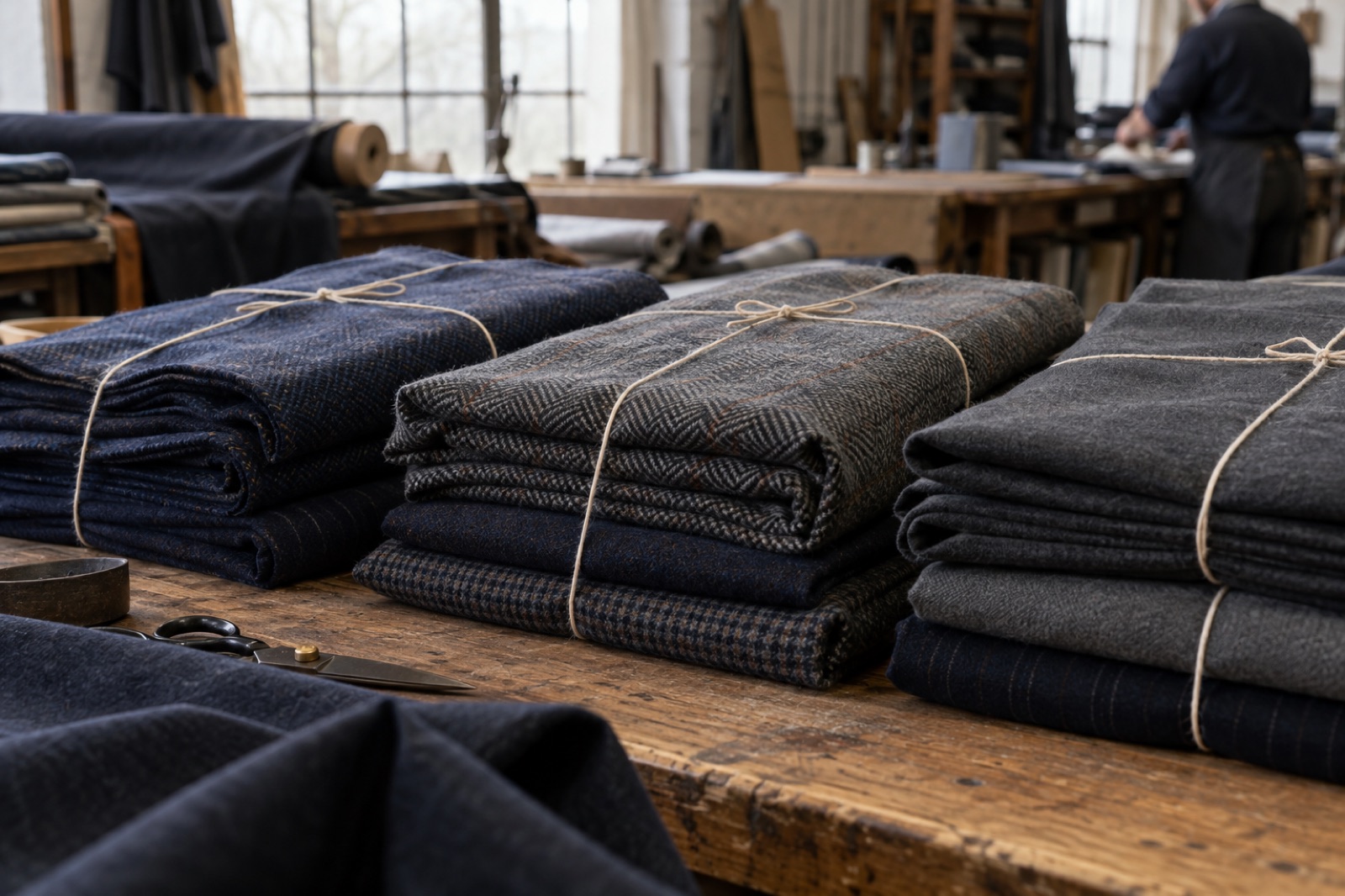
A shop owner rang last autumn about three bolts of cloth sitting on a shelf behind her till. She had bought them at a trade show two seasons earlier: a grey flannel, a glen check she liked for autumn jackets, and a bolt of navy worsted from a house she had worked with once before. The customer they were meant for had cancelled, her factory at the time only worked with its own range, and now the cloth was dead stock she could neither sell nor use. She asked one question: can you make it up?
We could. The arrangement is called cut, make and trim. The shop sends the cloth, we cut, sew and finish the garment. The work goes through the same cutting tables and the same 200 tailors in our Shanghai workshop as every other order. The only difference is where the cloth came from. That season we made up all three bolts, and the finished jackets sold within the month. The shelf was clear by December.
Which suit factories do CMT with a tailor shop's own cloth, and what does it cost per suit?
Most made-to-measure factories that serve tailor shops accept CMT. The question worth asking is not whether a factory offers the service but what the quoted price covers and what it leaves out. At Centi Sartoria, CMT starts from USD 100 per two-piece suit, ex works Shanghai, with a one-piece minimum. Production takes 14 days from a confirmed order once the cloth has arrived and been checked. That price covers cutting, sewing, your choice of fused, half canvas or full canvas interlining, lining, buttons, shoulder pads, sleeve heads and finishing. The cloth is yours. Shipping from Shanghai and import duty at your end are extra.
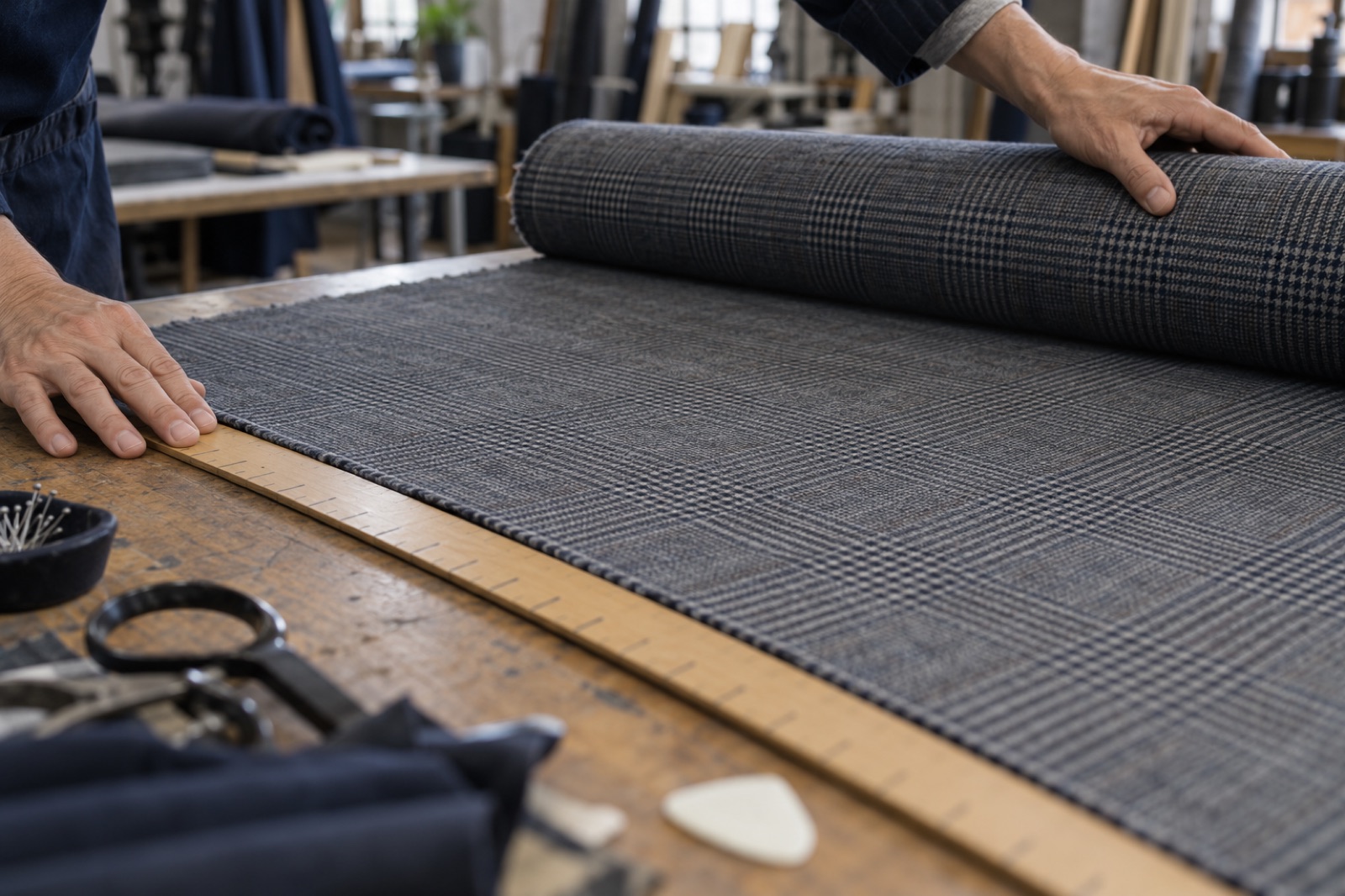
A length of cloth arriving at the cutting table for inspection before the pattern goes down.
We list 33 mills and cloth merchants on our own fabric range, 26 of them in Europe, and for shops that want us to supply the cloth as well our full make price starts from USD 167 per two-piece suit. But CMT means the cloth can come from anywhere: a house on our list, a house not on our list, or a length a customer walked into your shop carrying. The cloth does not need to match our range. It needs to arrive in sufficient quantity and pass a visual check. For working figures on how much cloth to send and what happens if it runs short, our CMT page has the detail.
When your own cloth is the right call
Three situations come up regularly, and in all three the answer is CMT.
You already own the cloth. It is on a shelf, paid for and not moving. Making it up turns dead stock into a finished garment with a margin attached. For USD 100 in making costs, you get a made-to-measure suit out of fabric that was otherwise sitting in your back room depreciating with every passing season. A shop that buys at trade shows, or that orders cloth in lengths for specific customers who then cancel, will recognise this shelf immediately.
The cloth comes from a house your factory does not buy from. Drapers, Fox Brothers, Harrisons of Edinburgh: names a shop's clients ask for that are not part of every factory's supply chain. We do not carry Fox Brothers or Drapers on our order list, and we are not agents or representatives for any mill or cloth merchant. But if your shop holds lengths from those houses, CMT is how they get made into garments. Harrisons of Edinburgh appears in our world only through one connection: Vitale Barberis Canonico's Solaro collection is licensed by Harrisons and woven by VBC. Everything else from Harrisons would arrive as CMT. If you want Fox Brothers flannel for an autumn shop window, you buy it from Fox Brothers and ship it to us.
A customer brings a specific cloth. Some clients arrive with fabric they have bought themselves, from a cloth merchant, a mill sale or an estate. Rather than turning them away, send what they have and we make it up the same way. A shop that says yes to customer-supplied fabric keeps the making fee and the relationship. A shop that says no sends that customer to somebody who will.
The situation where CMT does not save money is also clear. If you have to buy the cloth new anyway, compare the total landed cost of purchasing plus shipping it to Shanghai plus CMT against our full make price. On commodity business weights in the 240 to 300 gram band, where 597 of our 822 weighed fabrics sit, the difference is often small enough that the logistics cost wipes out whatever you saved by sourcing your own cloth. CMT saves money when the cloth is already in your hands and you are choosing between making it up and leaving it on a shelf.

A glen plaid from our range, cut from cloth we hold. CMT lets a shop send its own check instead.
What to settle before you ship the cloth
Sending fabric halfway around the world before settling the details costs time on both ends. Agree on these points first.
- Construction. Fused, half canvas or full canvas? The CMT starting price of USD 100 is for a fused two-piece. Half canvas and full canvas cost more (our construction guide shows the structural difference). Heavier cloth generally earns its keep in a canvas jacket.
- Quantity. How much cloth to send depends on the pattern for that person, not a generic yardage table. Our CMT page has the working figures. The rule is always the same: calculate from the individual measurements and the design, add a margin for matching and contingency, and agree in advance what happens if it runs short.
- Measurements. The same measurement form as every other order: 47 fields, 31 required. One person, one tape measure, one spec sheet, whether the cloth is ours or yours.
- Labels. The garment is made in Shanghai. The label says Made in China. If your customer or market requires a specific care label, brand label or fibre content tag, send those with the cloth or agree on the wording before production starts.
- Shipping to us. You ship the fabric to our Shanghai workshop at your cost. We inspect it on arrival. Production runs 14 days from a confirmed order, and for CMT that clock starts after the cloth has been checked. Finished garments ship back to you, with shipping and import duty at your end.
- What to expect back. A finished made-to-measure garment cut to your customer's measurements, made with your cloth, in the construction grade you chose. We stand behind every piece: if something is not right, we make it right.

Pattern matching at the pocket flap and cuff. One of the things a shop checks when the finished garment arrives.
What CMT does not cover
CMT is a making arrangement, not a fabric sourcing service. We do not source cloth on your behalf from a house we do not carry. If you want cloth from a smaller English, Scottish or Italian weaver whose name does not appear on our supplier list, you buy it from them or your cloth merchant and ship it to us. We cut and sew. We do not negotiate with the mill, hold their stock or act as their representative.
CMT also does not change the timeline in the one direction most shops forget to plan for. If your cloth has to cross an ocean to reach Shanghai, that shipping time comes before the 14 days of production, not during it. A CMT order for a customer with a date needs the cloth in Shanghai well ahead of the deadline, and the transit time from Europe or the United States to China is measured in weeks, not days.
For a broader look at what we stock for wholesale supply alongside CMT, including trims, linings and ready cloth, that page covers the rest of the range.
The fastest route is see prices and your margin, 3 min: seven questions, free, and you get the wholesale price sheet, your margin per suit at your own retail price, a direct line to a partner manager and an account on our ordering system. If you already have cloth on a shelf, mention it in the notes. Or get in touch directly and we will walk through the CMT details with you.
Frequently asked questions
Which suit factories do CMT with my own cloth for a tailor shop, and what does it cost per suit?
Most made-to-measure factories that serve tailor shops accept cut, make and trim. At Centi Sartoria, CMT starts from USD 100 per two-piece suit, ex works Shanghai, from a one-piece minimum. Production takes 14 days from a confirmed order once the cloth has arrived and been checked. The price covers cutting, sewing, interlining, lining, buttons, shoulder pads, sleeve heads and finishing. Shipping and import duty are extra.
Can I send cloth from a house my factory does not stock?
Yes. CMT means you supply the cloth. If your shop holds Fox Brothers flannel, Drapers tweed or a length from any other house not on your factory's list, the factory cuts and makes it the same way it handles its own range. The only requirements are that the cloth arrives in enough quantity and passes a visual check before cutting begins.
How much cloth do I need to send for one suit?
The amount depends on the pattern for that individual, not a fixed table. Your factory should calculate the requirement from the measurements and the design, then add a margin for matching and contingency. Ask before you ship rather than guessing from a generic yardage number.
Is CMT cheaper than ordering full make with the factory's own cloth?
Sometimes. If you already own the cloth, your only cost is CMT plus shipping the fabric to the factory. If you have to buy the cloth new, compare the total landed cost of purchasing plus CMT against the factory's full make price, which includes cloth. On standard business weights in the 240 to 300 gram range, the difference can be small.
What happens if the cloth I send is not enough to cut the pattern?
A responsible factory inspects the cloth on arrival and tells you before cutting. Once a length has been cut, the cloth cannot be replaced, so the conversation about quantity always happens first. Agree on who bears the risk of a shortfall before you ship.