Journal Entry
Best Made-to-Measure Suit Manufacturer: Take the Test, Not the Verdict
Every guide to choosing a made-to-measure suit manufacturer is written by someone who wants to be chosen, including this one. Here is the test to run on any supplier, the four supplier types compared honestly, and where we are not the right fit.
Two months ago a buyer forwarded me a PDF titled something like "7 Questions to Ask Your Manufacturer Before You Sign." No logo I recognised, a tidy checklist underneath: cloth origin, construction, turnaround, minimum order. Sound advice, all of it, until question five: does your partner offer tiered pricing after your first three orders. And question seven: can your team be onboarded onto a shared ordering system. I read those twice before it clicked. Someone had turned their own product roadmap into a scorecard and mailed it to a stranger as neutral advice, and the buyer had no way to know, because nothing on the page said who had written it.
We have done the same thing. Not with that document, with this one: a guide telling you how to choose a made-to-measure suit manufacturer, written by a made-to-measure suit manufacturer.
So read what follows by taking the questions and leaving the conclusion. Every guide to choosing a supplier, ours included, was written by someone who wants to be chosen. The questions are still useful. Put them to every name on your shortlist, including ours, and trust your own answers over anyone's copy, this page included.
The test matters more than the verdict
That is the spine of everything below. The article compares the four types of made-to-measure suit manufacturer that retailers and brands buy from, then turns the same test on us, including the parts we do not pass well. If you take one thing from this page, take the six questions in the next section and put them to every supplier on your list. Ask us last, once you already know what a good answer sounds like.
Six questions to ask any supplier
A serious supplier answers all six clearly and in writing, not with a call that never quite arrives at specifics.
- Minimum order. Can you buy one suit, or are you being pushed toward a bulk run you did not ask for?
- Construction. Do you choose between fused, half canvas and full canvas, or does every quote land on fused? The difference is laid out in our construction comparison, and it is worth reading before the rest of this matters much.
- Cloth. Are the mills named and checkable, or is it "fine Italian wool" with nothing behind it?
- Real customisation. Lapel, canvas, lining, fit, on one garment, not a handful of stock sizes with a new label sewn in.
- Fit and measurement. How many fields does the form capture, and will they show you the form before you commit? Our own fit system is where we answer that for our process specifically.
- When something is wrong. Not a vague promise to make it right. Get the split in writing: who decides fault, and who pays for rework and the second shipment.
That is the abbreviated list. The longer one, with the exact wording to use on a call and what a dodge sounds like, is in our guide on starting a clothing brand.
Four supplier types and their costs
Almost every supplier you meet is one of four types, and none of them is bad. Each is built for a different order size and a different relationship, and each has a cost that a sales call will not volunteer.
| Supplier type | Built for | Where it costs you |
|---|---|---|
| Online platform | Fast, low-commitment testing with no minimum stress | Construction is fixed and customisation stops at a handful of presets |
| Volume OEM factory | The lowest price per unit, at real scale | Minimums run into the hundreds, and one custom request can stall the whole line |
| Local tailor | Full customisation and one relationship, no minimum | Capacity tops out quickly, and a second shop or a second city has nothing to lean on |
| Production partner (our type) | Small orders with real construction and named cloth | You are trusting a workroom you may never stand inside, on a pattern block that belongs to the factory, not you |
The online platform is the easiest first step and the least reversible ceiling: fast to test, cheap to start, and structurally unable to give you full-canvas construction later without a change of supplier. The volume OEM factory rewards exactly one thing, order size, and a single custom request is often enough to get your account deprioritised until the next bulk cycle. That last column in the table is the one most guides in this category leave blank for themselves.
If you are weighing the local tailor row specifically, a closer look at running suit production through a tailor shop covers where that capacity ceiling sits. A scaling comparison across multiple locations is worth reading if the choice in front of you is local tailor versus production partner, because that is usually where the decision gets made. And if your plan depends on a minimum order that does not exist at the volume end of this table, read that before you sign with anyone in the bottom two rows. A longer, scored version of this whole comparison lives in how to choose a suit manufacturer.
How we answer our own test
Here is how Centi Sartoria answers the six questions, with the numbers behind each answer so you can check them rather than take them from us.
Our minimum is one suit. That used to be rare. It is not any more, across three of the four rows in the table above, so do not spend your one screening question on it. Spend it on construction and cloth instead.
Our standard production window is 14 to 20 working days, booked separately from shipping. If you need a fully customised bulk order delivered inside a week, we will tell you we cannot do it before you place the order, not after.
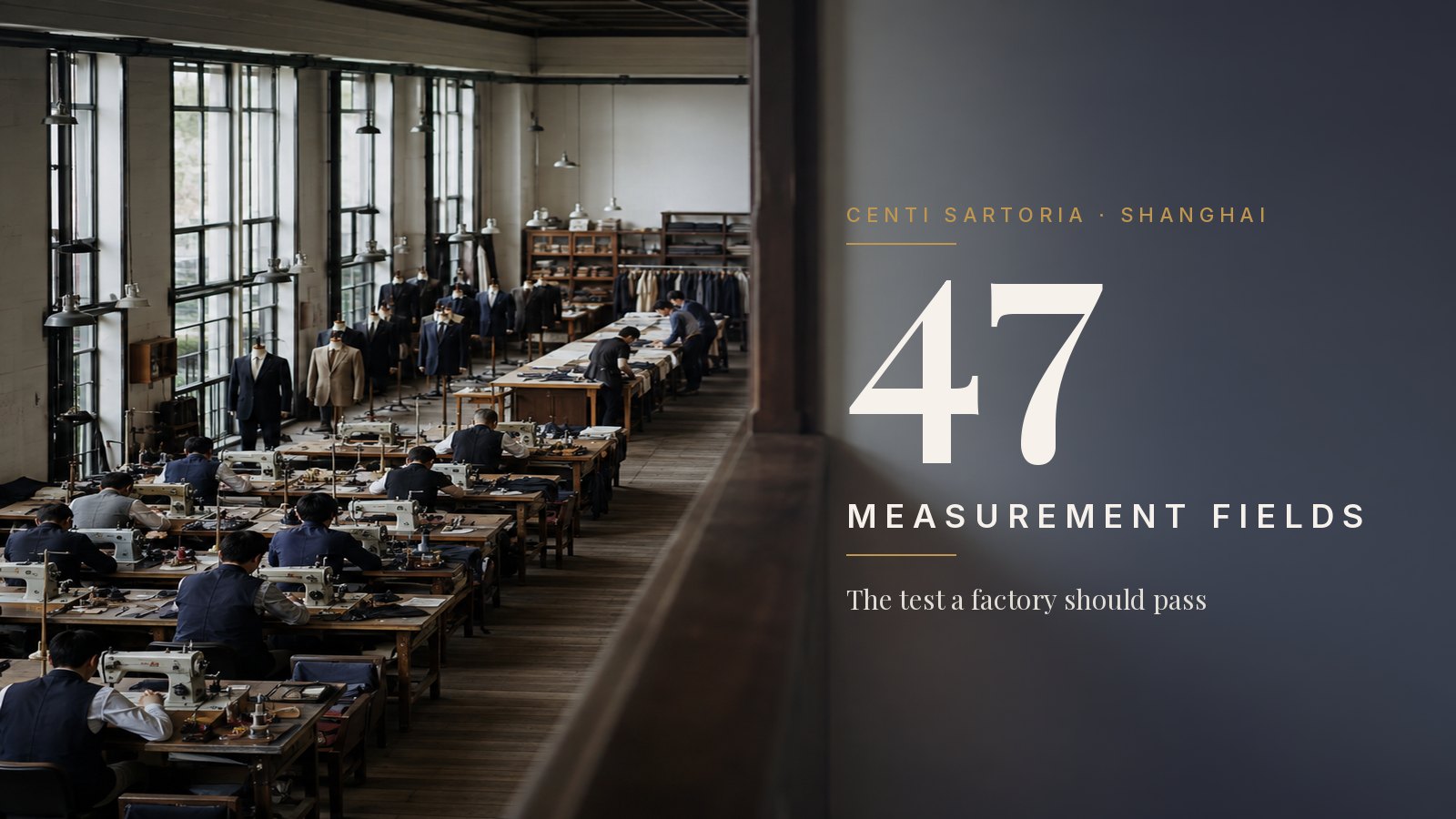
Our size chart captures 47 measurement fields in total, including several a stock chart never asks for, like stomach, front chest, back chest and sleeve cuff on the jacket alone. Ask any supplier, us included, to show you the form itself before you send a client's measurements anywhere. If they will not show it, that is your answer.
On customisation, the number is 347 style options across jacket, trouser, waistcoat and shirt combined, 159 of those on the jacket alone. A number like that only tells you something once you ask the follow-up: how many of those options can you combine on a single order before a surcharge appears. That is usually where full customisation turns into a shorter list with a few extra boxes to tick.
Our cloth comes from named, checkable mills: Ermenegildo Zegna's Trofeo (240 grams) and Traveller (250 grams) lines, 162 styles between them; Vitale Barberis Canonico's Four Season line at 280 grams, 40 styles; and smaller specialists including Corsini, Nobility, which carries a 185 gram linen, and T.Ingeniator, with shirting running through Corsetti. None of it is blended. Every fabric in the range is a single fibre, mostly merino wool, with straight wool, linen and a small run of cotton filling out the rest, so a composition claim is one you can hold a supplier to exactly rather than roughly. Of the 831 fabrics we carry, 822 list a stated weight, and 597 of those sit between 240 and 300 grams, the band a commercial jacket should live in. Go meaningfully under that and a jacket will look sharp folded on a shelf and creased by mid-morning on someone's back. Naming a mill is not the same as proving the cloth is what they say it is; ask for the bunch number, not just the country, from us or from anyone else.
Our pricing starts at €108 ex-works for a Classic two-piece and €254 ex-works for a full-canvas two-piece, because floating a canvas through a whole front takes hours that fusing skips entirely. Note what that price does not tell you: whether the canvas was padded by machine or by hand. Those are two different jobs sold under one name, and the price on any quote, ours included, is worth reading with that question attached. If a quote from anyone lands near the bottom of that range without naming the construction, ask what got cut to reach that number. Then check what the number becomes once freight and duty are added; our landed cost breakdown walks through that, and the margin model built around one number is worth running before you commit to any price on this page, ours included.
On what happens when something is wrong, our answer is the same instruction we gave you for question six: get it in writing before you order, not after, whichever supplier you choose. We are not going to turn that into a marketing line here.
We manufacture in Shanghai, and we are not treating that as a detail to bury; more on how and why is in made-to-measure suit manufacturing in China. The next section covers who that should rule out.
Who we are not a fit for
A guide like this only means something if it also says no. Here is where we are not the right supplier, without softening it.
If you need a pattern you can take with you, we are not it. Private-label and white-label work, ours included, is built by adjusting the factory's own pattern block to your spec. That pattern stays with the factory, never with you. Read private label versus white label versus OEM before you assume otherwise of any manufacturer, us or anyone else.
If your label needs to say Made in Italy, walk away from us now. Our cloth is largely European, some of it Australian, and verifiable. Our garments are cut and sewn in Shanghai, and the label says so. We are not going to find a workaround, and anyone who tells you they can put European cloth on a Shanghai-made jacket and still call it Made in Italy is lying to you, not just to us.
If you will not commit without standing in the workshop yourself, and you have no plan to travel, we are a harder fit than we would like to admit. We ship swatches and full sample garments, and that answers most of what a buyer wants to know. It does not answer the part where some buyers need to watch the cutting table with their own eyes before they trust a factory at all, and a courier package is not a substitute for that, whatever we say to reassure you.
If you are buying at high volume on unit price alone, a dedicated commodity line built to run one style in the thousands will beat our price every time. That is what that line is built for. We are built for the opposite problem, small orders with real construction choice, and trying to be good at both at once is how a supplier ends up mediocre at each.
And if you need a full batch delivered next week, we are not your supplier either. Fourteen to twenty working days is the real number, and we would rather lose the order than promise something we already know we cannot hit.
Before you write any of this off, our guide on what to check before you start covers the wider version of these questions for a first-time brand, not only the manufacturing ones.
Run the test on everyone
None of the six questions above belong to us. They work on any manufacturer you are evaluating, including the next one that sends you a PDF with its own name nowhere on it. Ask about minimum order, construction, named cloth, real customisation, a realistic lead time, and what happens when something goes wrong. Write down the answers before you compare a single price.
If you want to run that test on us directly, with your own spec and your own numbers, get in touch and I will answer in writing, in the order you asked.
Frequently asked questions
How do I choose a made-to-measure suit manufacturer?
Ask every candidate six things in writing: minimum order, construction choice, named and checkable cloth, how deep the customisation goes, a realistic lead time, and what happens when something arrives wrong. Do not treat the answers as a scorecard for whoever wrote the guide you found them in, including this one. Ask us the same six questions before you ask anyone else, and ask us last.
Which supplier type is best for a retailer or brand?
No single type is best for everyone. Online platforms suit fast, low-commitment testing where construction options matter less than speed. Volume OEM factories suit brands ready to commit to large runs of one style. Local tailors suit a single shop that wants full craft with no minimum. Production partners like us suit shops and brands that want real construction and named cloth without holding stock, provided you are comfortable working on the factory's own pattern block rather than one you can move elsewhere.
What minimum order should I expect from a made-to-measure suit manufacturer?
It depends on the type. Volume OEM factories often want dozens or hundreds of units per style. Online platforms and production partners can typically work from a single suit. Centi Sartoria's minimum is one suit, but do not let that decide your shortlist on its own; it no longer separates a serious supplier from a weak one the way it did a few years ago.
How long does made-to-measure suit production take?
A garment cut to a client's measurements needs real production time. Centi Sartoria's standard is 14 to 20 working days before shipping, which is booked separately and varies by destination. Be careful with any supplier promising a fully customised order inside a week; on true made-to-measure work, that is not a promise worth trusting from anyone, including us.
Can a manufacturer put my own brand label in the suit?
Yes. This is white-label or private-label production: the manufacturer builds to your specification, sews your label in, and never appears on the finished piece. Centi Sartoria works this way by default. What is worth checking with any partner, us included, is whose pattern block the garment is built on. Most white-label work, ours too, is cut on the factory's own base pattern and adjusted to spec, not on a pattern you own and could take elsewhere.
Does manufacturing in China mean lower quality?
No, and we will not dodge the other half of that question either. Our cloth comes from European and some Australian mills; our garments are cut and sewn in Shanghai, and the label says exactly that. Quality is set by construction, named cloth and inspection, not by the country stitched into the collar. If you need a garment that can legally carry a Made in Italy label, manufacturing in Shanghai is the wrong answer regardless of what the cloth cost, and we would rather tell you that now than after your first order.