Journal Entry
Who Owns the Biella Mills: Tallia, Guabello and Cerruti Inside Marzotto and Piacenza
Tallia di Delfino, Guabello and Cerruti share a Biella postcode but not an owner. A plain map of which holding group sits behind which bunch card, and why it matters when your client asks.
A shop owner in the Netherlands asked me last month why his Guabello invoice arrived from a company called Marzotto. He had been ordering the cloth for two years and never noticed, because the bunch card said Guabello and his clients only saw the bunch card. The question behind it was simple: if Marzotto owns Guabello, does the same group own Tallia di Delfino too? And what about Cerruti, whose name he kept seeing on a different shelf?
The answer is not complicated, but it is split across two different holding groups, and no swatch card in the world will tell you that. Here is the map.
Two groups, three mills, one valley
The Biella valley holds dozens of mills, and a handful of holding groups own most of the names a shop is likely to carry. For the three mills on this page, the ownership breaks down into two groups.
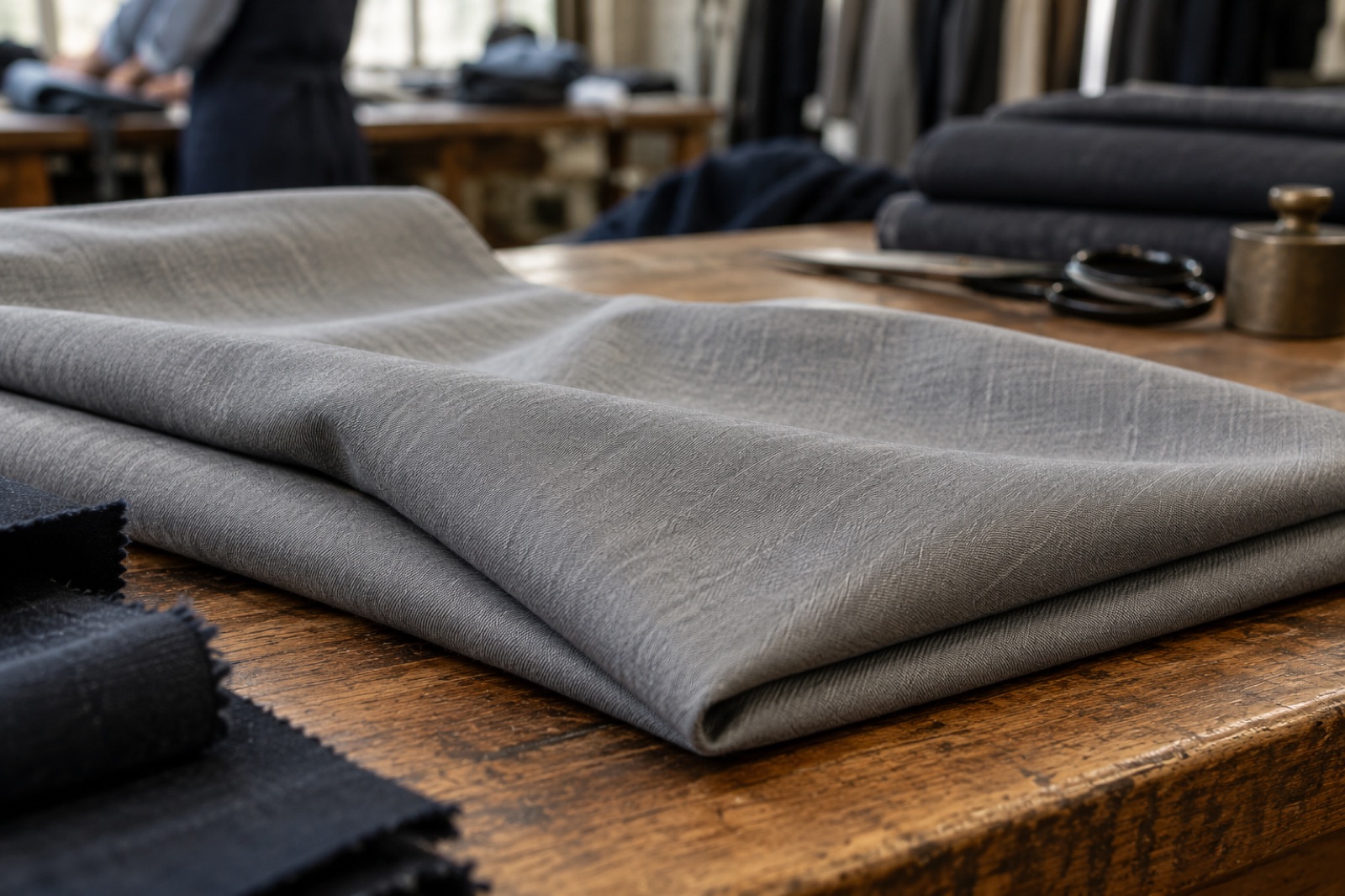
Light grey worsted, the kind of cloth these Biella mills have woven for generations.
Marzotto Group holds:
- Fratelli Tallia di Delfino (joined 2008). Roots traced to 1903 in Strona. Sources merino, cashmere, vicunja, mohair, silk, linen and hemp. Weaves as fine as Super 200s in its Suprema Lana bunch. The mill states 100% of production still stays in Strona.
- Guabello (part of Marzotto since 1991). Founded 1815 in Mongrando. Known for its Super 130s Onethirty collection. Full production still run at the single Mongrando site.
Gruppo Piacenza holds:
- Lanificio F.lli Cerruti (bought outright November 2022). The Biella wool mill founded on the Cervo river in 1881. Previously backed by private equity firm Njord Partners from 2018. Now under the same roof as Piacenza 1733, the noble fibre specialist.
That is the entire ownership map for these three names. Everything that follows is context a shop needs when the bunch card does not answer the question.
Marzotto fabric: what the group name means on your paperwork
Marzotto Group describes itself as the largest European textiles group. In April 2024, Faber Five, the Favrin family's holding company, took a majority stake in the group. That deal sits above the mill level: it changed who owns Marzotto, not what Tallia di Delfino or Guabello weave.
What matters to a shop placing an order:
- Tallia di Delfino invoices come from Biella Manifatture Tessili Srl, under the coordination of Marzotto Wool Manufacturing. That legal name is printed at the bottom of the mill's own website, not on the collection pages a buyer usually reads. If your accountant or customs agent needs the company name, it is that one, not "Fratelli Tallia di Delfino."
- Guabello invoices come through its Lanificio Guabello name, also inside Marzotto. The mill has stayed on one site in Mongrando for over two centuries.
A group acquisition at the holding level does not change what the weaving floor does. The looms stay. The building stays. The weavers who have been running those looms for decades stay. What changes is the name on the invoice and the entity your accountant files under, a distinction that matters once a year at tax time, not once a week at the cutting table.
Neither mill's bunch numbers changed when they joined the group. A Tallia di Delfino Suprema Lana swatch carries the same reference it had before 2008, and a Guabello Onethirty card carries the same reference it had before 1991. If a client brings in an older swatch and asks you to reorder, the bunch number still works.

A light grey suit from our range, the kind of cloth Guabello and Tallia di Delfino both weave well.
We order both mills' cloth against confirmed orders. Neither is held in our Shanghai warehouse. The mill's own lead time runs before our 14 days in production start, and shipping is extra. Full details sit on each mill's own page: Tallia di Delfino and Guabello.
Cerruti: the mill that left one group and joined another
The Cerruti name trips people up more than any other on our supplier list, because two separate companies share it. Lanificio F.lli Cerruti is the Biella wool mill, founded in 1881. The Cerruti 1881 fashion house was launched in Paris in 1967 by Nino Cerruti, who used his grandfather's founding year as the brand name. Nino sold the fashion house in 2000. It is now owned through Hong Kong's Trinity Limited, controlled by China's Shandong Ruyi group since 2017. The two companies have not been connected in any operational sense for over two decades.
We buy from the mill, not the fashion brand.
In November 2022, Gruppo Piacenza bought the mill outright. That put Lanificio F.lli Cerruti under the same Biella family group that owns Piacenza 1733, the cashmere and vicunja house. The ownership is shared; the cloth is not interchangeable. Cerruti's strength is worsted suiting. Piacenza's strength is the noble fibre range sitting above it.
A Cerruti order now routes through Gruppo Piacenza's Biella office, not through the mill on its own. If your supplier list still names a separate Cerruti entity, update it.
A checklist for when a client asks "who makes this?"
A client pointing at a swatch card and asking who made the cloth is asking a fair question. Here is what to have ready:
- Mill name vs group name. The bunch card says Guabello. The invoice says Marzotto. Both are correct. The mill weaves it; the group owns the mill.
- Legal entity. For compliance paperwork, you need the legal name, not the brand. Tallia di Delfino is Biella Manifatture Tessili Srl. Cerruti is Lanificio F.lli Cerruti, now under Gruppo Piacenza S.p.A. Get this in writing before you hand it to an accountant.
- Production site. Tallia di Delfino: Strona. Guabello: Mongrando. Cerruti: Biella, on the Cervo river. All three still weave at their historic sites.
- Fashion brand confusion. Only Cerruti has this problem. The fashion house is a separate company in Hong Kong. If a client says "Cerruti" expecting a Paris runway story, correct them before they repeat it to their own customer.
- Bunch numbers survive ownership changes. A group acquisition does not reset a mill's reference system. The same bunch, the same cloth, the same number.

Grey worsted from our range. The sleeve buttons and the cloth are what a client sees; the holding group behind the mill is not.
Why consolidation keeps happening in Biella
The Biella valley has seen steady consolidation. Marzotto added Tallia di Delfino in 2008 and had Guabello since 1991. Gruppo Piacenza bought Cerruti in 2022, added Lanificio Piemontese in 2020, and then acquired Arte Tessile, a jacquard and raschel specialist. In December 2025, Como-based Gentili Mosconi acquired Lanificio Cesare Gatti in Biella through a court process.
The pattern is the same each time: a smaller mill that can no longer carry fixed costs on its own joins a group that can. For a shop, the practical effect is that the name on the swatch card stays the same, the bunch numbers stay the same, and the invoice arrives from a different legal entity. Check the entity before you file it.
None of this changes what we cut. We buy cloth from these mills as a customer, not as an authorised supplier, dealer, licensee or representative of any of them. A two-piece suit in Guabello or Tallia di Delfino or Cerruti cloth starts from USD 167 ex works Shanghai in our cloth, with a one-piece minimum, 14 days in production from a confirmed order, and shipping extra. If the shop already holds its own cloth from any of these mills, we cut it under CMT from USD 100.
For a broader look at how these three sit alongside the other 30 names on our list, see the full fabric brands guide and the supplier list. The mill-specific detail, including collections, books and stock status, sits on each supplier's own page: Tallia di Delfino, Guabello, Cerruti 1881, Piacenza 1733.
For the Italian fabrics that work best in a shop's everyday range, our guide on Italian suit fabric for a shop's core range covers the practical side.
Frequently asked questions
Does Marzotto Group own Tallia di Delfino?
Yes. Fratelli Tallia di Delfino joined Marzotto Group in 2008. The legal entity behind the brand today is Biella Manifatture Tessili Srl, under the coordination of Marzotto Wool Manufacturing. The mill states 100% of production still stays in Strona, in the Biella valley where it started.
Is Guabello the same company as Marzotto?
No, but Marzotto owns it. Guabello has operated as a division of Marzotto Group since 1991. It still runs production at its original single site in Mongrando, Biella, where Antonio Guabello and his brother founded it in 1815.
Who bought Lanificio F.lli Cerruti from the Cerruti family?
Gruppo Piacenza bought Lanificio F.lli Cerruti outright in November 2022. The private equity firm Njord Partners had held a stake from 2018. The Biella wool mill is now under the same ownership as Piacenza 1733, the noble fibre house.
Is Cerruti 1881 the fashion brand the same as the Biella wool mill?
No. Lanificio F.lli Cerruti is the Biella wool mill, founded in 1881. The Cerruti 1881 fashion house was launched in Paris in 1967 by Nino Cerruti, sold by him in 2000, and is now owned through Hong Kong's Trinity Limited. The two are separate companies.
Does it matter to a tailor shop which holding group owns a Biella mill?
It matters for paperwork, not for cloth. An invoice from Tallia di Delfino arrives from Biella Manifatture Tessili Srl, not from a company called Tallia. A Cerruti order routes through Gruppo Piacenza's Biella office, not through the fashion brand. Getting the legal name wrong costs time at customs or with an accountant.