Journal Entry
Cloth Merchant or Mill: What the Name on the Bunch Tells a Shop
Half the names on a tailor shop's fabric shelf belong to cloth merchants, not mills. A guide to which of our 33 suppliers weave their own cloth and which commission it, and what the difference means for lead times, bunch overlap and pricing.
A shop owner asked us last month why the same grey pinstripe turned up in two different bunch books with two different numbers. He had been showing one book to clients for a year, and a colleague across town was selling what looked and felt like the same cloth from a different house at a different price. Neither was counterfeit. The cloth was real, the numbers were both valid, and the explanation was simple: both names on the covers were cloth merchants, not mills, and both had commissioned the same weave from the same Yorkshire loom.
That is the sort of thing that never comes up until it costs you a conversation with a client. A cloth merchant and a mill do different jobs in the supply chain, and knowing which is which changes how you order, how long you wait, and what you tell the person standing at your counter.
What a Cloth Merchant Does, and What a Mill Does
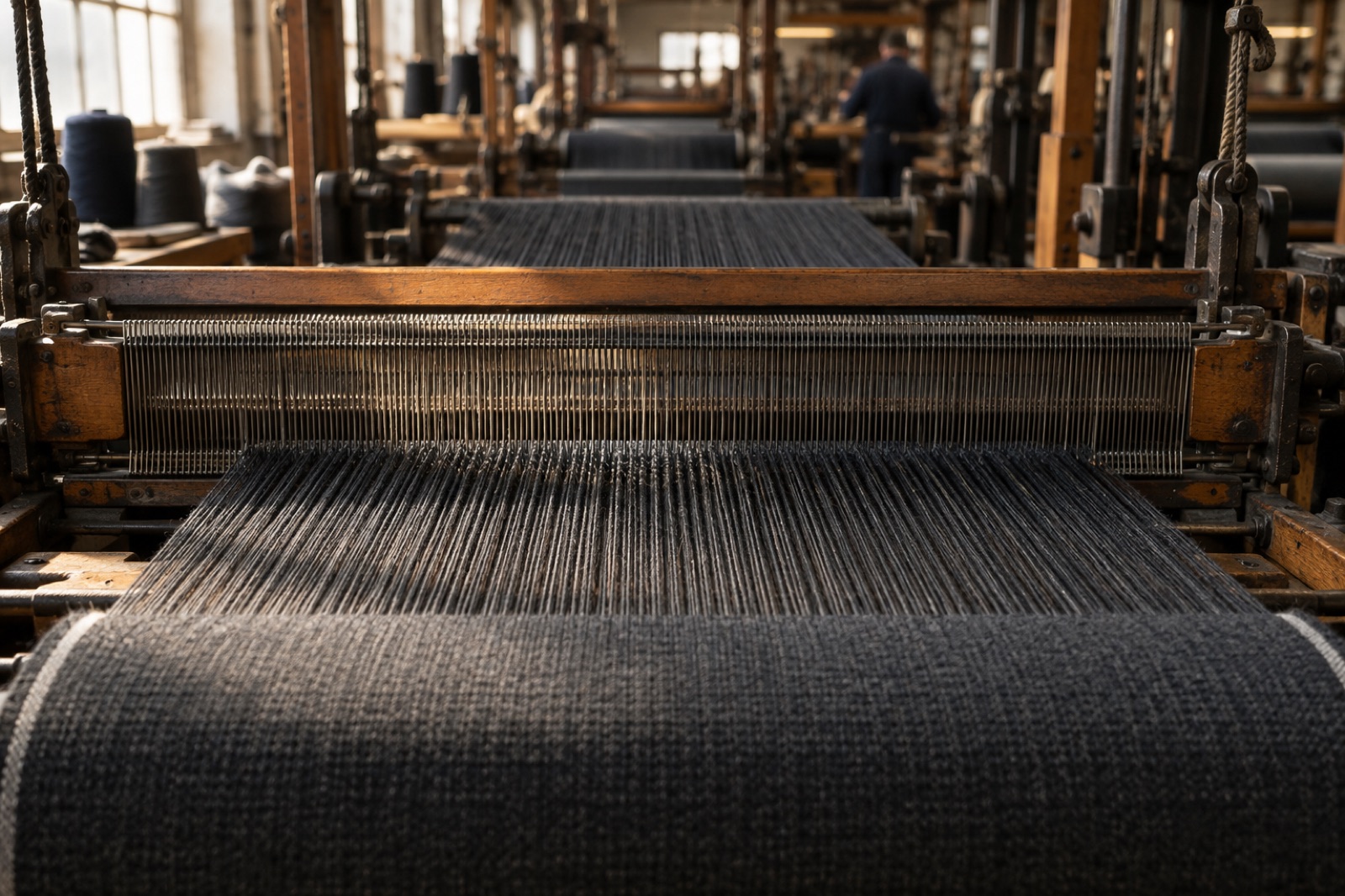
A mill weaves. It owns looms, it buys yarn, it runs the yarn through those looms, and what comes off the other end is a bolt of cloth. The large Italian mills handle most of the process under one roof: Zegna in Trivero, Vitale Barberis Canonico in Pratrivero, Reda in Valle Mosso, Drago in Lessona. They spin, they weave, they finish, and the cloth carries their name because they made it.
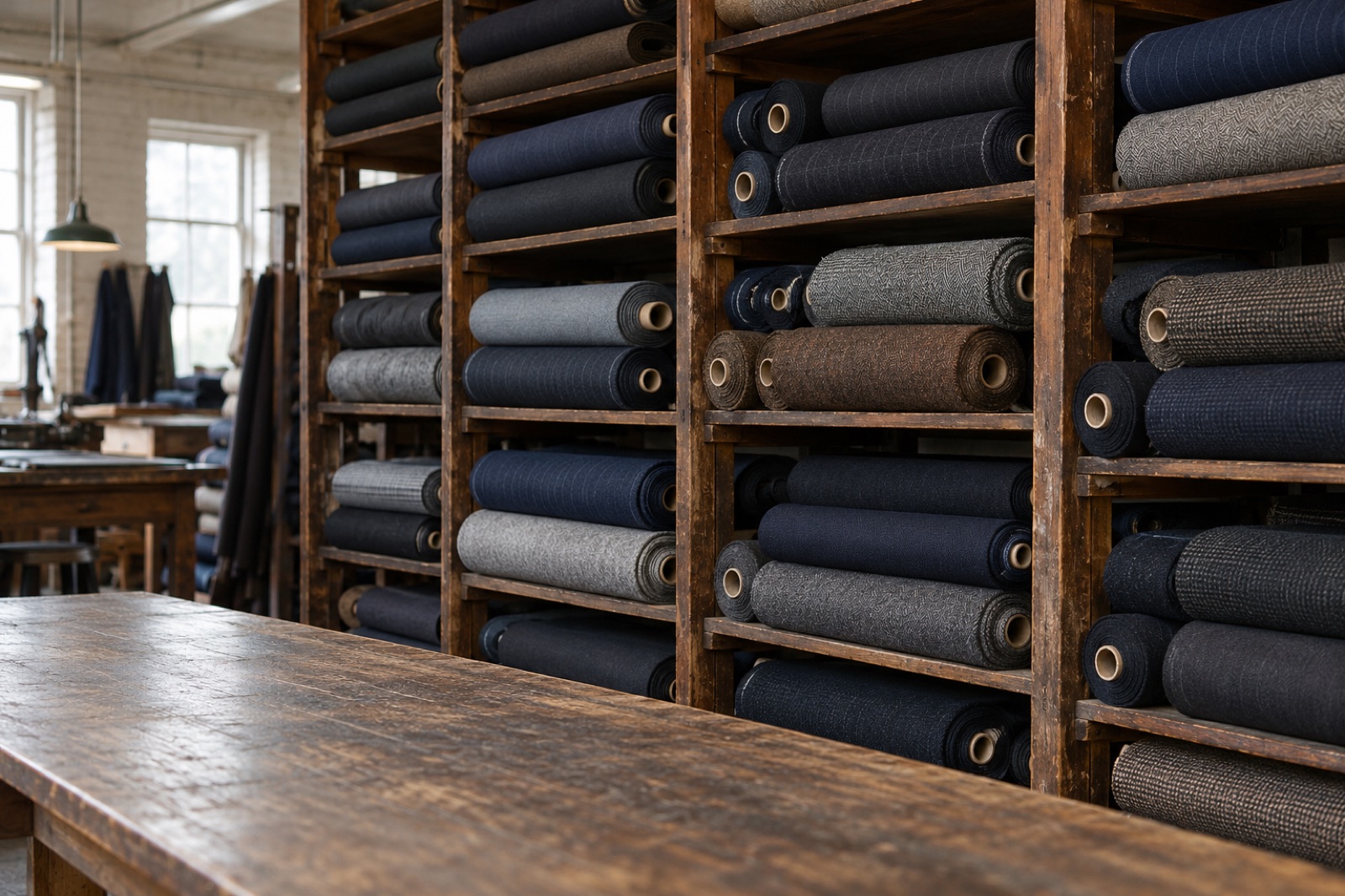
A merchant's stockroom holds cloth from several mills under one roof. The bunch book is the merchant's; the loom is someone else's.
A cloth merchant designs. It writes the yarn specification, chooses the weight, picks the finish, and sends the recipe to a mill that does the weaving on commission. Dormeuil has been doing this from Paris since 1842. By trade reporting, as much as 85 percent of its cloth is woven at Pennine Weavers in Keighley, Yorkshire, the same commission mill that weaves for Dugdale Bros and Holland & Sherry. The cloth is real Dormeuil cloth, designed and specified by Dormeuil, but it was not woven on a Dormeuil loom, because Dormeuil does not own one.
That is not a shortcoming. A good merchant's value is in the collection: knowing which yarn to twist at which tension, which weight to target for a season, which finish will sell in a given market. The weaving is one step. The design of the cloth is another, and a merchant owns the second.
Which of Our 33 Suppliers Are Mills and Which Are Merchants
We work with 33 mills and cloth merchants, 26 of them in Europe. Roughly half weave their own cloth. The other half commission it. Here is the split, with only what their own pages say.
Mills (weave their own cloth)
| House | Country | Founded | Held or ordered in |
|---|---|---|---|
| Zegna | Italy (Trivero) | 1910 | Held in Shanghai: 162 styles (99 Trofeo, 63 Traveller) |
| Vitale Barberis Canonico | Italy (Pratrivero) | 1663 | Held in Shanghai: 40 Four Seasons styles |
| Reda 1865 | Italy (Valle Mosso) | 1865 | Ordered in |
| Drago | Italy (Lessona) | 1973 | Ordered in |
| Guabello | Italy (Mongrando) | 1815 | Ordered in |
| Tallia di Delfino | Italy (Strona) | 1903/1921 | Ordered in |
| Cerruti 1881 | Italy (Biella) | 1881 | Ordered in |
| Piacenza 1733 | Italy (Pollone) | 1733 | Ordered in |

Browsing our Shanghai material library. Mills and merchants sit side by side on the same rail.
Merchants (commission the weaving)
| House | Country | Founded | Held or ordered in |
|---|---|---|---|
| Dormeuil | France (Paris) | 1842 | Ordered in |
| Holland & Sherry | United Kingdom (London) | 1836 | Ordered in |
| Caccioppoli | Italy (Naples) | c. 1920 | Ordered in |
| Ariston | Italy (Nola, near Naples) | 1920 | Ordered in |
| Gladson | United States (New York) | 1948 | Ordered in |
| Officine Paladino | Singapore | 2017 | Ordered in |
| Dugdale Bros | United Kingdom (Huddersfield) | 1896 | Ordered in |
Both (merchant with its own mill)
Scabal was founded as a merchant house in Brussels in 1938 and bought a weaving mill in Huddersfield in 1973. Most of what it sells is woven on that mill. It is a merchant by origin and a mill owner by acquisition, and the cloth handles closer to English worsted than the Brussels address suggests.
What the Split Means for a Shop's Lead Time
When you order a fabric that a mill weaves and we hold in Shanghai, the cloth is already here. Production starts when the order is confirmed and runs 14 days, shipping extra.
When you order a fabric from a merchant, or from a mill we do not hold, the cloth has to be ordered in first. A merchant adds its own handling time on top of the mill's release schedule: a Dormeuil order goes from Paris to a Yorkshire loom, the mill weaves it, the merchant inspects it, and then it ships to us in Shanghai. Only then do our 14 days begin. That can add weeks, depending on the house and the season.

A glen plaid from our range. Whether the cloth came from a mill or a merchant, the same pattern room and the same 200 house tailors cut and sew it in Shanghai.
This is why the two mills we hold in stock matter: Zegna (162 styles) and Vitale Barberis Canonico (40 styles) skip the ordering-in step entirely. For everything else, ask us how long the house takes to release the cloth before you promise a delivery date to your client.
Same Cloth, Different Bunch: Why It Happens
A commission mill weaves to a specification, not to a brand. If two merchants write similar specs, the mill may weave on the same warp for both. The result is two bolts of cloth that are physically identical, or close to it, sold under two different bunch names and two different numbers at two different prices.
This is not fraud. It is how the commission model works. But it means that a client who walks into your shop holding a competitor's bunch number may be looking at the same base cloth you already carry under a different name. The practical check is simple: ask for the mill's lot number, not just the merchant's reference, and compare weight and composition against the selvedge. We covered the longer version of that check in our guide on how to verify mill cloth is real.
What to Tell a Client Who Asks
Most clients will never ask whether a name on a bunch book belongs to a mill or a merchant. But the ones who do tend to be the ones worth keeping. Here is a short checklist for handling the question honestly.
- If the client asks whether Dormeuil makes its own cloth: say it designs the cloth and commissions the weaving. By trade reporting, most of it is woven in Yorkshire. What Dormeuil owns is the collection, not the loom.
- If the client names a mill and a merchant in the same breath as though they are the same thing: separate the two. Zegna and VBC own their looms. Holland & Sherry and Dormeuil do not. Both supply excellent cloth. The distinction is in how it reaches you, not whether it is good.
- If the client found the same cloth cheaper somewhere else: check the bunch number, the weight and the mill lot. If they match, the cloth is the same and the price difference is margin. If they do not match, the cloth is not the same, however similar the hand may feel.
A shop that can explain this clearly, without disparaging either side, is a shop that earns trust on fabric questions that the client cannot answer alone.
The Bunch Number Is the Starting Point
Whether a name on the cover belongs to a cloth merchant or a mill, the bunch number is what ties a piece of cloth to a verifiable origin. A merchant's bunch number traces back to a commission; a mill's bunch number traces back to a loom run. Either way, it is the one thing you can match against a swatch, a selvedge and a weight.
If your current supplier cannot give you a bunch number for the cloth in your sample, that is worth knowing before you build a price list around it. We list every one of our 33 suppliers with their stock status, their highlights and whether they are a mill or a merchant, so a shop can plan lead times and answer client questions from the same page.
Our production runs 14 days from a confirmed order, shipping extra. The cloth is the variable. A held fabric ships the day you confirm. An ordered-in fabric ships when the house releases it. Knowing which kind of house you are ordering from is the first step toward giving your client an honest date.
Frequently asked questions
What is the difference between a cloth merchant and a mill in the suit fabric trade?
A mill weaves the cloth itself, usually on its own looms in a single location. A cloth merchant designs collections and commissions the weaving from one or more mills, then sells the finished cloth under its own name. The same physical bolt of worsted can carry the merchant's bunch number and the mill's lot stamp, because the merchant specified it and the mill made it.
Which suit fabric brands are cloth merchants, not mills?
Among the houses we work with, Dormeuil, Holland & Sherry, Caccioppoli, Ariston, Gladson, Officine Paladino and Dugdale Bros are all merchants. They design their collections and commission the weaving rather than running their own looms. Scabal is a merchant that also owns its own mill in Huddersfield.
Does it matter to a tailor shop whether a fabric comes from a merchant or a mill?
Yes, for three practical reasons. First, a merchant adds its own handling time to the mill's production schedule, which can extend the lead time on a special order. Second, the same cloth can appear in more than one merchant's bunch book under different names and numbers. Third, a merchant's margin sits on top of the mill's price, so two merchants selling the same base cloth may price it differently.
Can the same fabric appear in two different bunch books?
Yes. A commission mill may weave the same yarn to the same specification for more than one merchant, and each merchant issues its own bunch number, cover and collection name. The surest way to compare is to ask for the mill's lot number, not just the merchant's bunch reference, and match the weight and composition against the selvedge.
How can a tailor shop verify whether a fabric name belongs to a mill or a merchant?
Check whether the company operates looms. A mill shows a factory address and often names its weaving capacity or fibre processing. A merchant shows a sales office, names the mills it commissions from, or simply presents finished collections without describing any weaving operation. We list this for every one of our 33 suppliers on our suppliers page.